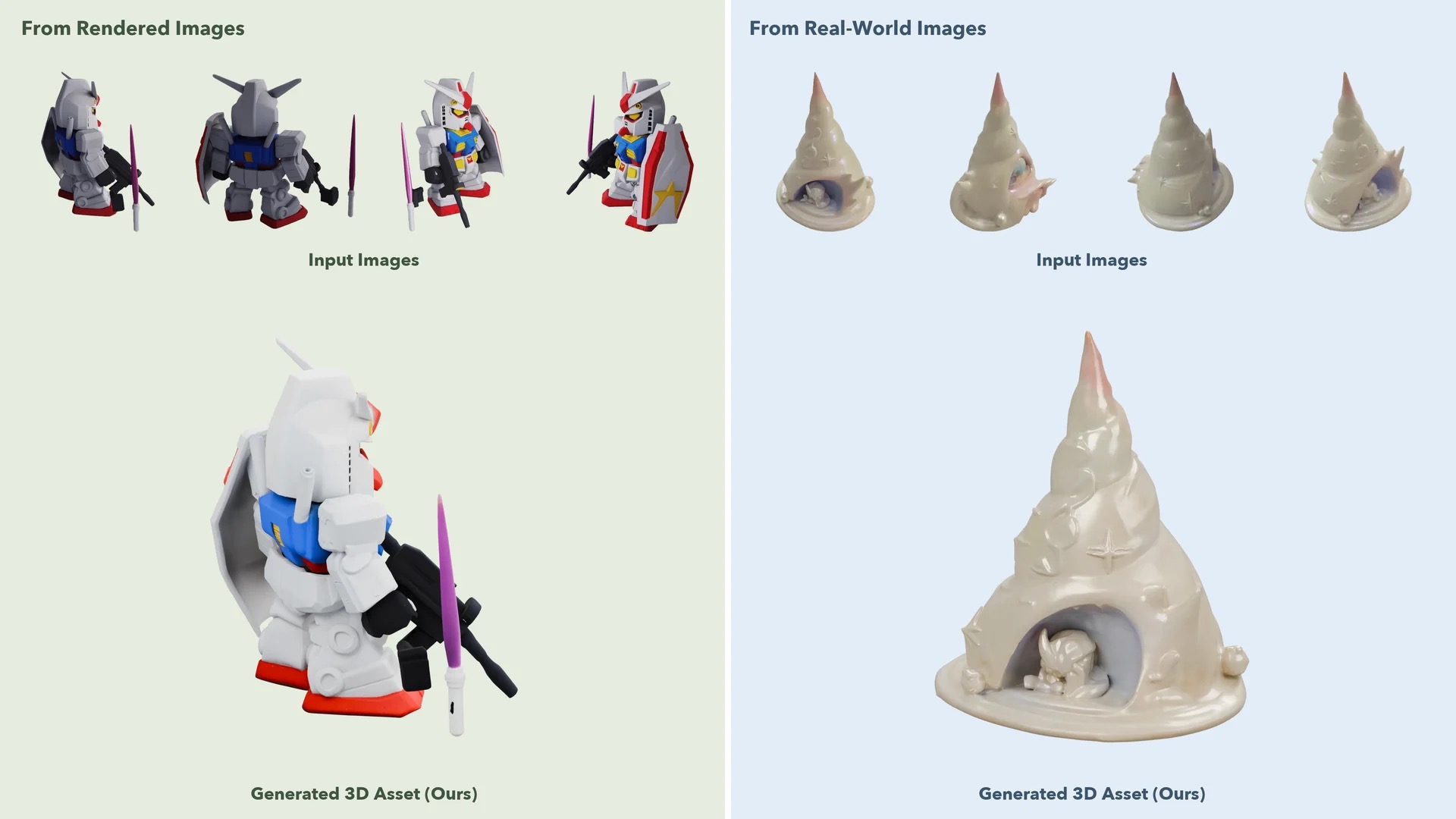
Point a few phone photos at an object from random angles. No turntable, no camera tracking, no known poses. Get back a complete 3D asset — including the sides you never shot. That is the pitch of UniForge3D, a paper out of Peking University and HKUST posted on October 11, 2026.
The Story
AI 3D has long been split into two camps. Reconstruction rebuilds what the camera actually saw. It is faithful, but it leaves holes where you did not shoot. Generation invents a whole object from a prompt or a single image. It fills every gap, but it drifts away from your real subject.
UniForge3D tries to do both at once. The trouble is that the two tasks live in different worlds. Reconstruction works in camera-relative space — everything is measured from where the lens sat. Generation works in a canonical space — a fixed, upright frame the model learned during training. Mix them naively and the coordinates fight each other.
The fix is a shared anchor-guided space. The model picks one input view as the anchor. The whole scene then follows that view’s horizontal angle while staying upright. Both branches now speak the same coordinate language. They swap features back and forth: one predicts per-view point maps, the other predicts a complete sparse voxel structure of the object.
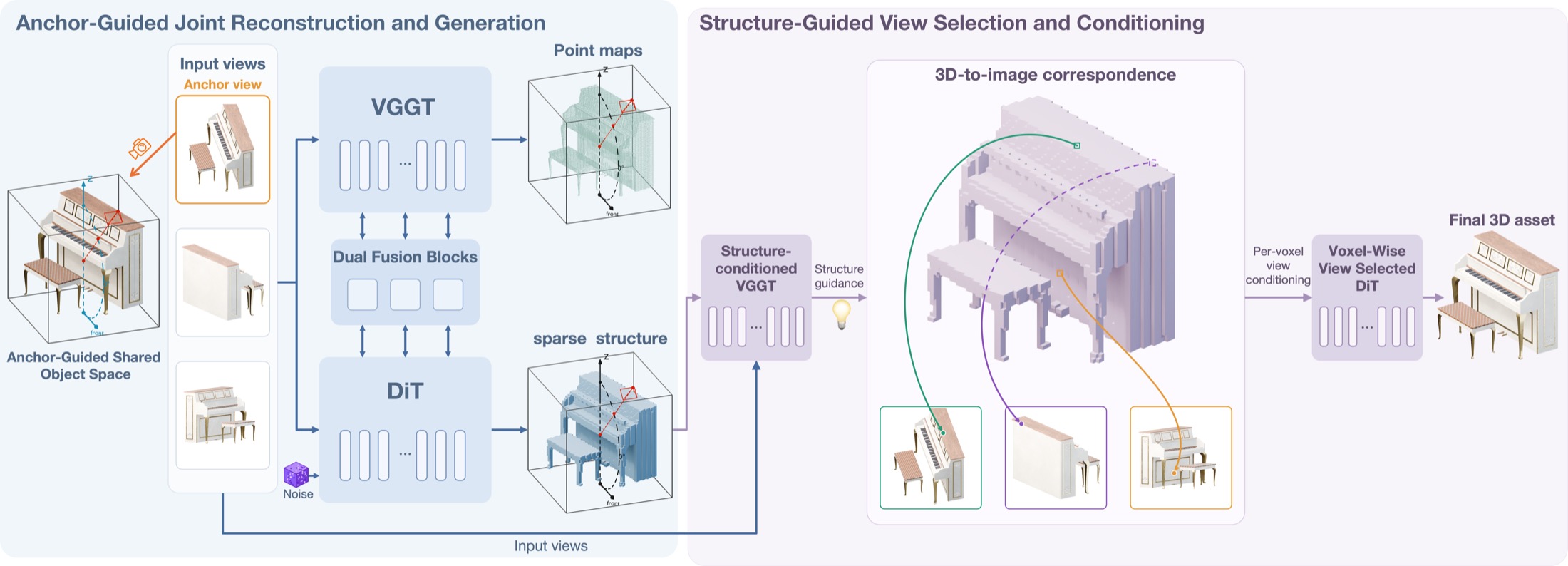
The clever part is structure-guided view selection. Instead of averaging all your photos into mush, the model looks at the generated structure first. Then, voxel by voxel, it asks: which input photo shows this spot best? It pulls detail from that one view. So a sharp close-up of the front does not get watered down by a blurry shot of the back.
Why You Should Care
Most image-to-3D tools you have tried take one image. That is magic for a hero shot, but it guesses everything it cannot see. UniForge3D sits in a more practical middle: you give it the few photos you naturally have, and it treats your real pixels as truth while inventing only the unseen parts.
“Unposed” is the word that matters. You do not need calibrated cameras or a COLMAP pass to recover poses. Snap, snap, snap, done. For anyone who scans real props, toys, or set dressing, that removes the most annoying step in the pipeline.
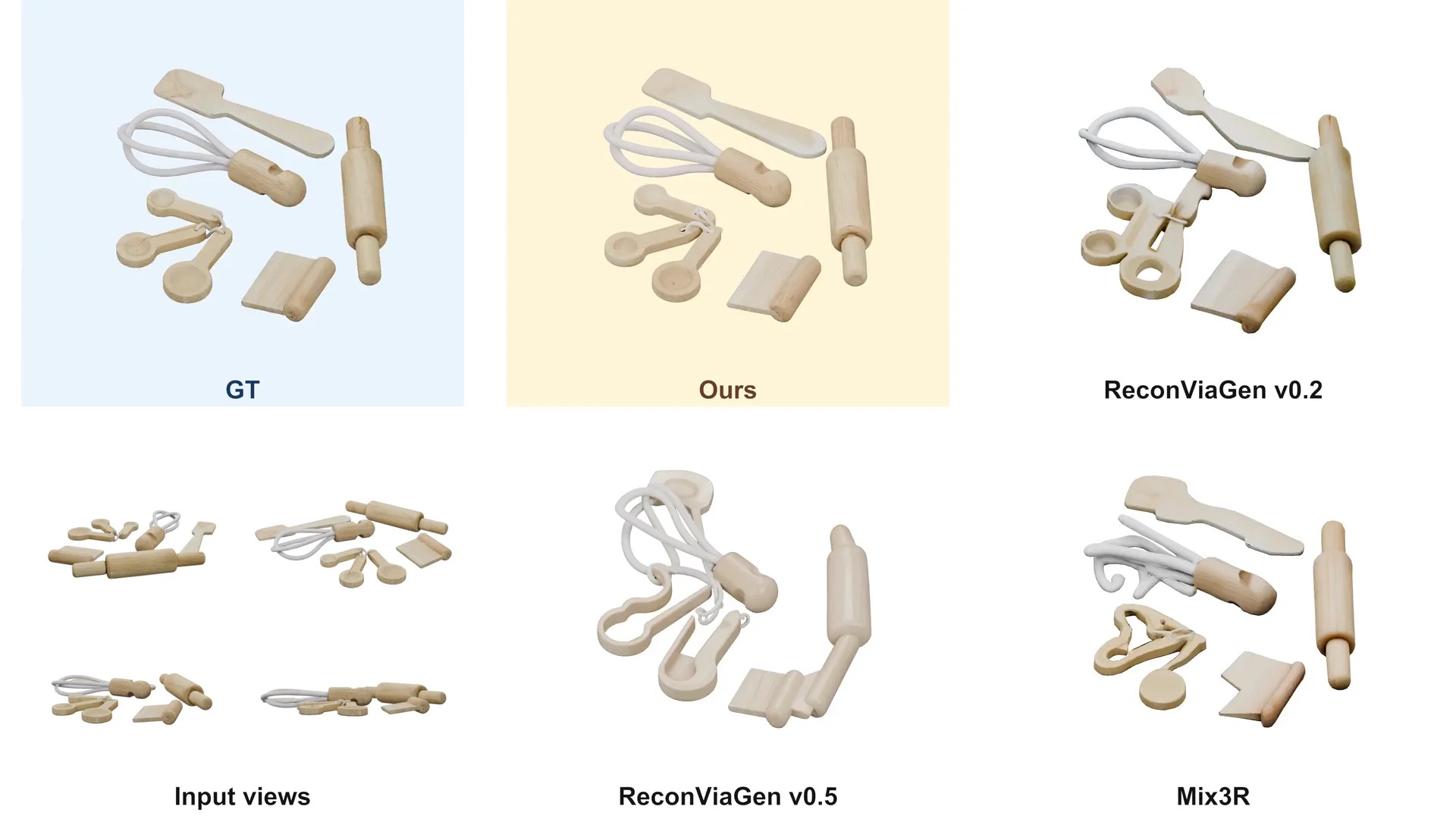
The authors report state-of-the-art appearance and geometry on two standard benchmarks, Toys4K and GSO (Google Scanned Objects). Be honest about the limits, though: the public paper and project page describe the output as a sparse voxel structure and point maps. They do not claim ready-to-use quad meshes or PBR material maps. This is object-level work — single items, not full scenes.
Try It / Follow Them
- Project page (figures, video comparisons): xishuxishu.github.io/uniforge3d-project
- Paper: arXiv:2610.15357
- Code and weights: the project page says both are “coming soon.” Nothing is downloadable yet — this is a read-and-watch, not a hands-on, for now.
IK3D Lab Take
We could not run this one. No weights, no code yet — so everything below is read off the paper and the project videos, not a test on our own objects.
That said, the idea is the right one. The “reconstruct what you saw, generate what you didn’t, in one shared frame” recipe is exactly where the field is heading, and we have watched it arrive piece by piece (Tripo’s Project Eden, Tencent’s Pixal3D, our own coverage of PixWorld). UniForge3D’s contribution is the plumbing: a single coordinate space so the two halves stop arguing, plus per-voxel view picking so your best photo actually wins.
Who should watch it: anyone building a scan-to-asset tool, and artists tired of shooting perfect turntables. Where it will break: thin structures, shiny surfaces, and the jump from voxels to a clean mesh you can hand to a rigger. We will revisit the day weights drop and put real phone photos through it. Until then, bookmark the repo and keep your expectations at “promising paper,” not “new daily driver.”
How this article was made: researched and drafted with AI assistance, then fact-checked against the original sources and reviewed by Issa before publication.