The Hook
The company that makes the lidar inside your next robotaxi just shipped a handheld scanner for 3D artists and robot trainers. Hesai’s Kosmo turns a 15-minute walk around a room into clean Gaussian splats, meshes and depth maps at once. And where the scan misses, generative AI invents the rest.
The Story
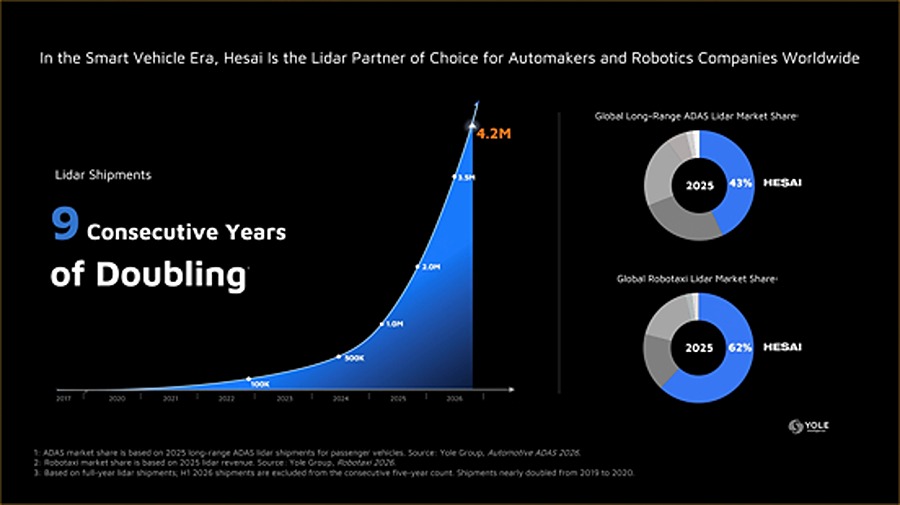
Hesai (Nasdaq: HSAI) is not a name from the splat world. It is a lidar heavyweight: Yole Group puts its share of global long-range passenger-car lidar at 43% in 2025, and the company shipped 628,275 units in Q2 2026 alone. On October 15, 2026, it launched Kosmo, its first product aimed squarely at 3D capture.
Kosmo has two halves. Kosmo One is the handheld device Hesai calls the “world’s first 8K ultra HD AI spatial camera” (a claim it footnotes as based on public info as of October 2026). It pairs a Class 1, 1535 nm lidar firing 569,000 points per second with a one-inch 8K sensor and a microsecond-synced IMU. Hesai claims millimeter-level geometric accuracy. A typical 100 m² room scans in about 15 minutes. One catch worth knowing: it captures at 8K, but exported files top out at 6K.
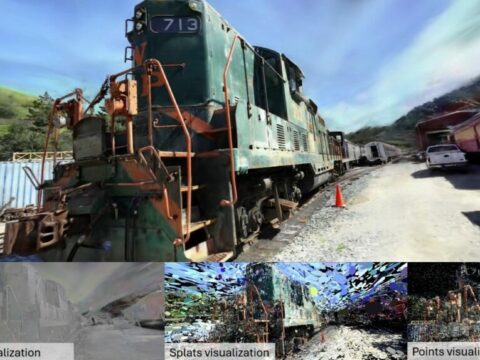
Kosmo World is the cloud half, where the real work happens. Its engine, the Kosmo Spatial Core, produces aligned 3D Gaussian splats, mesh and depth from one reconstruction. Splats carry the look, meshes carry the interactive objects, depth carries the distances. Hesai says generation runs up to about 5x faster than comparable 3DGS products under similar conditions, though it has not published absolute times.
Here is the AI part that matters. The Spatial Core uses generative AI to fill areas the scan never saw, and to rebuild materials and textures. On top of that, AI semantic segmentation splits the scene into individual objects you can select and move. So the output is not a frozen point cloud. It is a scene that has been cleaned, completed and labelled by models before you ever open it.
Why You Should Care
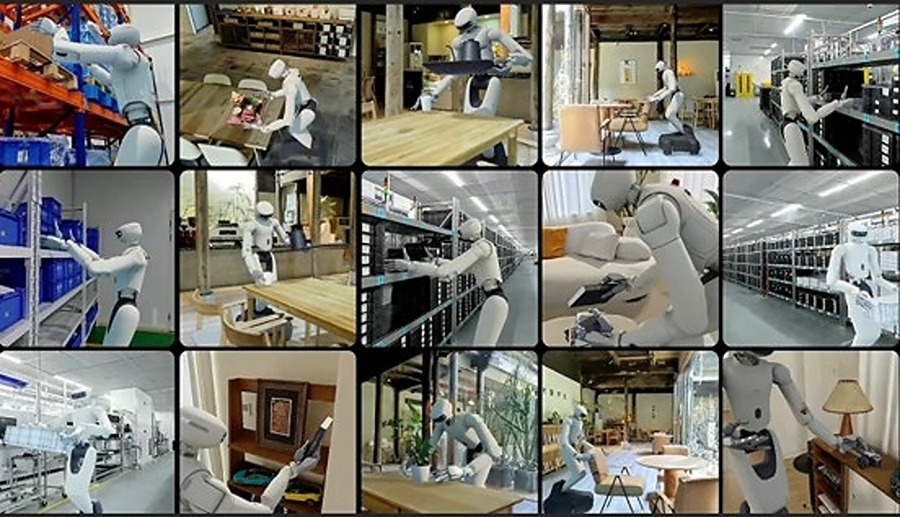
Hesai is not selling this to splat hobbyists first. It is selling it as a data engine for “physical AI” — the robots and world models that need huge amounts of real, accurate 3D space to learn from. That framing is the interesting part for everyone in creative 3D, because it points at where splat capture is heading: not pretty captures, but structured, labelled, robot-ready worlds.
The headline demo is a Dairy Queen store. Building a 3D training environment by hand would take a professional team about 300 hours, Hesai says. Kosmo scanned and reconstructed it in roughly 15 minutes. A Sharpa robot trained in that virtual store hit a 99% task success rate before being installed in the real one. Hesai also claims one captured space can spin out more than 10,000 training trajectories.
Treat those numbers as the vendor’s own. They are impressive and specific, but they are Hesai’s figures, measured by Hesai, with footnotes saying results vary. What is harder to dismiss is the output pipeline: splats as .ply and .sog, meshes as .obj, full scenes as .usd and .usdz, plus integrations listed for NVIDIA Isaac Sim, Unreal Engine, Houdini and Pixar’s RenderMan. That is a capture tool designed to drop straight into real pipelines.
“Over the past decade, we have enabled machines to see the world. Over the next decade, we will enable robots to understand and change it.”
Dr. Yifan “David” Li, Co-Founder and CEO, Hesai
Try It / Follow It
- Official product info and launch details: hesaitech.com
- Deep hardware breakdown (specs, months of hands-on): Radiance Fields
- Launch press release and executive quotes: Engineering.com
One thing to watch: Hesai has not published pricing or regional availability. Early orders came from humanoid robotics firms, and partners named so far are Galbot and Dexmal. Pixar’s Dylan Sisson already scanned the plaza outside the Steve Jobs Building with an experimental unit and rendered it in RenderMan, with native splat support due in RenderMan 28 this winter.
IK3D Lab Take
We have not tested Kosmo. No price, no public unit, no hands-on — so this is a read on the launch, not a review. With that said, this is the signal we have been tracking all year, made concrete: splat capture is quietly merging with world-model training. The Spatial Core doing generative gap-fill and object segmentation at capture time is the real story, more than the 8K sensor or the lidar pedigree.
Who should care now? Studios and labs building robot sims, virtual production and location-based worlds who want clean, labelled USD scenes without a photogrammetry cleanup marathon. Who should wait? Solo splat artists and small 3D shops — a handheld lidar rig from a company that sells to automakers is almost certainly priced for enterprises, and a free app plus a phone still covers most creative needs. Where it will break: the generative fill is a guess by definition, so anywhere accuracy is non-negotiable (heritage, survey, legal), you will want to check what the AI invented versus what the lidar actually saw. The vendor’s 5x and 300-hour claims also deserve an independent test before anyone repeats them as fact. Still: when the lidar industry’s 800-pound gorilla decides splats are the future of 3D data, the rest of the field should take notes.
How this article was made: researched and drafted with AI assistance, then fact-checked against the original sources and reviewed by Issa before publication.