AI can now dream up a 3D character from a single sentence in seconds. Then it hands you a beautiful, completely dead statue. The unglamorous, deeply human job of rigging — building a skeleton, painting skin weights so the mesh bends without tearing — has stubbornly refused to be automated. Tsinghua University and VAST (the team behind Tripo) just took the biggest swing yet at that wall, and it runs on your local machine in ComfyUI on 4 GB of VRAM.
The Story
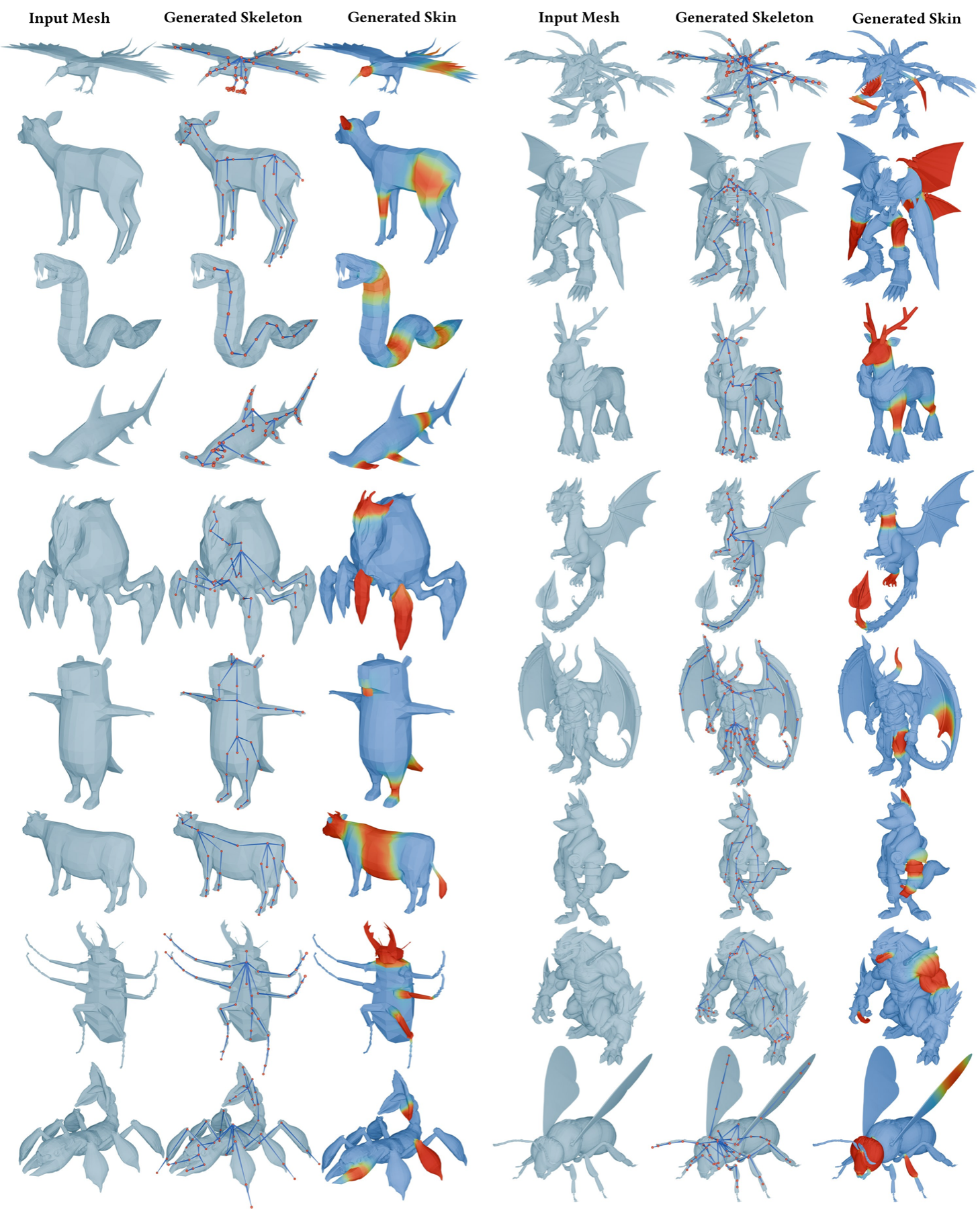
The new paper is called SkinTokens: A Learned Compact Representation for Unified Autoregressive Rigging. The name buries the lede, so here’s the plain version: for years, auto-rigging tools treated skinning — deciding how much each bone pulls on each vertex — as a messy, high-dimensional guessing game. Every vertex needs a set of weights, meshes have hundreds of thousands of vertices, and the whole thing was bolted on after the skeleton, decoupled and fragile. That’s why prior tools produced skeletons that looked plausible but skinning that smeared, tore, or candy-wrapped the moment you actually posed the character.
SkinTokens throws out the regression approach entirely. The core insight: skinning weights are extremely sparse — any given vertex is really only influenced by a handful of nearby bones. So the authors trained a compact, discrete “vocabulary” of skin-weight patterns (using an FSQ-CVAE, if you want the acronym) and call each entry a SkinToken. Suddenly, skinning isn’t a continuous regression nightmare — it’s a language.
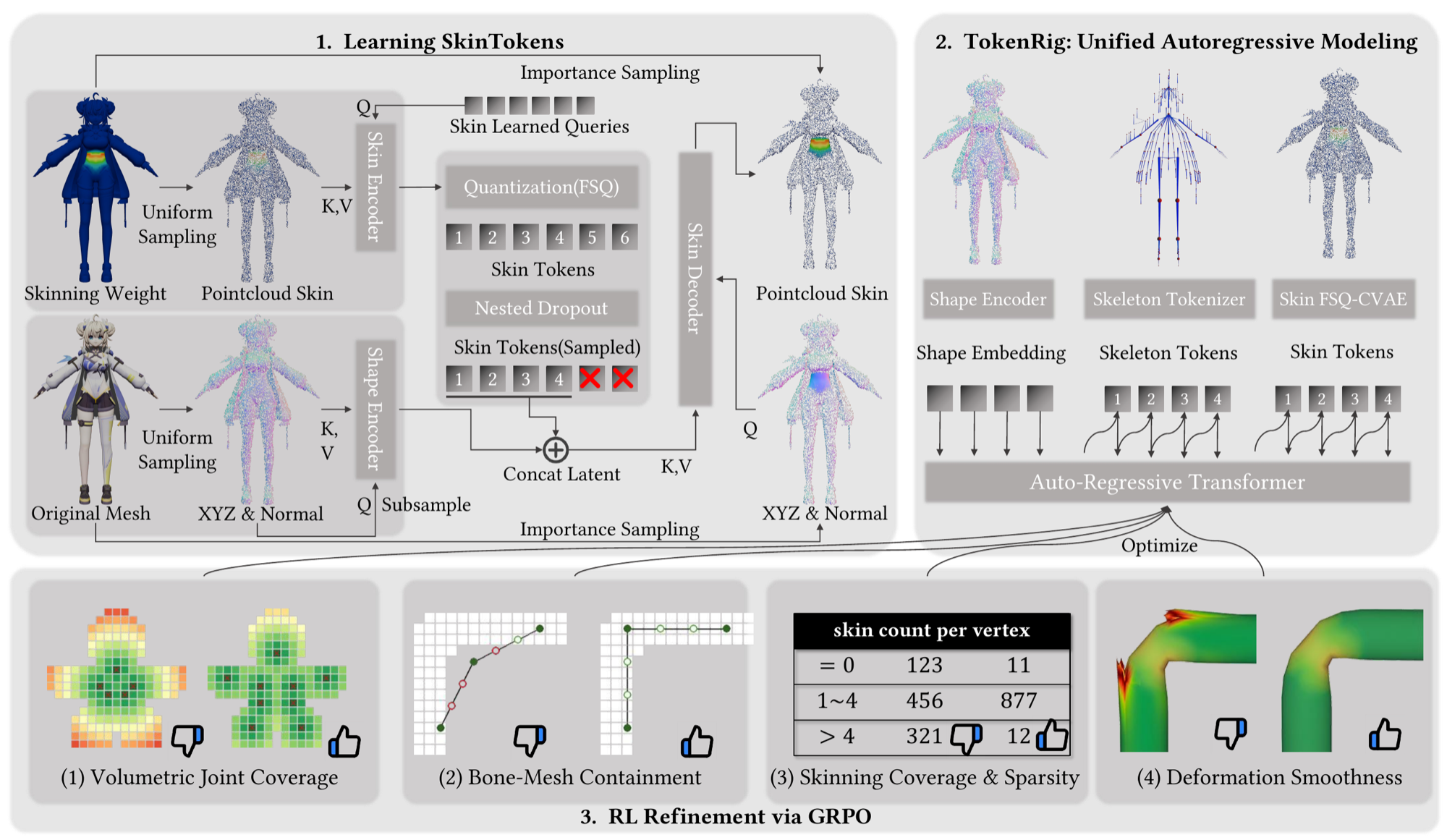
Once skinning is a language, you can do what every frontier model does: predict it token by token. Their framework, TokenRig, treats the entire rig — joint positions, bone hierarchy, and the skinning SkinTokens — as one unified sequence generated autoregressively. Skeleton and skin are no longer two separate problems glued together; they’re one coherent output. Then, borrowing a trick straight from the LLM playbook, they fine-tune it with reinforcement learning (GRPO) using reward functions that score geometric and semantic quality — pushing the rig toward results that don’t just score well numerically but actually deform correctly.
Why You Should Care
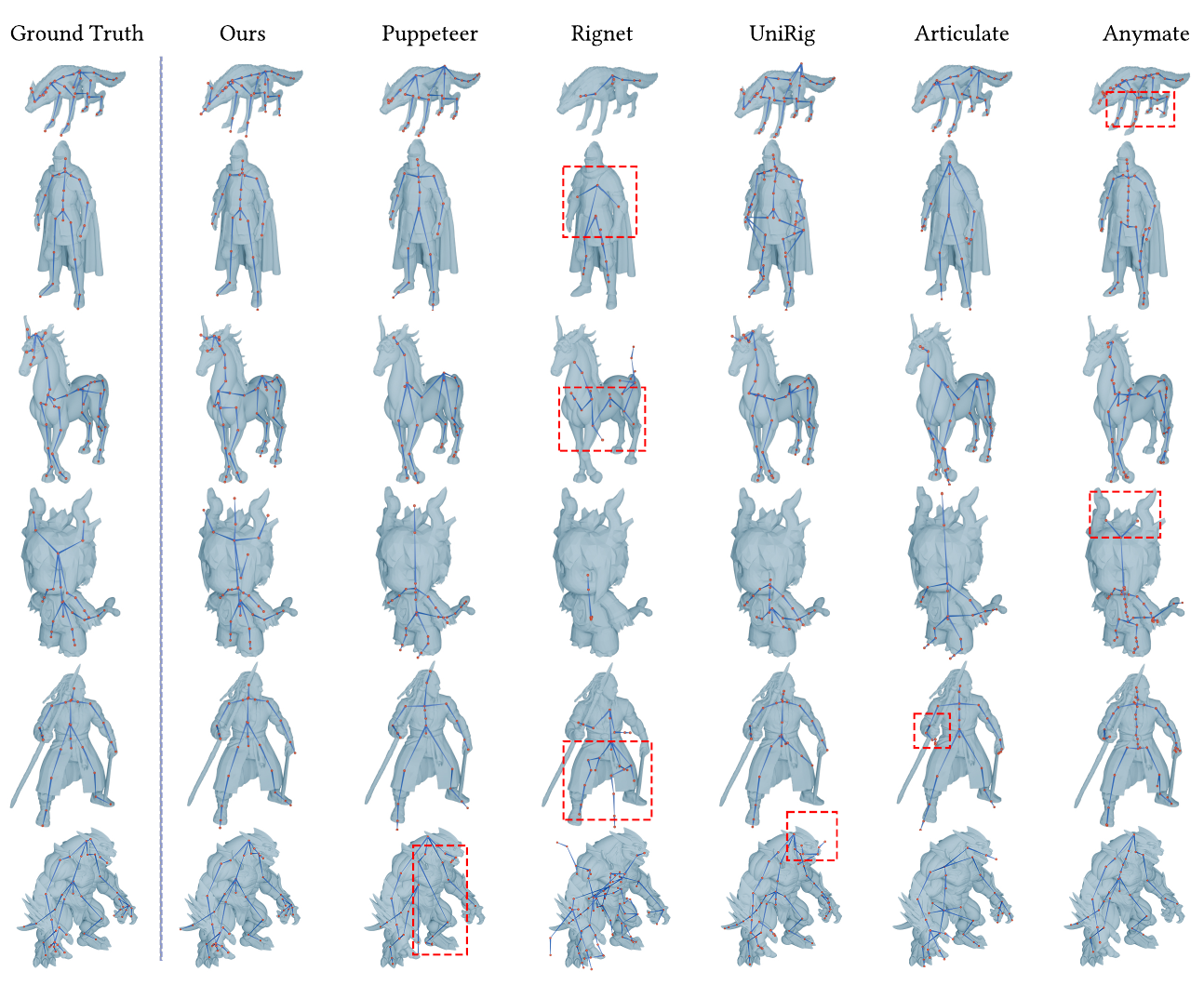
The numbers are not incremental. Against the previous state of the art — including UniRig, RigNet, MagicArticulate and Puppeteer — SkinTokens reports a 98% to 133% improvement in skinning accuracy, plus a 17–22% bump in bone prediction from the RL refinement pass. Those aren’t rounding-error gains; skinning quality more than doubling is the difference between “usable” and “throw it away and rig by hand.”
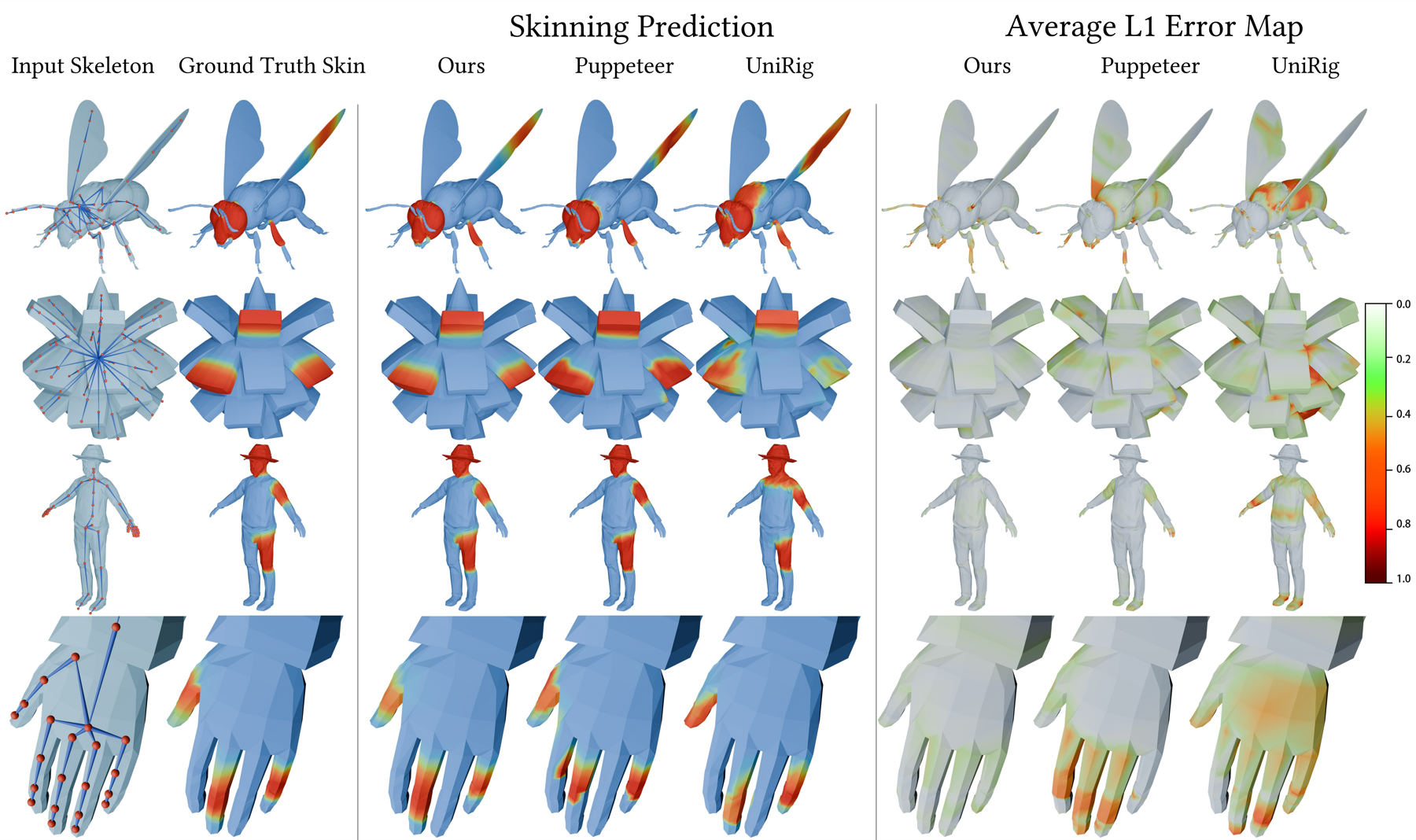
Here’s why this matters for anyone touching AI 3D. The generation half of the pipeline is basically solved — Tripo, Rodin, Meshy, Hunyuan and a dozen others will hand you a gorgeous mesh from text or an image in seconds. But a mesh you can’t move is a paperweight. Rigging has quietly become the bottleneck standing between “AI made me a character” and “AI made me a character I can drop into Unreal and animate.” Close that gap convincingly and the entire text-to-playable-character dream stops being a demo and starts being a Tuesday afternoon.
Try It / Follow Them
This is the best part: you don’t have to wait for a paywalled cloud service. The community has already wrapped SkinTokens into ComfyUI, so it slots into the same node-based workflow you’re probably already using for generation.
- ComfyUI-SkinToken (Rizzlord) — feed it a mesh (TRIMESH), get back a rigged GLB or FBX. Automatic skeleton, AI skinning weights, mesh cleanup, and bone renaming to Mixamo or Unreal Engine 5 conventions for direct Mannequin retargeting. Runs on roughly 4 GB VRAM.
- ComfyUI-SkinTokens (Aero-Ex) — an alternate wrapper with a headless Blender server and a Three.js previewer for interactive FBX inspection right in your workflow.
- The paper & project page — figures, comparisons, and the full method write-up from Jia-Peng Zhang and colleagues at Tsinghua & VAST.
Install via ComfyUI Manager (search “ComfyUI-SkinToken”) or git-clone into your custom_nodes folder. Set skeleton_template to UE5 and bottom_center_origin to true if you’re heading into a game engine — the pivot lands at the character’s feet where Unreal and Unity expect it.
IK3D Lab Take
We’ve spent a lot of pixels on this blog celebrating the generation explosion — and rightly so. But rigging is where the hype quietly went to die, and SkinTokens is the first result that made us sit up rather than shrug. Reframing skinning as a discrete language you can generate autoregressively is genuinely clever, and the fact that the gains land hardest on skinning — the part everyone else treated as an afterthought — tells you they aimed at the right problem.
Two honest caveats. Benchmark numbers are not the same as production reliability, and “133% better” on a metric still means you’ll want to eyeball the shoulders and hips before shipping. And auto-rigging a stylized biped is a very different beast from a six-legged creature with a cape. But this is running locally, for free, in ComfyUI, today. That combination is how a research paper becomes a pipeline default. If you’re generating characters and dreading the rig, this is the node to test this weekend. The dead-statue era is finally on the clock.