Hook
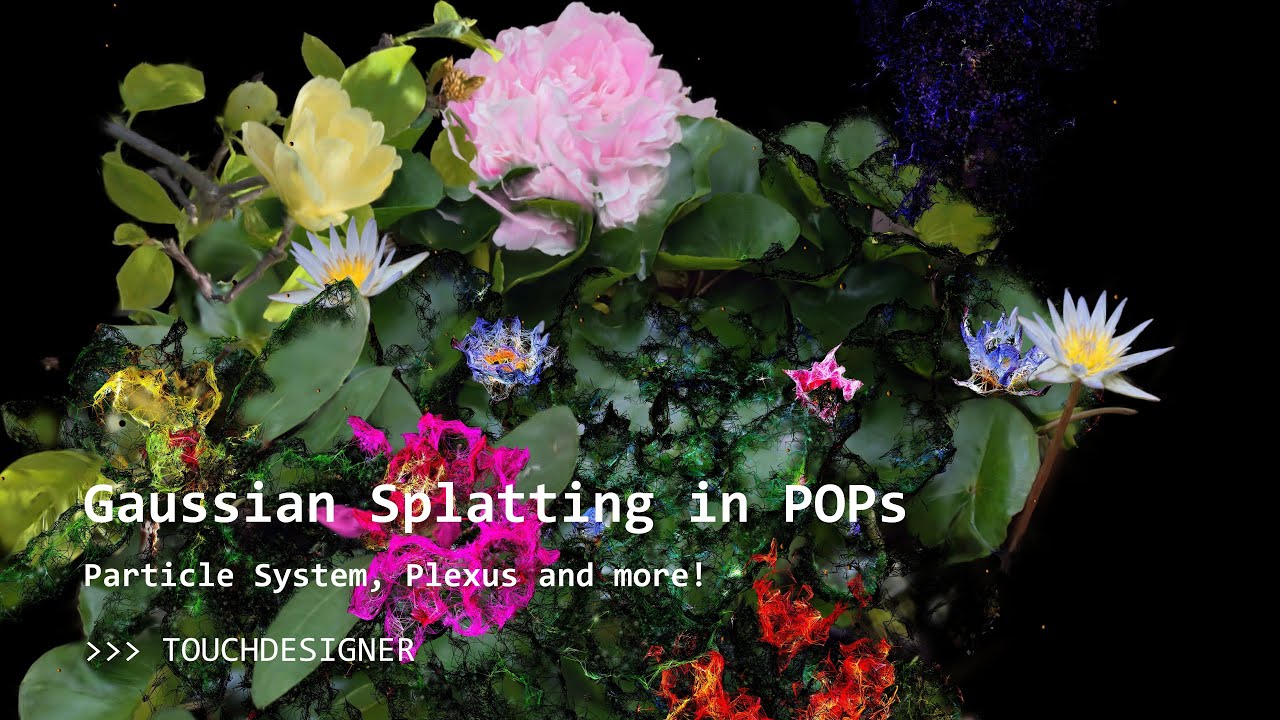
For three years we’ve watched Gaussian splats colonize every offline tool on Earth — Blender, Cinema 4D, Houdini, Octane, Unreal. But the one place splats never lived is the place where images are actually performed: TouchDesigner, the engine behind concert visuals, projection mapping and gallery installations. Lake Heckaman just fixed that. His GSOPs toolkit drops native .ply and .spz splats straight into TouchDesigner’s node graph — and then lets you dissolve them into particles, relight them, and make them react to audio, live, at 60fps.
The Story
Heckaman’s tool goes by two names you’ll see used interchangeably in the community — TDGS (TouchDesigner Gaussian Splatting) and its newer, expanded incarnation GSOPs (Gaussian Splat Operators). The important thing: this is not the Houdini plugin of the same acronym from CG Nomads. Different developer, different engine, no relationship. This one is built for real-time.
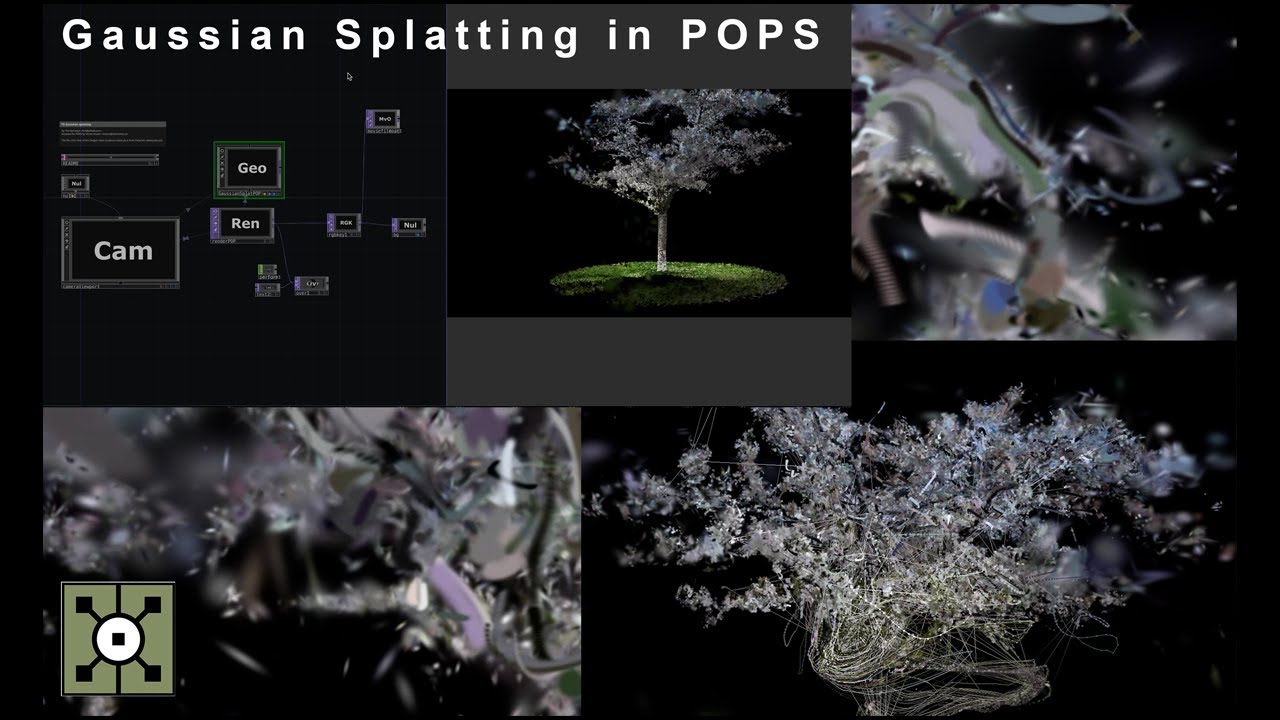
The breakthrough that made it possible is POPs — TouchDesigner’s new Point Operators framework, a GPU-native way to push millions of points around per frame. A Gaussian splat is a point cloud with fancy per-point attributes (position, color, opacity, covariance), so it maps onto POPs almost perfectly. Heckaman rebuilt his toolkit on top of POPs and suddenly things that were impossible became one node.
What you actually get is a stack of operators that treat a splat like living, composable geometry:
- A per-point particle system — the headline trick. Every Gaussian becomes a physics-driven particle, so an entire captured scene can explode, drift, or dissolve into a point cloud and reassemble.
- Relighting with native TouchDesigner lights — drop a standard light into the scene and it actually affects the splat.
- True 3D motion blur, bokeh depth-of-field, alpha accumulation, chroma key and baked color correction (gamma, brightness, contrast) — real post, applied to captured reality.
- A Proximity-POP plexus effect that laces glowing lines between nearby Gaussians, plus Heckaman’s own AttributeBlur POP to smear effects across the cloud.
- Optimizers — Frustum Delete, Thin Splat and Blowout — to cull and lighten heavy captures, plus global or texture-driven blending between multiple loaded splats.
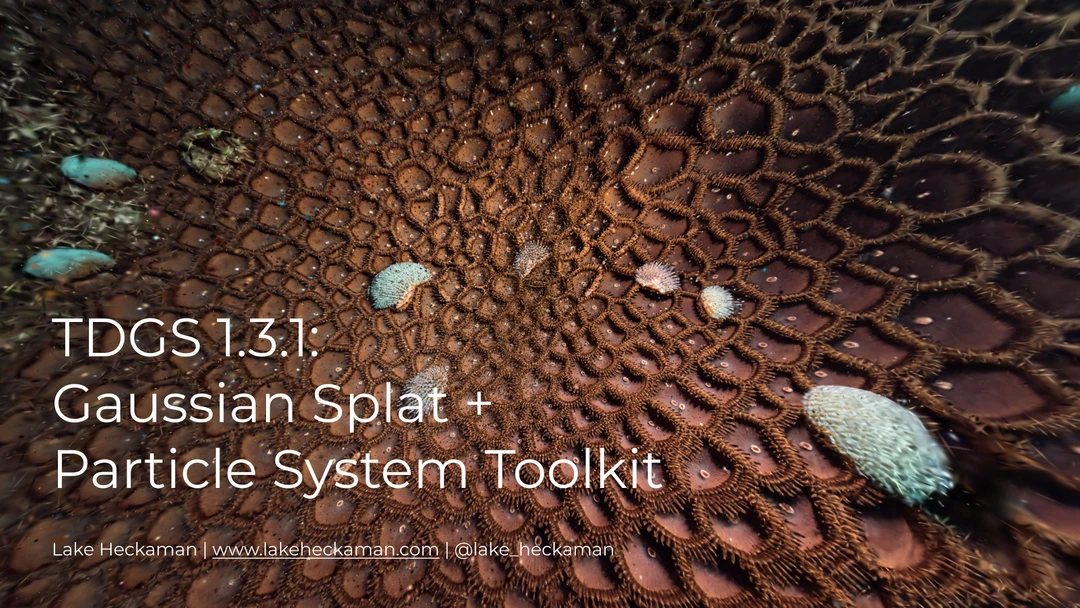
The latest release, TDGS 1.3.1, is the one that makes it real for the rest of us: full macOS support, running natively on Apple Silicon, alongside the Windows/RTX path. Heckaman lists it for TouchDesigner 2025.32820 and newer, tested on everything from an RTX 4090 to an M3 Mac.
Why You Should Care
Here’s the shift. Until now, a splat was a thing you rendered — you captured a place, cleaned it up in Postshot or KIRI, and dropped a static, beautiful ghost into a render. Gorgeous, but frozen. TouchDesigner is the opposite philosophy: everything is a signal, everything is reactive, everything runs now. Marrying the two means captured reality stops being a backdrop and becomes an instrument.
Think about who lives in TouchDesigner: VJs, projection-mapping artists, stage designers, museum-installation builders, live-show technical directors. These people have been faking volumetric reality with meshes and point clouds for a decade. Now they can walk into a real location with a phone, splat it, and pipe that capture into an audio-reactive show where the walls of a real cathedral bloom apart to the kick drum. That’s not a workflow improvement — that’s a new medium landing in the hands of the people best equipped to abuse it beautifully.
And because it’s capture-agnostic, it slots cleanly onto the pipeline the Lab already covers: shoot with any splatting app, export a .ply or .spz, and GSOPs picks it up. The whole radiance-field ecosystem just gained a live, performative output stage it never had.
Try It / Follow Them
- Get it: There’s a free Lite tier (non-commercial) to kick the tires, and a paid Create tier that adds a commercial license plus courses. Both live on Lake Heckaman’s Patreon — start with his “START HERE” post.
- Watch it move: Heckaman’s walkthrough “Gaussian Splats in TouchDesigner — Now in POPs” shows the particle system, plexus and relighting in action.
- Prereqs: TouchDesigner 2025.32820+, Windows/RTX or an Apple Silicon Mac.
- Read up: Radiance Fields’ coverage and the AllTouchDesigner breakdown.
IK3D Lab Take
We’ve spent months documenting splats getting bolted into every serious DCC and render engine on the market. GSOPs is the first time we’ve seen them handed to the live crowd — and honestly, that’s where splats always wanted to be. A captured place that reacts, breathes and shatters to sound is a more radical idea than another 10-million-poly export. The one asterisk: this is a solo-developer, Patreon-gated toolkit riding a brand-new POPs framework, so expect rough edges and treat 1.x accordingly. But if you own TouchDesigner and you’ve ever wanted to make a real room dance, download the Lite tier tonight. This is the most fun anyone has had with a point cloud all year.