At SIGGRAPH 2026’s Real-Time Live!, the audience became the demo. People pulled out their phones, sent in a picture, and seconds later that picture was a fully textured, rigged, and animated 3D character walking around a shared scene on the big screen. The team behind it — VAST, the makers of Tripo AI — walked away with Best in Show.
The Story
Real-Time Live! is SIGGRAPH’s flagship live-demo showcase. No pre-rendered video, no “results may vary” footnote — everything has to run on stage, in front of a few thousand of the most demanding graphics people on Earth. This year it was chaired by Mk Haley and ran eight demos spanning AI, robotics, rendering, and simulation. The one that won was called “Create Interactive 3D Assets in Seconds!”
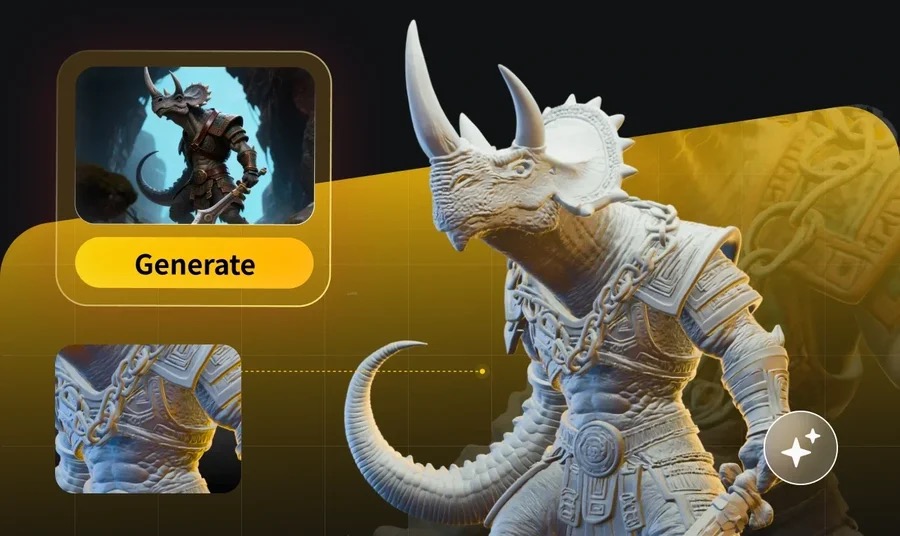
The pitch is simple to say and hard to build: hand the system an image, get back a complete 3D asset — mesh, texture, skeleton, and motion — in seconds. Not a gray blob. Not a T-posed statue you still have to rig for an afternoon. A character that already knows how to move. The showstopper was letting the room drive it: attendees submitted prompts from their own phones, and each creation instantly dropped into one shared, animated scene. The presenters called it “a new paradigm for interactive 3D content creation,” and for once the room agreed.
The team reads like a who’s-who of the generative-3D wave: Ying-Tian Liu, Hanxiao Wang, Yuan-Chen Guo, Yumeng Li, Yi-Hua Huang, Yu-Lin Tsai, and Yan-Pei Cao — mostly from VAST, with collaborators at the Chinese Academy of Sciences and the University of Hong Kong. VAST is the company behind Tripo, a name regular Lab readers know well.
Why You Should Care
Here’s the part that matters. For two years, AI 3D has been great at the shape and terrible at everything after it. You’d generate a beautiful mesh and then hit the wall the Lab keeps calling the “dead-statue problem” — no bones, no weights, nothing that moves. Rigging and animation stayed slow, manual, and expensive. That wall is exactly what this demo knocked down, live.
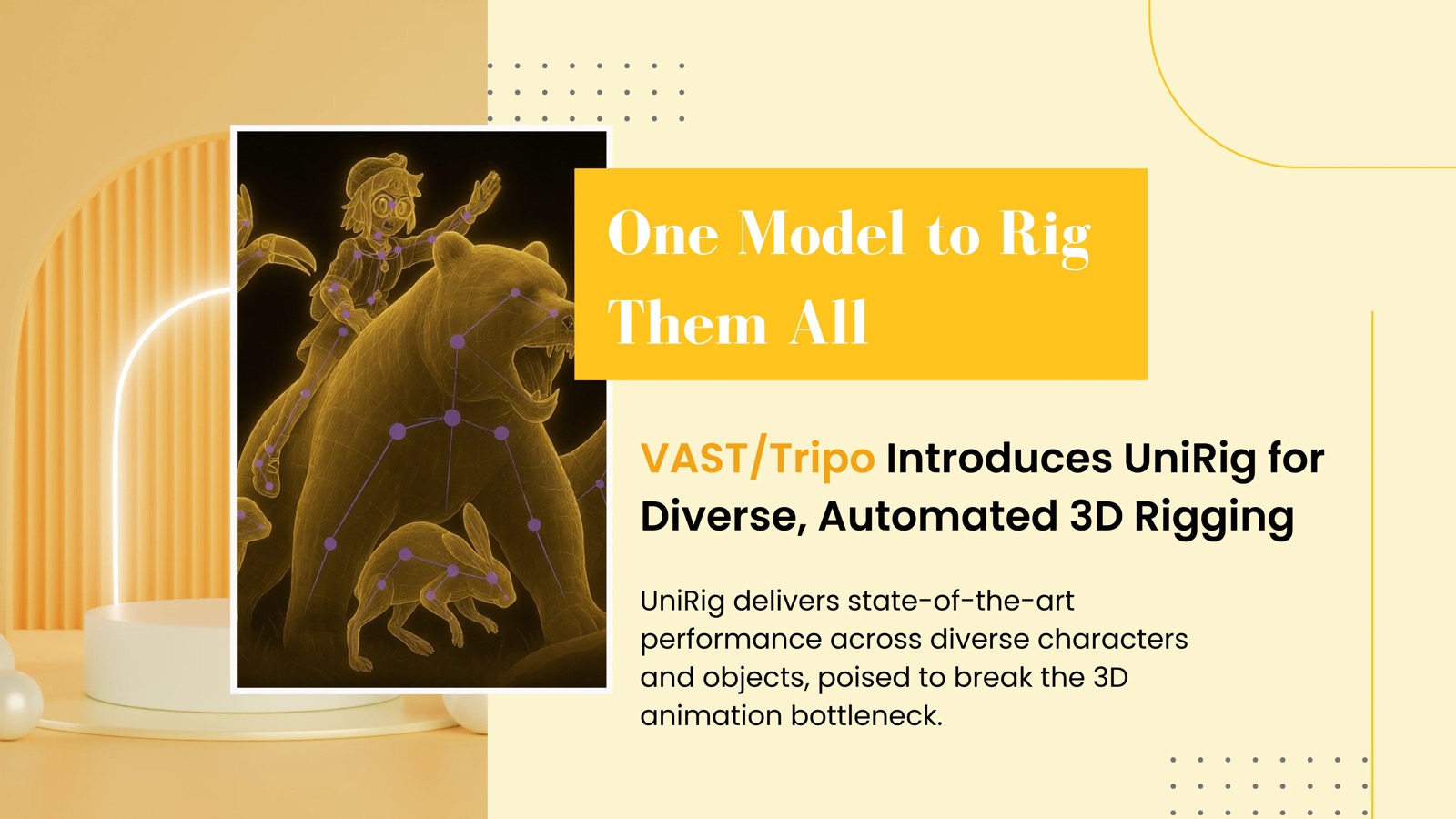
And it didn’t come from nowhere. This is VAST assembling parts it has been shipping in public. UniRig gave it one auto-rigger for humans, animals, and stylized props. Tripo P1.0 made the mesh side fast and topology-aware enough for game engines and robotics in around two seconds. Auto-rig and one-click animation stitched the rest. Real-Time Live! was the moment all of it clicked together into a single, seconds-long loop — in front of witnesses who don’t clap easily.
If you make games, this is the asset backlog evaporating: a napkin sketch or a reference photo becomes a movable extra you can throw into a scene before lunch. If you do previz, virtual production, or interactive installations, the “shared scene the crowd fills up” idea is a template you can steal outright. And it wasn’t the only AI moment on stage — the same session featured a Promptable AI Camera, “Game-Ready Hair in Minutes,” and even a Disney Olaf brought to life as a reinforcement-learning robot. Real-time generative creation is no longer a slide. It’s the show.
Try It / Follow Them
- Use the tech now: the image-to-3D and auto-rig pipeline is live in Tripo Studio — drop in an image, get a mesh, rig it, animate it.
- Go open-source: UniRig is on GitHub with weights, if you’d rather build the rigging step into your own pipeline.
- Watch the demo: the full Real-Time Live! 2026 session is up, and the program page lists every presenter.
- Read the recap: SIGGRAPH’s own blog write-up covers all eight demos.
IK3D Lab Take
We’ve covered every piece of this puzzle as it landed — TripoSplat generating splats, Tripo H3.1 doing film-grade meshes, AniGen turning a photo into a rigged character, SkinTokens treating rigging like a language. What Real-Time Live! proved is that the pieces are now a pipeline, fast enough to run on a stranger’s phone photo while a crowd watches. The gap between “I have an idea” and “it’s a moving 3D character in my scene” just collapsed to the length of a text message. Winning Best in Show against hardened graphics veterans isn’t hype — it’s the field admitting the dead-statue era is over. Now go point your phone at something.

Wow, watching photos transform into rigged 3D characters in seconds is absolutely wild! That kind of real-time speed used to be impossible. I’ve been playing around with krea 2 prompt techniques lately to get better results from image generators, and tools like this are pushing the bar even higher. Thanks for sharing this cool demo! krea 2 prompt
This is seriously mind-blowing! I’m always looking for ways to easily transform images, almost as much as I use my AI image editor for quick edits. Can’t wait to see what else they come up with!
Wow, this is seriously cool! It reminds me a bit of how I use Refini for old photo restoration, but taken to a whole new level.
This SIGGRAPH demo sounds absolutely wild – turning photos into 3D characters instantly is mind-blowing! Reminds me a bit of how quickly I can convert AVIF to JPG for my own projects.
Wow, this is seriously cool! I’m always looking for ways to push my digital art, like with the prompts I find on AI prompts, but this real-time 3D generation is next level.
This is seriously cool! It reminds me a bit of how I used to make my pixel avatars for forums with the classic Squareface Generator back in the day, but obviously way more advanced.
This is seriously cool tech! It reminds me of how quickly I got my new professional headshots from AI headshots, just instant results.
This is seriously mind-blowing tech! Imagine the possibilities for creators, especially with tools like AnimeVolt coming out that streamline story-to-video production. The future of animation is wild!
This is seriously next-level stuff! I’m trying to imagine what I could build with this, especially since I’m already using PixMelody for my 3D figures.