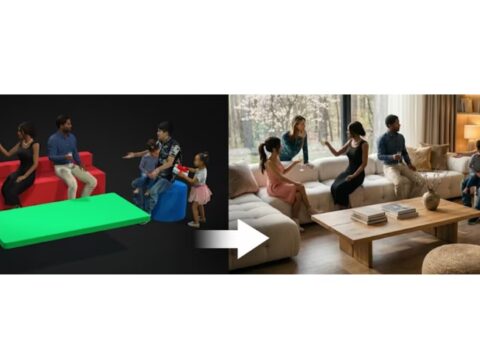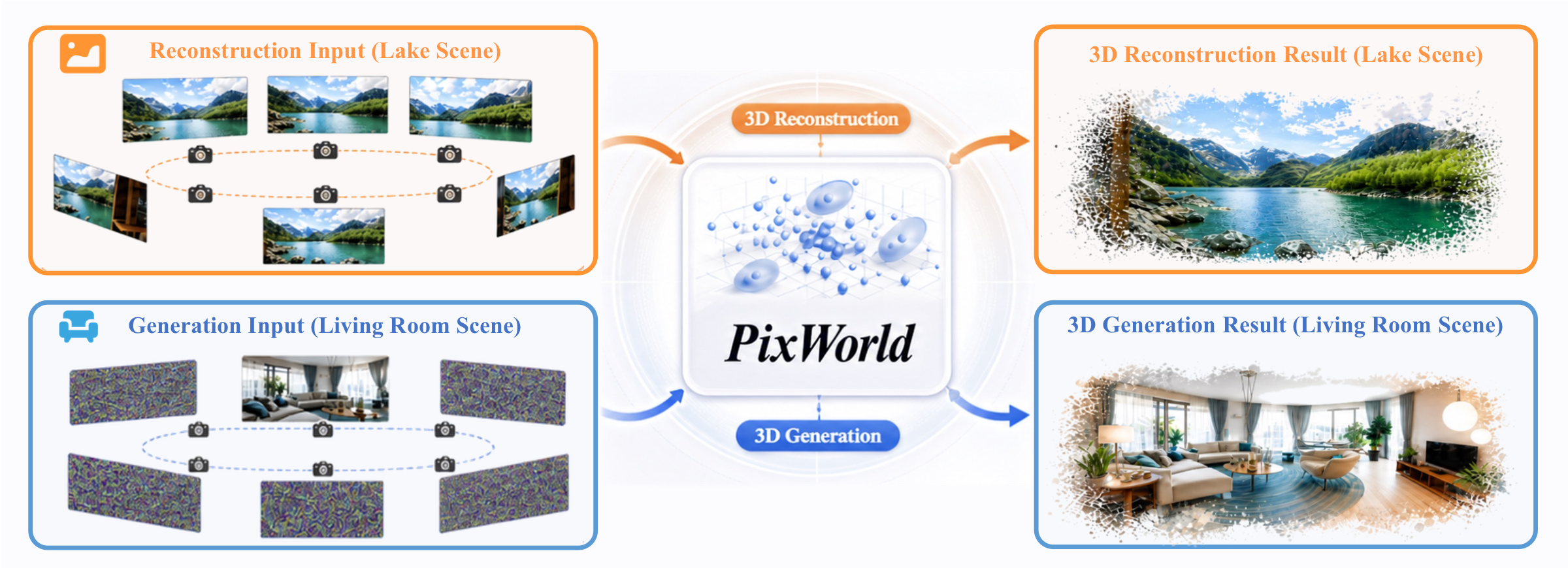
For two years the AI 3D world has quietly split into two tribes: the reconstruction people who turn your photos into a scene, and the generation people who conjure a scene from a prompt. PixWorld just walked in and said they were the same problem all along. One pixel-space diffusion model. Reconstruct a real lake or dream up a living room — same weights, same forward pass, about six-tenths of a second.
The Story
PixWorld dropped on July 6th from a team at Nanyang Technological University and AISphere — Sensen Gao, Zhaoqing Wang, Qihang Cao, Dongdong Yu, Changhu Wang and Jia-Wang Bian — and it has been sitting near the top of Hugging Face’s trending papers ever since. The pitch is deceptively simple: feed the model a set of posed views, mark some of them as clean and some as noisy, and let a two-stream diffusion transformer sort it out. The clean views are treated as things to reconstruct. The noisy ones are things to generate. Both flow through the same network, and out the other side comes a pixel-aligned 3D Gaussian scene you can fly through.
That framing is elegant, but the part that made us sit up is what PixWorld removed. Almost every serious generative 3D system today runs through a VAE — a variational autoencoder that squishes images into a compact latent code, does the diffusion there, then decodes back to pixels. It’s fast, but it’s also a lossy bottleneck that blurs fine geometry and bakes in whatever the autoencoder felt like keeping. Regular Lab readers will remember NVIDIA making exactly this argument for 2D images with PixelDiT (“NVIDIA Just Killed the VAE”). PixWorld carries that same heresy into 3D: no VAE, no latent bottleneck. Diffusion is supervised directly on the rendered pixels via a flow-matching loss, with a differentiable Gaussian renderer closing the loop.
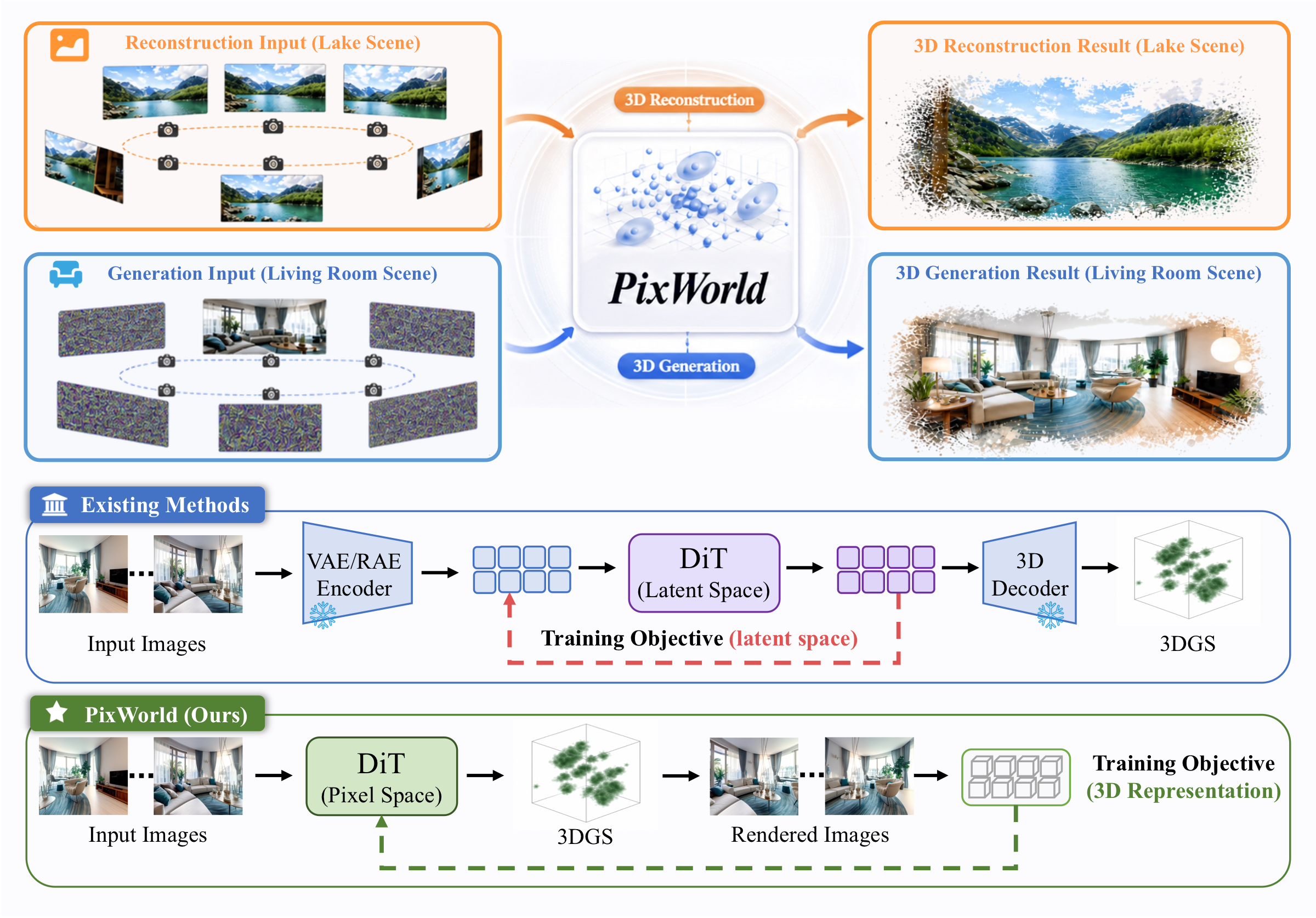
Killing the VAE usually costs you geometric sanity — pixels alone don’t know what “3D” means. PixWorld’s answer is a geometry perception loss: it pushes its rendered views to agree, in feature space, with a frozen 3D foundation model (π³ / VGGT). In plain terms, a pre-trained network that already understands depth and correspondence acts as a silent tutor, feeding real 3D structure into a model that otherwise only ever sees flat images. That’s the trick that lets a pixel-space method produce clean, coherent scenes instead of pretty mush.
Why You Should Care
Two words: the clock. World generators are notoriously slow — the kind of thing you kick off and go make coffee. PixWorld’s 4-step distilled model spits out a 480p explorable scene in 0.636 seconds. The paper lines it up against the field and the gap is almost comic:
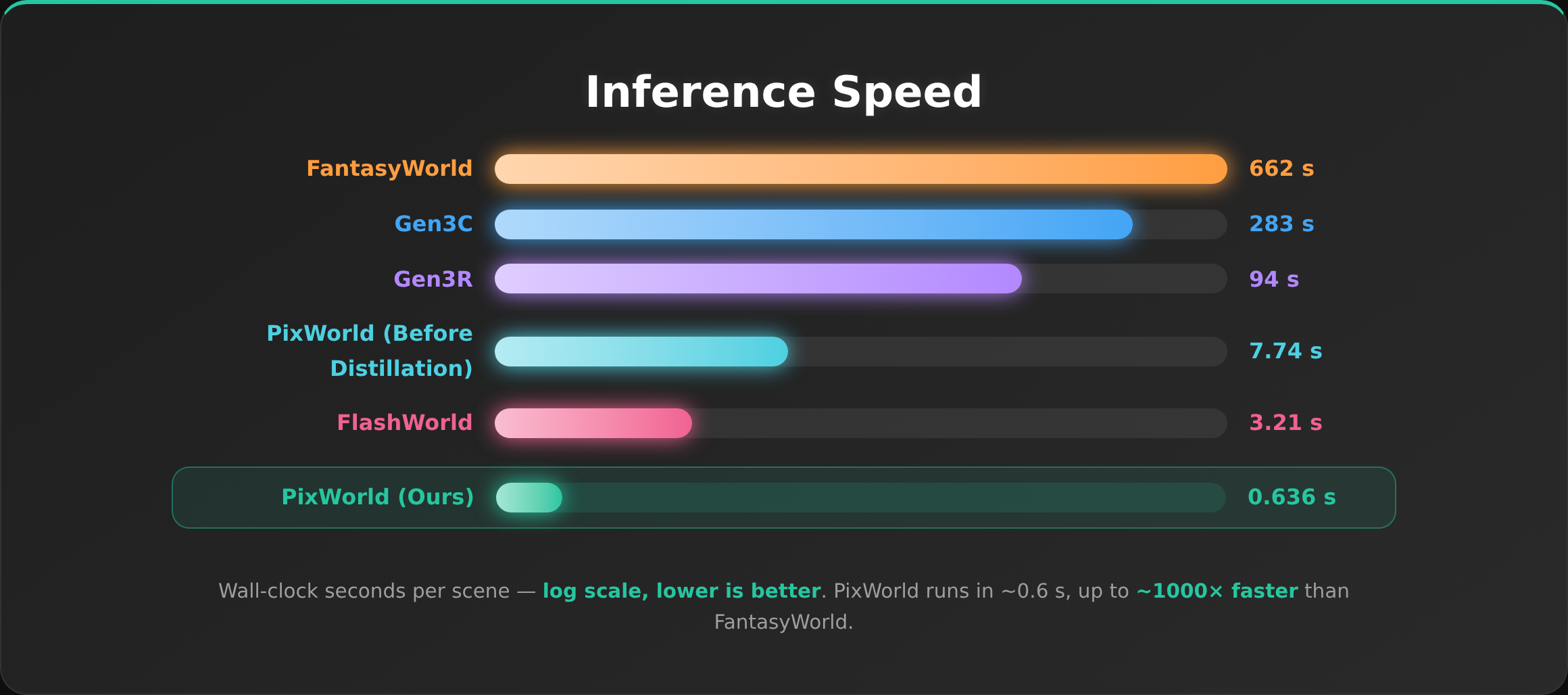
FantasyWorld takes 662 seconds. Gen3C, 283. Gen3R, 94. FlashWorld, 3.21. PixWorld: 0.636 — up to roughly 1000x faster than the slowest of them. And this isn’t speed bought with garbage quality: it posts a 71.04 average on WorldScore and 26.21 dB PSNR on RealEstate10K four-view reconstruction, holding its own on quality while lapping everyone on latency.
Sub-second world generation is the threshold where this stops being a render job and starts being an interaction. Think about what a real-time PixWorld would mean for the tools this Lab tracks: a Marble-style world you nudge and re-roll instantly instead of waiting out a queue; a game engine that fills a bare level with a coherent room the moment a designer describes it; an image-to-3D step fast enough to live inside a live viewport. When reconstruction and generation share one model, you also get the genuinely useful middle ground — hand it three real photos of a room and one imagined wall, and it’ll blend the captured and the invented into a single consistent space. That’s a workflow, not a demo.
Try It / Follow Them
Honesty first: you can’t run PixWorld yet. As of this writing the GitHub repo is a placeholder — the cleaned datasets (RealEstate10K, DL3DV, ACID) and the PixWorld-480P-4-step weights plus inference code are all marked “coming soon.” So this is one to watch, not download. But the paper is complete, the numbers are on the table, and the direction is clear enough to bet on.
- Project page & videos: sensengao.github.io/PixWorld
- Paper: arXiv 2607.05373
- Code (star it for the drop): github.com/SensenGao/PixWorld
- Discussion: Hugging Face paper page
IK3D Lab Take
There’s a pattern forming and PixWorld is the clearest expression of it yet: the VAE bottleneck, once treated as free architecture, is turning into the thing to cut. PixelDiT made the case in 2D; PixWorld makes it in 3D and throws in a 1000x speedup as proof it was worth the trouble. Collapsing reconstruction and generation into one model is the deeper idea, though — because in the real world the line between “a place that exists” and “a place I want” was always blurry, and a tool that treats them identically is a tool that finally matches how creators actually think. Weights aren’t out, benchmarks aren’t the same as your messy phone photos, and “coming soon” is doing some heavy lifting. But if this lands the way the paper promises, sub-second, VAE-free, unified world models are the next thing every one of us ends up building on. Star the repo. This one’s going to matter.