Hook
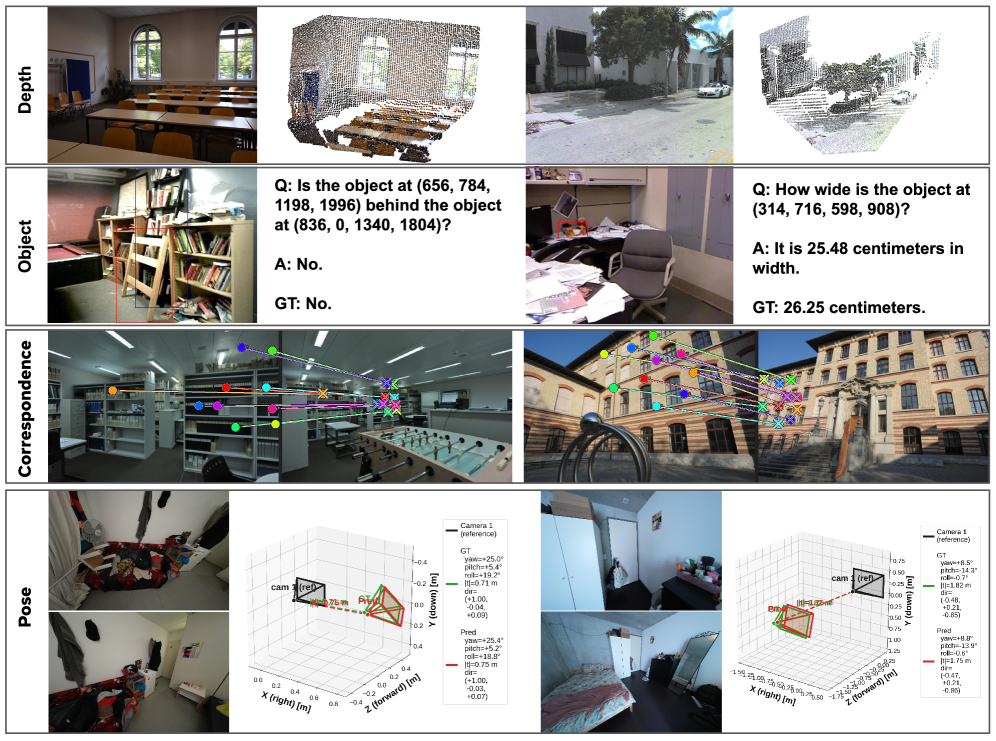
For two years the whole 3D-AI industry has been building bigger, weirder, more specialized machines — depth experts, pose regressors, correspondence networks, each with its own custom architecture and its own bag of tricks. Then a team from Meta and Princeton took a plain, off-the-shelf chat model, changed almost nothing about it, and made it spit out metric depth, pixel matches and camera poses as text tokens — matching or beating the specialists. The paper’s title is a shrug and a mic-drop at the same time: Vision Language Models Are Native 3D Learners.
The Story
VLM3 starts from Qwen3-VL-4B — a small, ordinary vision-language model, the kind you’d use to caption an image or answer questions about it. No extra 3D encoder. No point-cloud head. No regression loss. The authors’ claim is deliberately provocative: all the machinery the field treats as necessary for 3D — architecture surgery, giant models, heavy augmentation, specialized losses — is, in their words, “actually not necessary conditions.” What matters instead is three unglamorous ingredients.
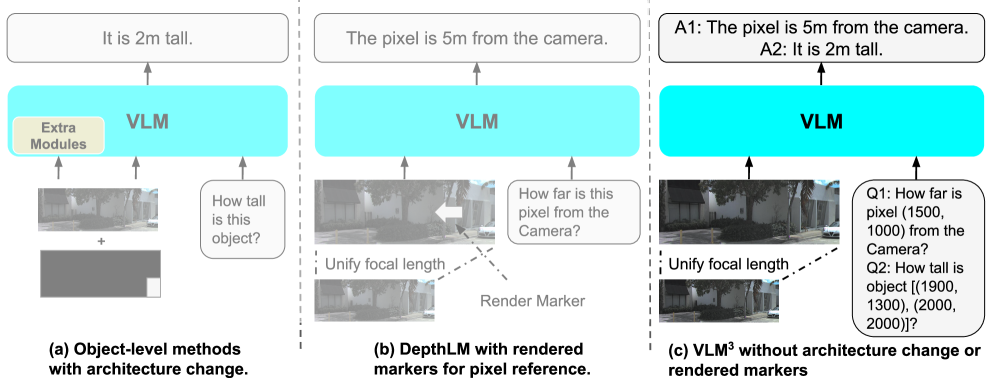
- Focal length unification. Resize every image so the camera’s focal length equals 1000 pixels. That single normalization kills the scale-ambiguity that usually forces people to bolt extra camera modules onto the network — here it’s just a resize.
- Text-based pixel reference. Instead of visual markers or coordinate heads, VLM3 normalizes pixel positions into a [0, 2000) range and talks about them in language. “The point at (740, 1120)” is a sentence, not a special token. The model reads and writes 3D the same way it reads and writes everything else.
- Data mixture and scaling. The least sexy finding is the most important: getting the dataset weighting right — by size — matters far more than inventing clever augmentations, exotic losses or new architectures.
Put those together and a 4-billion-parameter generalist does classic geometry by next-token prediction — it literally describes the answer in text. The authors call using plain next-token prediction for something like camera-pose estimation “arguably a completely new paradigm,” and it’s hard to disagree.
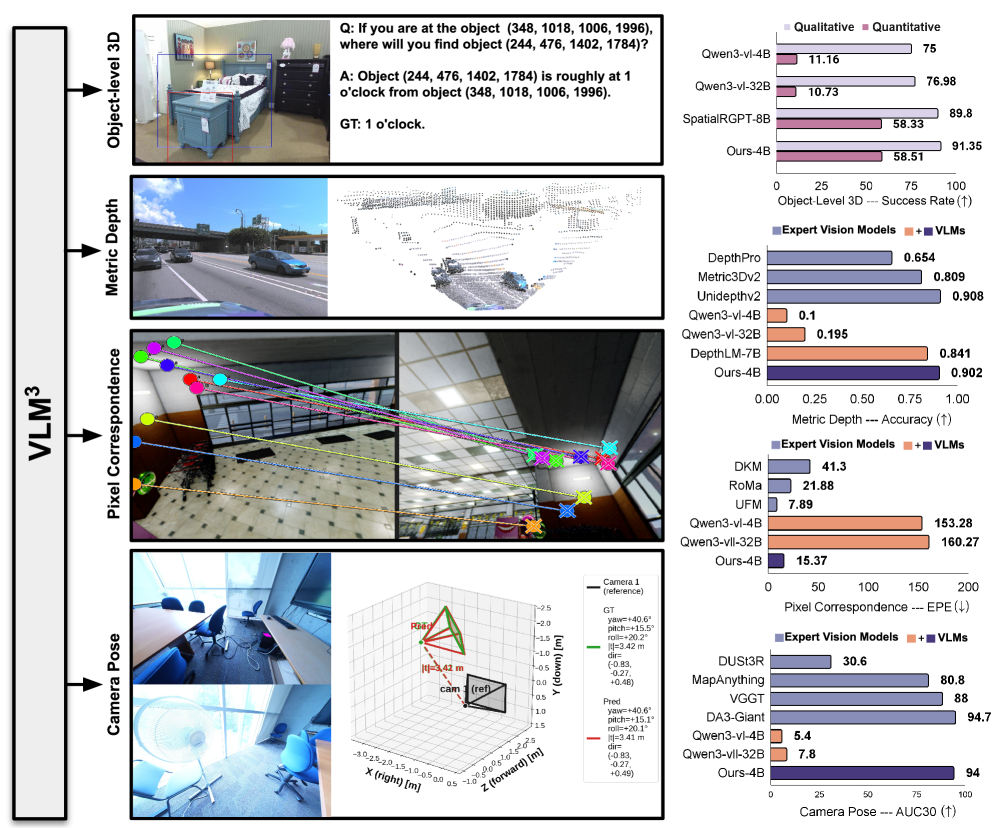
The numbers are the part that stops you scrolling. On metric depth, VLM3-4B hits 0.904 (δ₁), clearing the specialized DepthLM-7B’s 0.838 and sitting shoulder-to-shoulder with dedicated depth networks like UniDepthV2 and MoGe-2. On camera pose it lands 94.0% AUC@30° — a hair behind the giant DA3 model (94.7%) and comfortably past VGGT (88.0%). On object-level 3D understanding it posts 91.35%, edging out the purpose-built SpatialRGPT-8B. Only in dense pixel correspondence does a specialist (UFM, EPE 7.89) still clearly win over VLM3’s 15.37 — and even there it beats older matching workhorses like DKM and RoMa.
Why You Should Care
Everything the Lab has covered lately — Marble, SpAItial, Tripo, TRELLIS, the whole splat-and-generate pipeline — assumes 3D is a separate stack you call out to: a depth model here, a pose estimator there, a mesh generator downstream. VLM3 quietly attacks that assumption. If the same chat model that already drives your agentic tools can also perceive depth, match pixels and recover camera pose natively, then 3D understanding stops being a bolt-on API and becomes a native verb the model already speaks.
Think about what that unlocks. The agent you chat with to generate a world could also measure it, align a new asset to a photo, or reason about where the camera stood — without you wiring three different specialist services together. “Spatial reasoning” and “language reasoning” collapse into one context window. For creative technologists building tools on top of VLMs, that’s the difference between orchestrating a pipeline and just… asking.
Try It / Follow Them
- Paper: arXiv:2605.30561 — VLM3: Vision Language Models Are Native 3D Learners (Cai, Liu, Xiong, Liu, Chandra, Shi).
- Code: github.com/facebookresearch/VLM3 — an inference notebook and sample data are up now (FAIR CC-BY-NC). Model checkpoints (e.g.
facebook/VLM3-depthon Hugging Face) are flagged “coming soon,” so watch the repo if you want to run it locally. - Paper page: huggingface.co/papers/2605.30561 for discussion and related work.
IK3D Lab Take
Let’s keep it honest: VLM3 is about perceiving 3D — depth, correspondence, pose, spatial reasoning — not generating a splat or a mesh. It won’t replace Tripo or Marble tomorrow, dense correspondence still belongs to the specialists, and the weights aren’t downloadable yet. Temper the hype accordingly.
But the direction is the story. After a year of the field answering every problem with “build a bigger, more specialized 3D model,” a 4B generalist doing geometry with a resize, a coordinate convention and a good data recipe is a genuine plot twist. It rhymes with the broader lesson of the last decade of AI: scale a general model, feed it the right data, and the specialized architectures you thought were load-bearing turn out to be scaffolding. If that holds for 3D perception, the future of our tools looks less like a rack of expert models and more like one model you talk to — and it already understands space. We’ll be watching for those checkpoints.