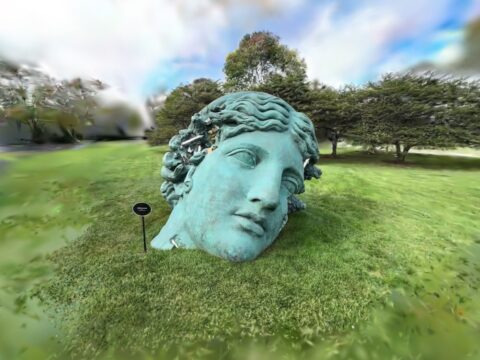
For two years, the Lab has told two parallel stories. One: AI that generates 3D from a single image — Tripo, Rodin, Meshy, TRELLIS. The other: Gaussian splatting eating every renderer on Earth — Photoshop, Octane, Unreal, your iPhone. TripoSplat just welded those two stories into one. Feed it a single image and it doesn’t spit out a mesh — it generates the Gaussian splat directly. And the Tripo team open-sourced the whole thing under MIT.

The Story
Here’s the distinction that matters, and the one most coverage gets lazy about. Almost every Gaussian splat you’ve ever seen was captured: you walk around a real object with a phone or a drone, shoot dozens of photos, and an optimizer fits millions of Gaussians to those views. That’s photogrammetry’s cooler cousin. It’s brilliant — and it needs the real thing sitting in front of you.
The other lane — Tripo H3.1, Rodin Gen-2.5, Meshy — generates 3D from imagination, but it outputs meshes. Triangles, UVs, textures. Great for game engines, awkward for the splat-native pipeline that’s now everywhere.
TripoSplat is the first open-source model to do the third thing: generate the splat itself. One image goes in; a cloud of 3D Gaussians comes out — no capture, no mesh, no remeshing step. Under the hood it’s a tidy generative stack: a DINOv3 encoder reads the image, a Flux2 VAE handles latents, a flow-matching denoiser hallucinates the 3D structure, and an octree Gaussian decoder turns it into splats. If those component names sound like the greatest hits of 2025–2026 generative AI, that’s exactly the point — this is the modern image-gen toolkit pointed at 3DGS.

The actual research contribution has a name: Density-Sampled Gaussians (DeG), accepted at SIGGRAPH 2026 (arXiv:2605.16355). The old way fixed the Gaussian count up front — same budget whether you’re rendering a flat wall or a butterfly’s wing scales. DeG learns to allocate: pile detail where the eye needs it, go sparse where it doesn’t. The result is the first 3D Gaussian generator that outputs an arbitrary number of Gaussians — anywhere up to 262,144 — so you slide the quality-vs-cost dial yourself instead of accepting whatever the model decided.
Why You Should Care
Three reasons this isn’t just another model drop.
- It feeds the pipeline you already use. Every tool the Lab has covered this spring — Photoshop 27.6, OctaneRender 2026, NVIDIA’s ray-traceable Spatial Fields, Aholo’s billion-splat browser viewer — consumes splats. TripoSplat is a content firehose for all of them: type or paste an image, get a drop-in
.ply/.splat. - You control the budget. Need a hero asset? Crank it to 262K Gaussians. Filling a VR scene with background props? Dial it down and keep your frame rate. That’s a knob mesh generators never gave you cleanly.
- It’s genuinely hackable. The whole inference path is ~2,000 lines across two files, with near-zero dependencies — no
transformers, nodiffusers, none of the version-conflict hell that makes most repos a weekend of debugging. MIT licensed. You can read it on a coffee break and ship it on a Tuesday.
Try It / Follow Them
- Zero-setup demo: the TripoSplat Hugging Face Space — drop an image, get a splat in your browser.
- Local run: grab the GitHub repo, pull the weights from Hugging Face, and run
run_example.py(orrun_gradio.pyfor a local UI). Dependencies are just numpy, safetensors, pillow, tqdm. - In ComfyUI: TripoSplat shipped with native support in ComfyUI v0.23.0 (June 1, 2026) — so it slots straight into your existing node graphs alongside your image-gen workflow. Generate an image, pipe it into TripoSplat, get a splat without leaving the canvas.
- View the output: open the
.ply/.splatin SuperSplat or SparkJS.

IK3D Lab Take
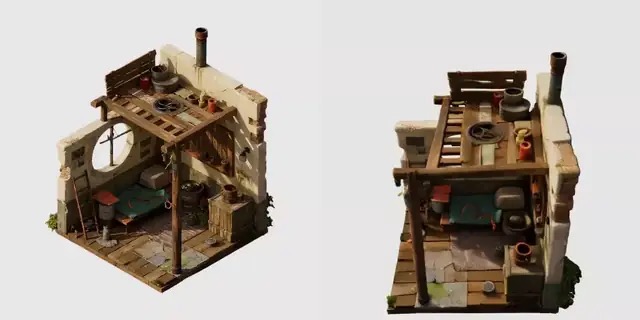
We’ve watched the splat ecosystem industrialize for months — renderers, viewers, file formats, capture rigs. The one missing piece was cheap generation: a way to make a splat without owning the object or running a render farm. TripoSplat is that piece, and the Tripo team gave it away under MIT instead of locking it behind a credit meter. The 640×320 showcase renders are small and the model won’t out-detail a careful 200-photo capture of a real object — be honest, this is for generated and conceptual assets, not survey-grade scans. But for filling a world, prototyping a scene, or feeding the splat-native tools you already love, this is the most exciting thing to land in the pipeline since splats went mainstream. Two files. Two thousand lines. One image in. Go break it.