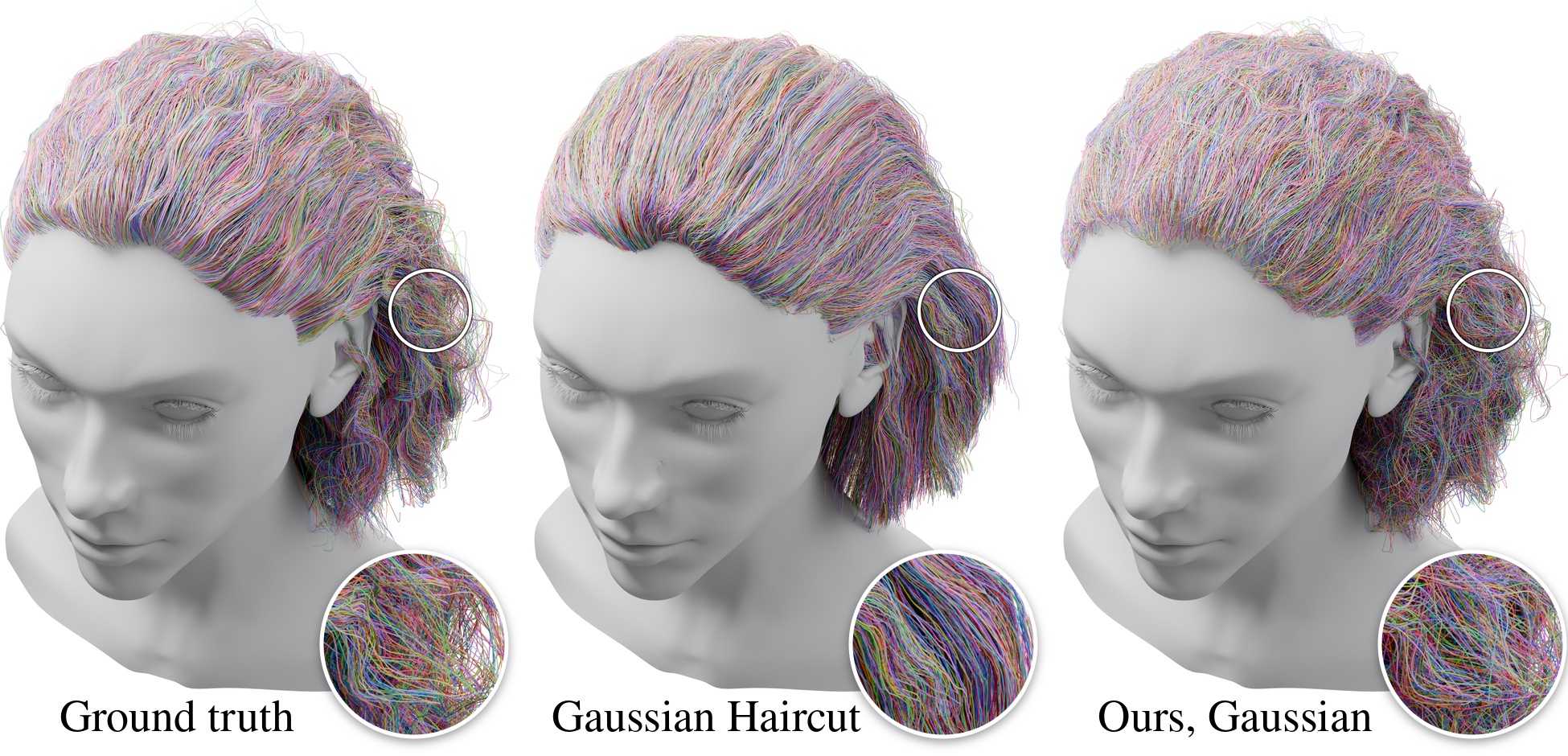
For three years, every Gaussian splat you have ever seen was built from points. Blobs in space, millions of them, blurred just enough to be learnable from photos. A new paper from Simon Fraser, UBC, Toronto and Wayve asks a simple question: what if the primitive were a curve instead of a point? The answer, called Spaghetti Splatting, pulls clean hair strands straight out of images — and treats classic 3DGS as a special case of itself.
The Story
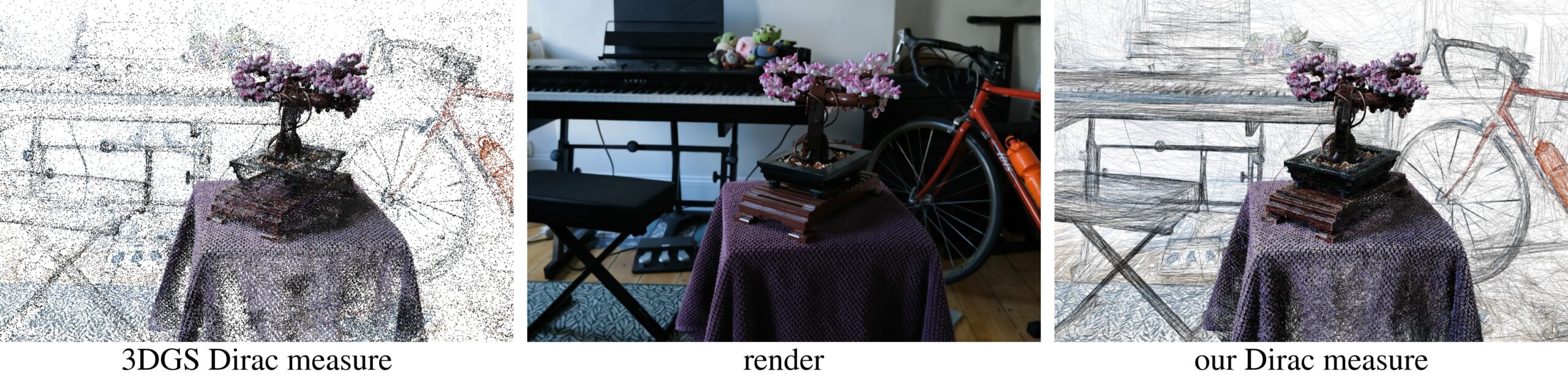
Here is the core idea, in plain terms. Points, lines and triangles are the building blocks of all 3D graphics. But they are infinitely thin — mathematically they are “Dirac masses” — so you cannot learn them from photos by gradient descent. They have no width to push around. The classic fix, used by EWA splatting and 3D Gaussian Splatting, is to blur each point with a soft kernel. That blur is what makes a splat differentiable, and therefore trainable from images.
Spaghetti Splatting takes that exact trick and applies it to curves. A curve is approximated by a polyline — a chain of short straight segments — and each segment is volume-rendered so connected segments composite correctly at their joints, without double-counting where they meet. Shorten the segments and the chain approaches a smooth curve. The authors call the primitive “curvilinear,” but the mental image is right there in the name: strands of spaghetti, each one a learnable thread in space.
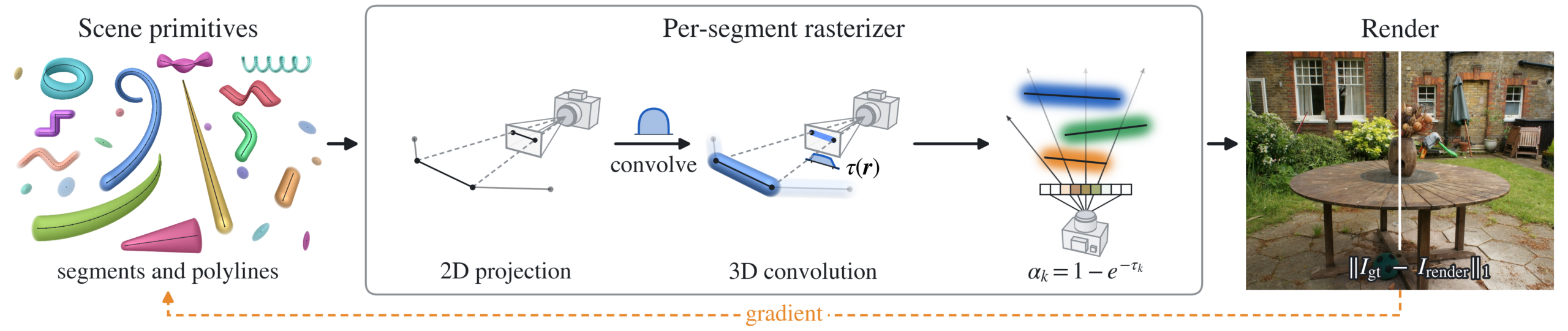
The elegant part: a point is just a curve of zero length. The paper states it directly — set a segment’s two endpoints equal and the math collapses back to the ordinary 3DGS point kernel. So Spaghetti Splatting is not a rival to Gaussian Splatting; it is a superset. Everything 3DGS does, it still does. It simply adds the option of length and connection. The approach also works with kernels beyond Gaussians (the authors test Beta kernels) and bakes in anti-aliasing.
Why You Should Care
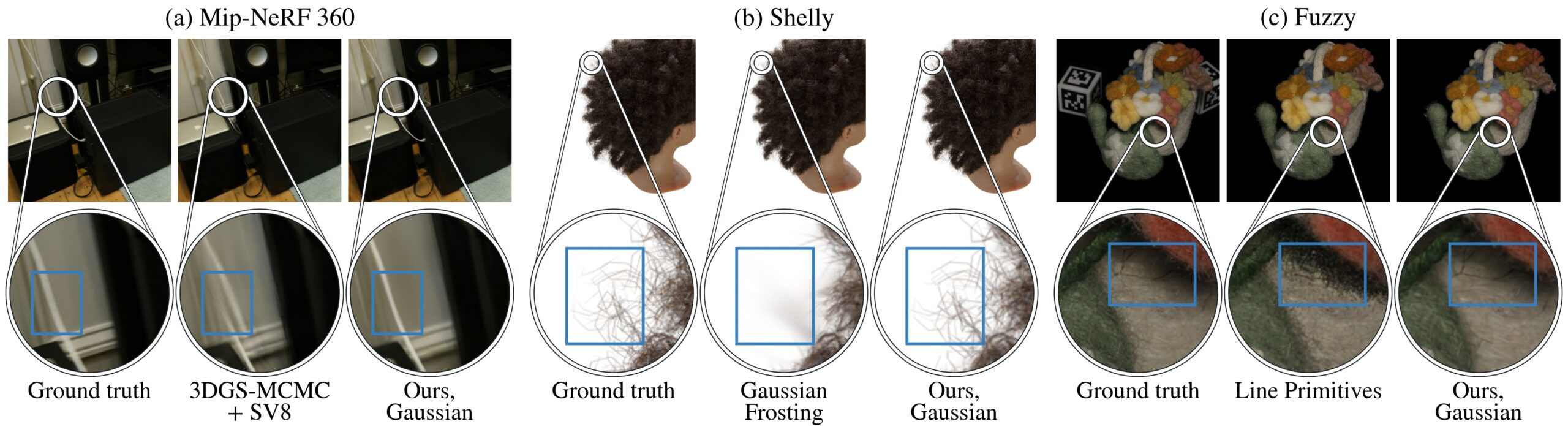
The headline result is hair. Reconstructing hair from photos has always been a nightmare, usually solved with hair-specific priors baked into the model. Spaghetti Splatting uses none of that and still wins. On the GeomHair benchmark, its strand-accuracy F1 score reaches 61.2 at a 2 mm threshold, against 46.9 for Gaussian Haircut — a 14.3-point gain — and the lead holds at 3 mm (80.3 vs 63.5) and 4 mm (88.9 vs 72.7). We read these numbers off the paper’s own table, not a press summary.
Why does that matter beyond hair? Because the output is connected. A normal splat scene is a cloud of disconnected blobs — great to look at, useless to simulate. A strand knows which point follows which. The authors feed their recovered hair straight into a physics simulation. Think of what that unlocks: ropes, wires, grass, fur, cables, cloth seams — any thin, structured geometry that artists currently rebuild by hand after a capture. And on ordinary “general scenes,” the method stays competitive with standard 3DGS, so you are not trading away everyday quality to get the strands.
Try It / Follow Them
There is nothing to run yet — this is a fresh preprint, submitted 9 November 2026 to arXiv (cs.CV). The authors write that they “commit to fully release code,” but the paper itself gives no public date, so treat any specific release day you see elsewhere as unconfirmed until the repo actually appears.
- Read the paper: arXiv 2611.12716 — “Spaghetti Splatting: Differentiating Curvilinear Dirac Masses via Convolution”
- Authors: George Shramko, Shrisudhan Govindarajan, Rudy Lam, Yizheng Xie, Daniel Rebain, David B. Lindell, Andrea Tagliasacchi
- Labs: Simon Fraser University, University of British Columbia, University of Toronto, Wayve Labs
- Watch Andrea Tagliasacchi’s group for the code drop — the same lineage behind a lot of modern radiance-field research.
IK3D Lab Take
This is the kind of paper we love: one clean idea that reframes a whole field instead of chasing another half-point on a benchmark. “A point is a zero-length curve” is the sort of sentence that, once you read it, feels obvious in hindsight — and that is usually the mark of a good primitive. If the connected-strand output holds up outside the paper’s curated scenes, it could become the default representation for anything hairy, stringy or fibrous.
Honesty check: we have not tested this — there is no code to test. The hair numbers are strong but come from the authors’ own evaluation on their chosen benchmarks, and they openly flag real-world hair capture as still an open problem, with fine texture needing many short segments (read: more compute). The real test comes when the code lands and someone outside the author list points it at a messy phone capture. If that works, this is a quiet milestone. If it only shines on clean synthetic hair, it is still a beautiful idea waiting for its engineering. Either way, we will be first in line to run it in the Lab the day the repo opens.
How this article was made: researched and drafted with AI assistance, then fact-checked against the original sources and reviewed by Issa before publication.



This sounds like a fascinating shift in 3D graphics! Replacing points with curves for things like hair strands must yield much more realistic results. By the way, I took a break from reading about computer vision to play MovieSpot—it’s such a fun daily movie guessing game with great clues! movie trivia game