Hook
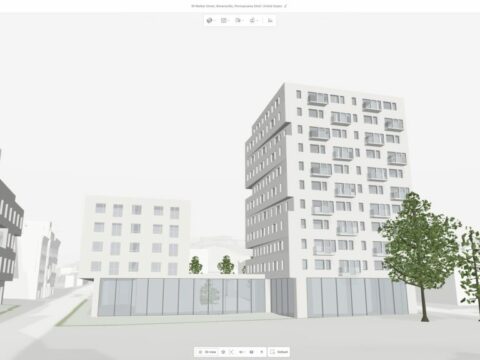
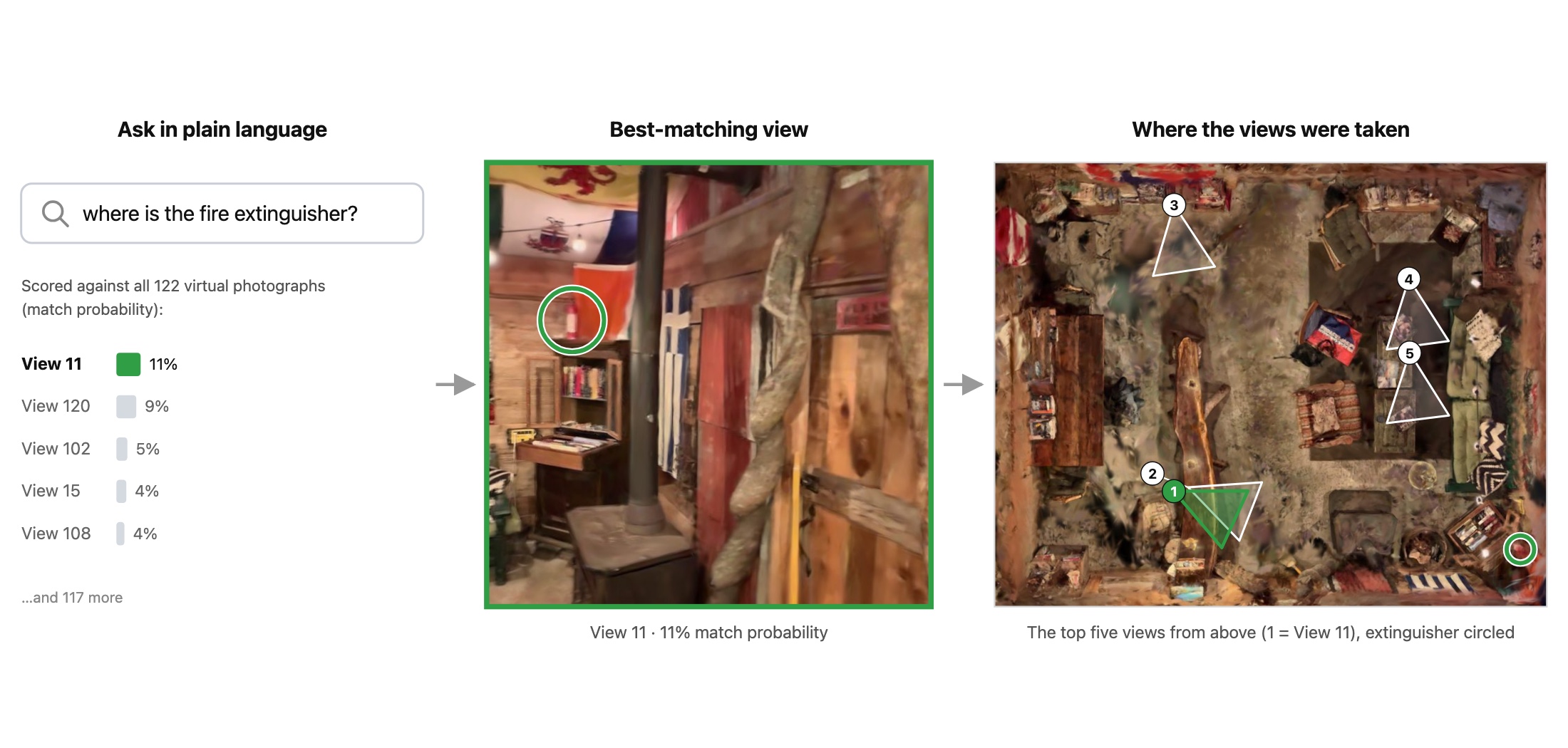
A Gaussian splat is a gorgeous 3D record of a real place — and until now, a dead end for any AI. The models that read images can’t read a splat. A small Vancouver team called SpatialView just found a sly way around that wall: don’t teach the AI to see in 3D, hand it a tidy stack of 2D photos the splat takes of itself. Ask “where is the fire extinguisher?” and it flies you to the spot.
The Story
SpatialView, a Vancouver company led by Thomas Charlton (PhD) and Conrad Koziol (PhD), published its method on 27 October 2026. The problem it attacks is simple to say and hard to solve. Multimodal AI — the kind that looks at a picture and answers questions — is trained on billions of 2D images. It has no comparable training for raw 3D formats like point clouds or Gaussian splats. So a splat of your warehouse is useless to an agent that can only “see” flat pictures.
One obvious fix is to feed the agent the original capture photos. SpatialView tried that first. It breaks in the real world: imported scans often arrive with no source photos, the footage was shot to reconstruct geometry rather than to inspect a specific object, and every photo is locked to the angle it was taken from. You can’t reframe a badly-shot detail without driving back to the site.
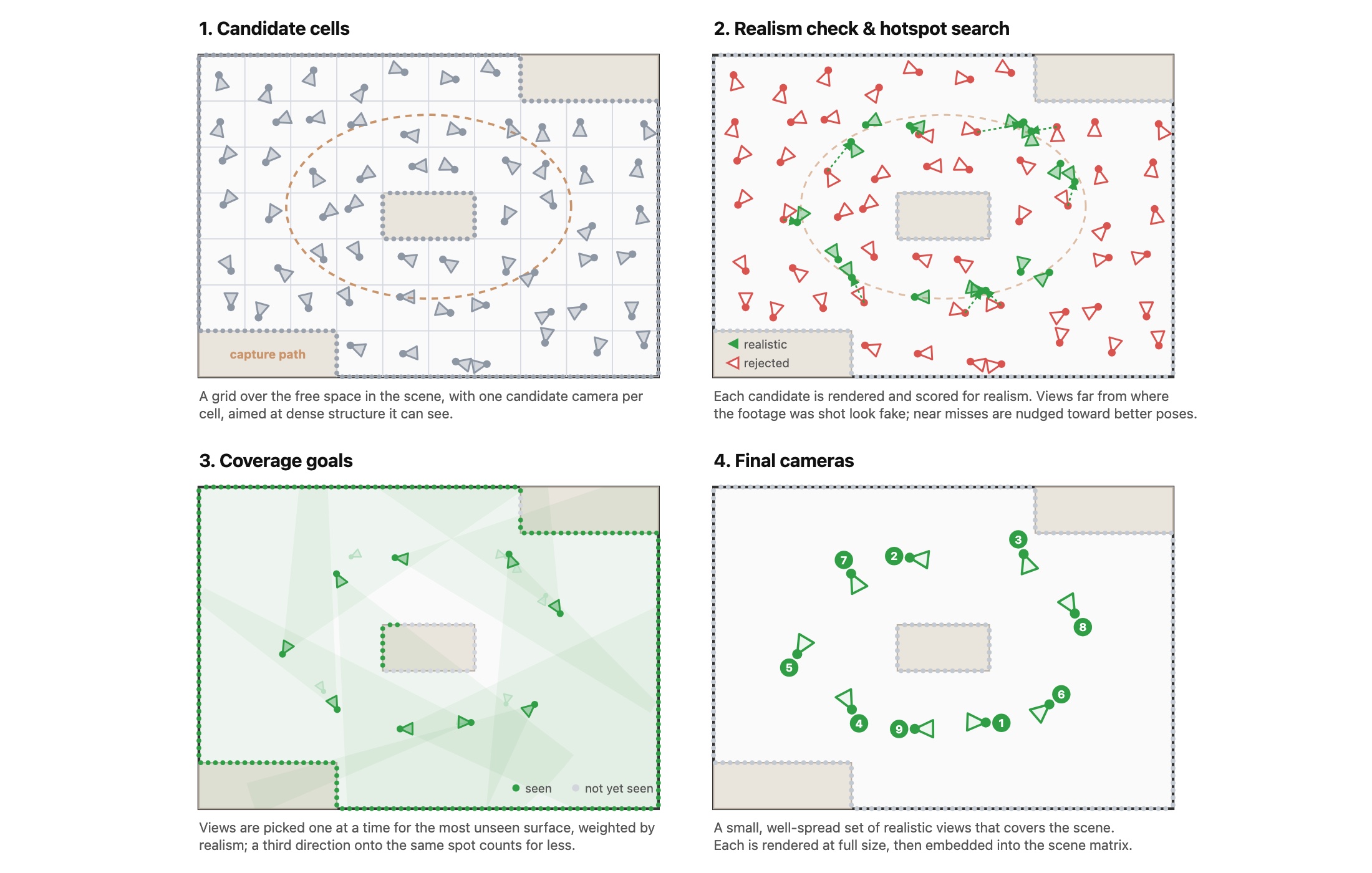
Their new trick is a pre-processing step they call automatic virtual framing. Instead of using real photos, the system renders fresh virtual photographs straight out of the finished splat. It works in four moves: scatter candidate cameras across the room’s open space; render each one and score how realistic it looks (a trained classifier catches the smeary, broken angles that splats produce when you drift too far from the capture path, and nudges near-misses into better poses); then greedily pick the smallest set of good views that still covers the whole scene.
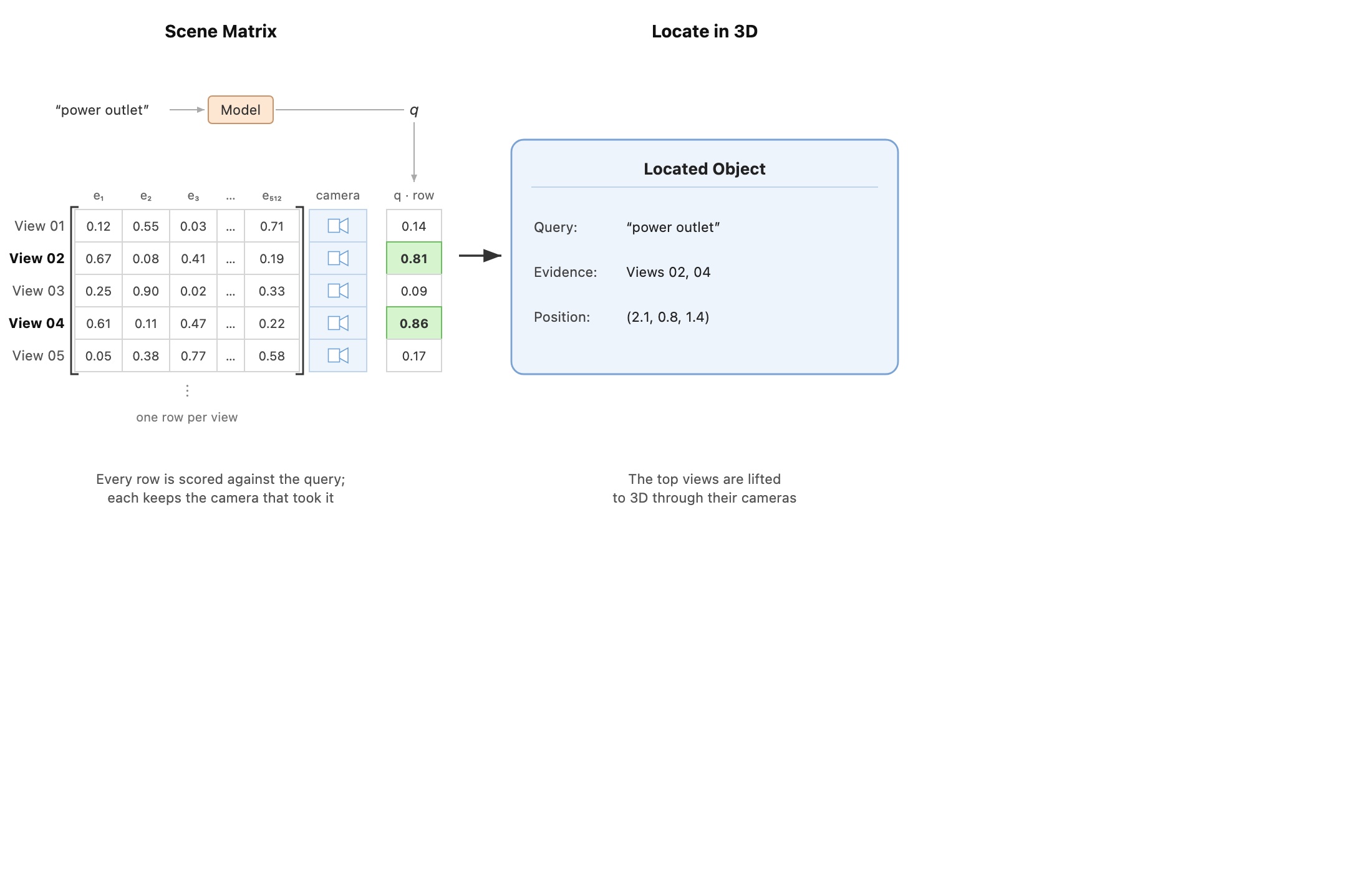
Each surviving view is then run through a standard image-text model and stored, one row per photo, in what they call a scene matrix. Crucially, every row remembers the camera position it came from. When you type a question, the agent embeds your words, scores them against every row, and lifts the best matches back to a real spot in 3D — plus a rendered image you can eyeball to check the answer.
The numbers they report are the interesting part. On a 1.8-million-Gaussian scan of a cabin — with the original photos deliberately withheld — the pipeline generated 122 virtual photographs at 1024×1024 to hit 95% surface coverage, versus 362 photos in the original capture. Framing and embedding the whole thing took under two minutes. Bigger scenes scale with Gaussian count: 5 million in about three minutes, 7 million in about six.
Why You Should Care
This is a different bet from the usual “language splatting” research. Methods like LangSplat and OpenGaussian bake language features directly into the geometry — powerful, but they weld the splat to one specific embedding model and demand heavy per-scene preprocessing. SpatialView keeps the index and the geometry apart. A better embedding model ships next year? Re-run the 2D renders, leave the splat untouched.
For anyone building digital twins, that decoupling is the whole game. It means a splat captured today stays useful as AI gets smarter, and it means the boring, high-value jobs — “is every fire extinguisher where the floor plan says?”, “show me every rack that’s installed wrong” — can be asked in plain English and answered with a picture a human can verify. Pre-computing the index also spares the agent from clumsily flying through the scene live on every single query.
Try It / Follow Them
The full write-up on the SpatialView blog includes an interactive demo of the cabin that runs entirely in your browser — type a query and the camera flies to the best-matching view. It’s the fastest way to feel what “semantic search over a splat” actually means. The work was first flagged by Radiance Fields, where Charlton published a guest summary on 7 November 2026.
IK3D Lab Take
We love this one for being lazy in the right way. The honest-but-hard road is a true 3D-native vision model; SpatialView noticed that road isn’t paved yet and built a clever detour on top of tools that already work. The Lab did not run the pipeline or reproduce the cabin benchmark — we read the method, checked the numbers against the primary source, and played with the browser demo. So treat the 122-photos-and-two-minutes figure as SpatialView’s own reported result, not something we timed.
Where will it strain? The realism classifier is doing a lot of quiet work — a cluttered, reflective, or poorly-captured splat will produce fewer “realistic” virtual views, and thin coverage means thin answers. And a 2D index can only find what a camera can be placed to see; nothing truly occluded ever makes it into a row. For inspection and compliance on clean captures, though, this is the most practical “talk to your splat” approach we’ve seen — precisely because it refuses to reinvent the model that reads the picture.
How this article was made: researched and drafted with AI assistance, then fact-checked against the original sources and reviewed by Issa before publication.