A 249-gram drone flies invisibly above the ruins of Pompeii, capturing 8K 360° footage of every fresco, every cracked column, every alleyway the volcano froze in time. Forty-eight hours later, you can walk through that exact slice of 79 AD inside a browser, in real-time Gaussian Splatting. This is Project ETERNAL — and it just opened the door for the rest of us to do the same thing, anywhere on Earth.

The Story
On April 23, 2026, Antigravity — the Insta360-backed drone outfit behind the world’s first sub-250g 8K 360° drone, the A1 — announced Project ETERNAL with two of the most credible partners they could have picked: CyArk, the non-profit that has been laser-scanning UNESCO sites for two decades, and Splatica, one of the cleanest cloud Gaussian Splatting pipelines on the market.
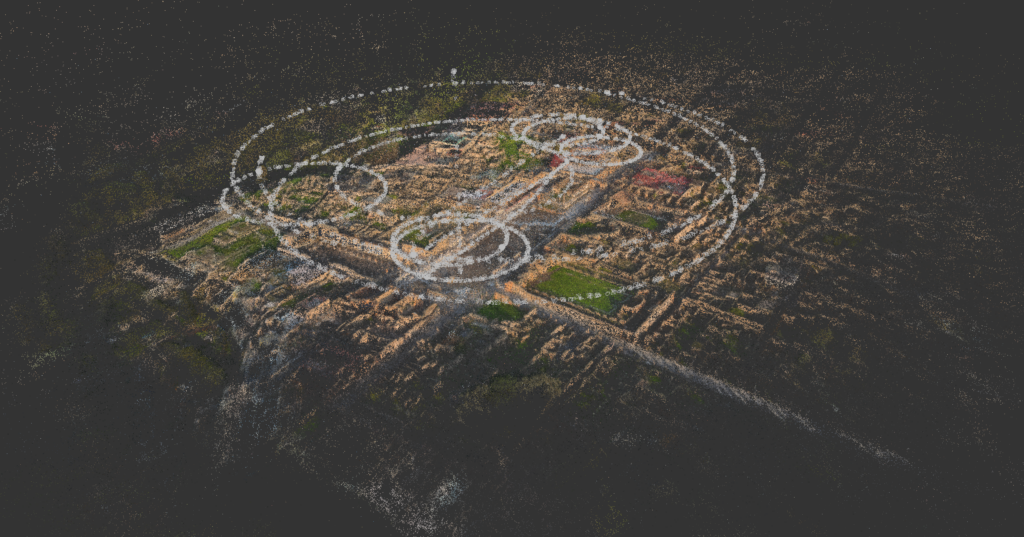
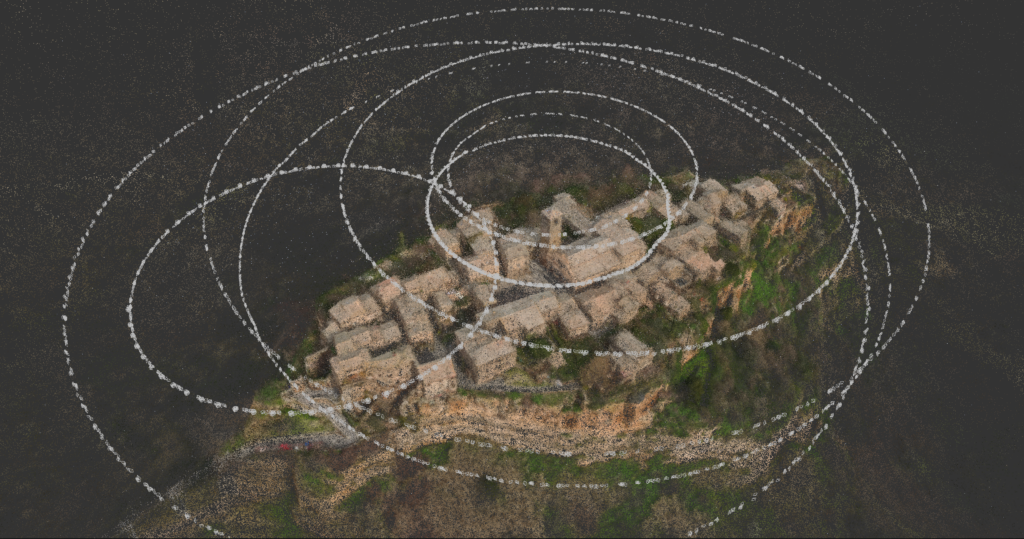
The pilot is the part that punches you in the chest. Two of the most fragile heritage sites on the planet — Civita di Bagnoregio, the Italian “Dying City” literally crumbling off its tuff cliff, and the Forum of Pompeii — have been captured in full 360° from the air with the A1, processed into 3D Gaussian Splats, and deployed as immersive web experiences on CyArk’s Tapestry platform. You can open them right now on a phone.
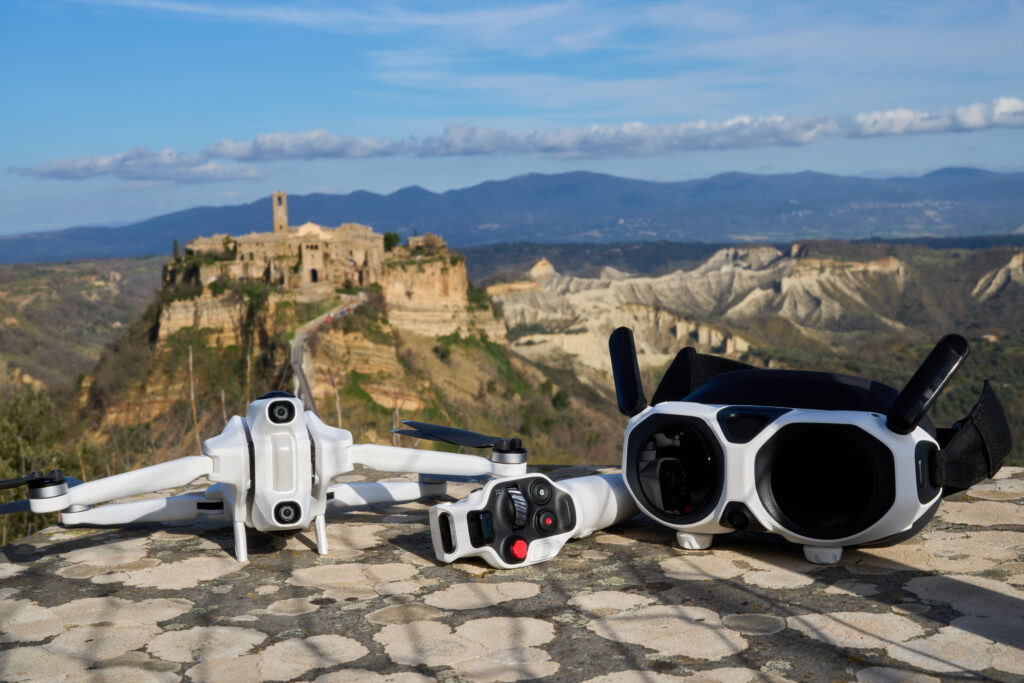
What makes this technically remarkable isn’t the drone alone — it’s the workflow. Traditional photogrammetry of a site like Pompeii means weeks of ground crews, hundreds of thousands of images, terrestrial LiDAR rigs, and a server farm chewing on it for days. The Project ETERNAL pipeline collapses that into one drone, one operator, one over-flight. The A1’s twin lenses produce a fully spherical 8K video stream — Insta360’s stitching algorithm makes the drone itself disappear from the frame — and Splatica eats that footage to spit out a navigable 3DGS scene.
John Ristevski, CyArk’s CEO, framed it bluntly: “Gaussian Splatting is changing the way we document and share cultural heritage. We’re able to expand access to extraordinary places while exploring new, more efficient ways to create immersive experiences.” Translation: a method that used to belong to museums and academics now fits in a 249g flying camera.
Why You Should Care
This is the moment 3D Gaussian Splatting stops being a research curiosity and starts becoming civilizational infrastructure. We’ve covered the tech stack — KIRI Engine 4.2 making splats production-ready, OpenUSD/glTF officially adopting them, Apple LGTM solving the memory wall — but those were all tooling stories. Project ETERNAL is the first one where the question shifts from “can we splat anything?” to “what should we splat first, before it’s gone?“
For us — creative technologists, 3D artists, archviz folks, world-builders — there are three immediate consequences:
- Aerial 360° just became the new default capture format for splats. A single over-flight beats a 400-photo orbit, and the parallax across the full sphere is exactly what 3DGS reconstructors love.
- The price ceiling collapsed. A1 + Splatica cloud = roughly $1,600 + a subscription to produce splats that, two years ago, required a $15K LiDAR rig.
- Browser-native delivery is real. CyArk’s Tapestry serves these scenes via WebGL with no plugin — meaning your client, your audience, or your studio’s Slack channel can open them on a phone.
Try It / Follow Them
Here’s the part that turns this from “cool press release” into get-up-from-your-desk-now: Antigravity opened a global UGC campaign — “If you could preserve one place forever, what would it be?” — and the first 1,000 participants get free full-scene Splatica processing for their 360° captures. No fine print, no paywall.
- Submission window: April 24 → June 24, 2026. Winners July 1.
- Process: capture with any 360° device → upload to Splatica → export → post to Instagram / Facebook / Reddit with
#Turn360to3Dtagging@antigravity_global. - Categories: living spaces, cultural heritage, creative/hybrid environments.
- Prizes: $3,500 + 1-year Splatica membership for first place, down to $180 for fourth. There’s also a Think Bold Challenge Fund for creators without gear.
- Walk through Pompeii right now: tapestry.cyark.org/content/pompeii-forum
- Walk through Civita: tapestry.cyark.org/content/civita-splat
- Project page: antigravity.tech/us/project-eternal/gaussian-splatting
IK3D Lab Take
Project ETERNAL is the cleanest argument we’ve seen in 2026 that 3D Gaussian Splatting has crossed from “interesting paper at SIGGRAPH” into “tool that should be in every creative technologist’s bag.” The combination is the trick: a sub-250g drone (no certification, no permits in most jurisdictions), full-sphere capture (no missed angles), cloud splatting (no GPU rig at home), and browser delivery (no app to install for the audience). The friction has been ground down to almost zero.
The honest reservation: cloud-only processing means your scenes live on Splatica’s servers, and the export-to-video step in the campaign rules tells us they’re not yet handing out raw .splat files to UGC participants by default. If you’re a studio building a heritage capture pipeline, that matters — push for the file-out workflow before you commit. But for the rest of us? Grab whatever 360° rig you have, point it at something that won’t survive your grandchildren, and contribute to what is genuinely shaping up to be the Wikipedia of 3D space.
The next time someone asks you what 3DGS is actually for, point them at Pompeii.