For years, the dirty secret of AI 3D generation was the cleanup tax: you’d generate something impressive, then spend hours rebuilding topology before it was actually usable. Tripo AI just made that problem irrelevant. Their new Smart Mesh P1.0 architecture, unveiled at GDC 2026, generates production-ready 3D assets with clean topology, correct edge flow, and engine compatibility — in two seconds flat.

The Story
This is not an incremental update. Smart Mesh P1.0 is a fundamental architectural shift in how AI generates 3D geometry.
Every previous AI 3D generation system — including Tripo’s own previous models — predicted geometry sequentially, building the mesh piece by piece. The problem? Sequential prediction produces messy, tangled topology. Faces that overlap, edge loops that make no sense, geometry that would take a character artist hours to retopologize before it could be rigged or shaded correctly.
P1.0 takes a completely different approach: it operates in a unified probabilistic space and resolves the entire global structure of a 3D object holistically in a single pass. The model understands the object as a whole before committing any geometry. The result is clean low-poly topology with correct edge flow — directly from the generation process, no reconstruction step needed.
Two seconds. That’s the generation time. And what comes out the other end is an asset that goes straight into Unity or Unreal.
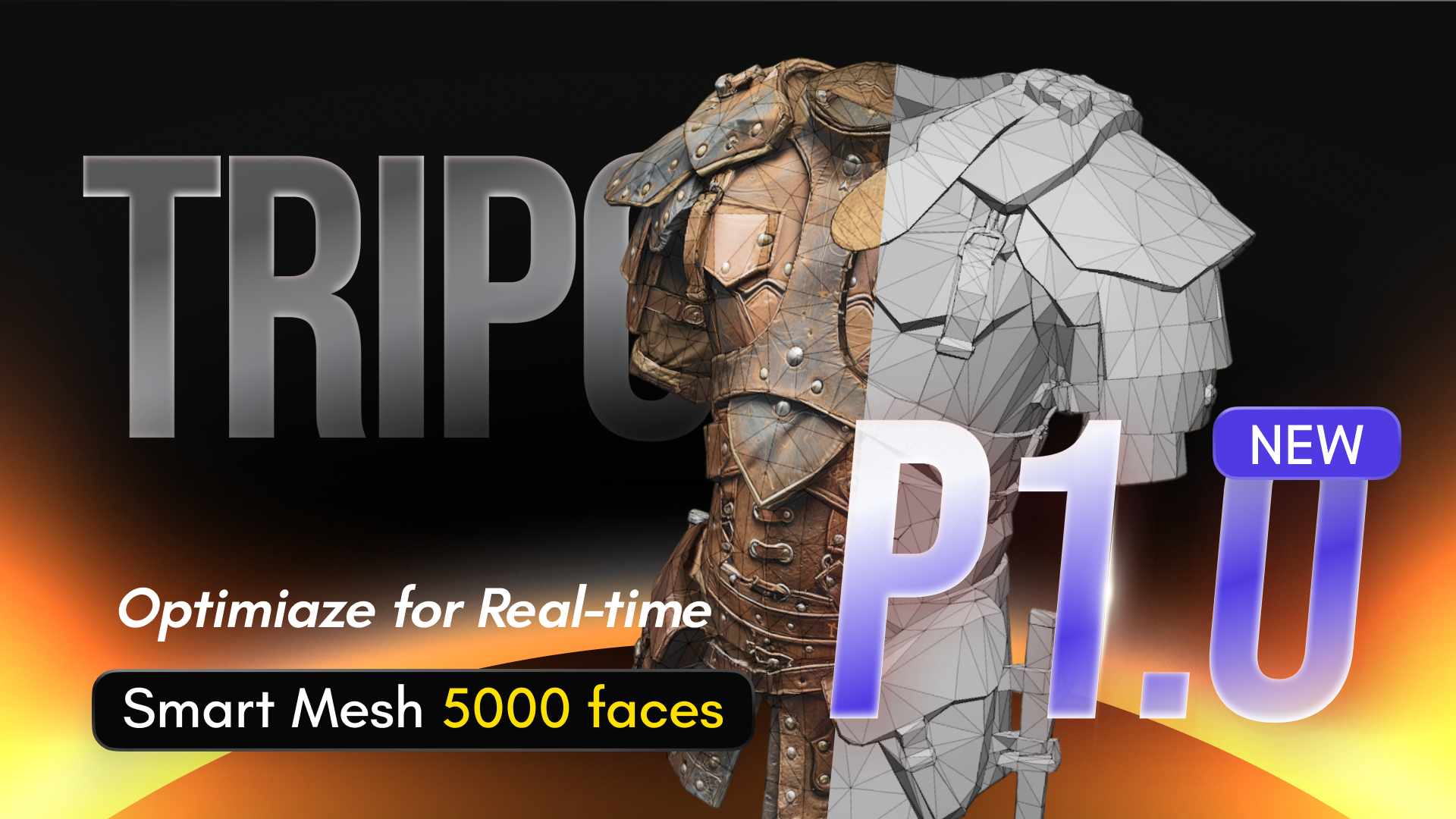
Tripo debuted P1.0 at GDC 2026 in San Francisco (Booth 1141, Moscone Center), alongside their high-fidelity flagship Tripo H3.1, which pushes visual accuracy to the max for hero assets — characters, mechanical structures, complex objects with intricate detail. They’re also early-stage exploring Tripo W1.0, a world model initiative that would move from single assets to entire environments. That’s the vision: AI 3D at every scale, from a prop in two seconds to a full world.
The scale of the platform backing this is real: 6.5 million creators, 90,000 developers, nearly 100 million 3D models generated. Their Tripo Game Hub — where developers turn generated assets into playable experiences — now hosts 100,000+ active developers and over 2,000 AI-powered interactive projects. This isn’t a research demo. It’s infrastructure.
Why You Should Care
The bottleneck in AI 3D pipelines has never been visual quality — tools like Rodin and Meshy have been producing impressive renders for a while. The bottleneck has always been usability: the gap between “that looks cool” and “I can actually ship this.”
Clean topology is the key. You cannot animate a mesh with bad edge loops. You cannot UV-unwrap geometry that intersects itself. Shader seams, rigging failures, physics glitches — all of these trace back to topology. Professional 3D artists spend enormous amounts of time on retopology specifically because every other tool in the pipeline depends on it being correct.
P1.0 attacks that problem at the model level. If it truly delivers consistent clean topology straight out of generation, the math changes for every indie game studio, every archviz team running rapid concept cycles, every XR developer trying to populate a scene. The bottleneck moves from “fix the mesh” to “iterate faster.”
Simon Song, Tripo AI’s founder and CEO, put it directly: “The real shift happens when AI-generated 3D assets require no reconstruction before entering production workflows. P1.0 is built around that idea — not just assisting existing pipelines, but becoming part of them.”
That framing matters. They’re not positioning this as a concept generation tool. They’re positioning it as pipeline infrastructure — something that sits upstream of your DCC app and replaces hours of artist time on base meshes.

Try It / Follow Them
- Platform: tripo3d.ai — web interface for prompt- and image-based 3D generation, plus workspace tools
- API / Developer access: Available for the 90K+ developer ecosystem — check their developer platform for integration docs
- Game Hub: Tripo Game Hub — where generated assets become interactive experiences
- P1.0 & H3.1 demos: Live at GDC 2026 Booth 1141 this week — if you’re at Moscone, go see it in person
- GDC announcement: Full press release on PRNewswire

IK3D Lab Take
The “AI 3D 2.0” label Tripo is using isn’t marketing fluff — it’s a real phase transition. Version 1.0 of AI 3D was about proving the concept: yes, you can get something 3D-shaped from a text prompt. Impressive, but not production-ready. Version 2.0 is about collapsing the distance between generation and deployment.
We want to test P1.0 hands-on — specifically against the retopology tax. Our benchmark: generate a game character base mesh and a mechanical prop, then measure how much cleanup they actually need before being rig-ready. If the answer is “almost none,” this changes how we scope rapid prototyping workflows at IK3D.
Watch this space. If P1.0 delivers on its promise consistently across diverse geometry types, it’s not just a great AI tool — it’s a rethink of where artists spend their time.
Tripo AI launched Smart Mesh P1.0 at GDC 2026, San Francisco, March 19, 2026. Platform at tripo3d.ai.



Good notes here. Bookmarking this for the next time I hit the same tradeoff. muse native audio to video