Marble, HY-World 2.0 and Lyra 2.0 will hand you a gorgeous Gaussian splat world — and every one of them is frozen. No drifting fog, no flickering candle, no swaying mast. OuroWorld, a new paper with public code, takes any static splat scene and makes it move in a loop that never shows a seam, from a camera you can still fly around.

The Story
The paper landed on arXiv on October 8, 2026 (arXiv 2610.12461). It comes from six researchers at National Yang Ming Chiao Tung University in Taiwan and Alaya Lab: You-Zhe Xie, Ting-Wei Chou, Yu-Hsuan Li, Kaipeng Zhang, Zhixiang Wang and Yu-Lun Liu. Alaya Lab is the group behind AlayaWorld, which we covered in August — this is a separate project.
The target is the 3D cinemagraph: a scene where part of the world moves, loops forever, and stays coherent when the camera moves. Earlier methods (3D Cinemagraphy, LoopGaussian, 3D-MOM, Gaussians-to-Life) all need you to paint a motion mask, and the paper notes most are limited to fluid-like or soft-material motion. OuroWorld asks for no mask and also handles object motion and changing light.
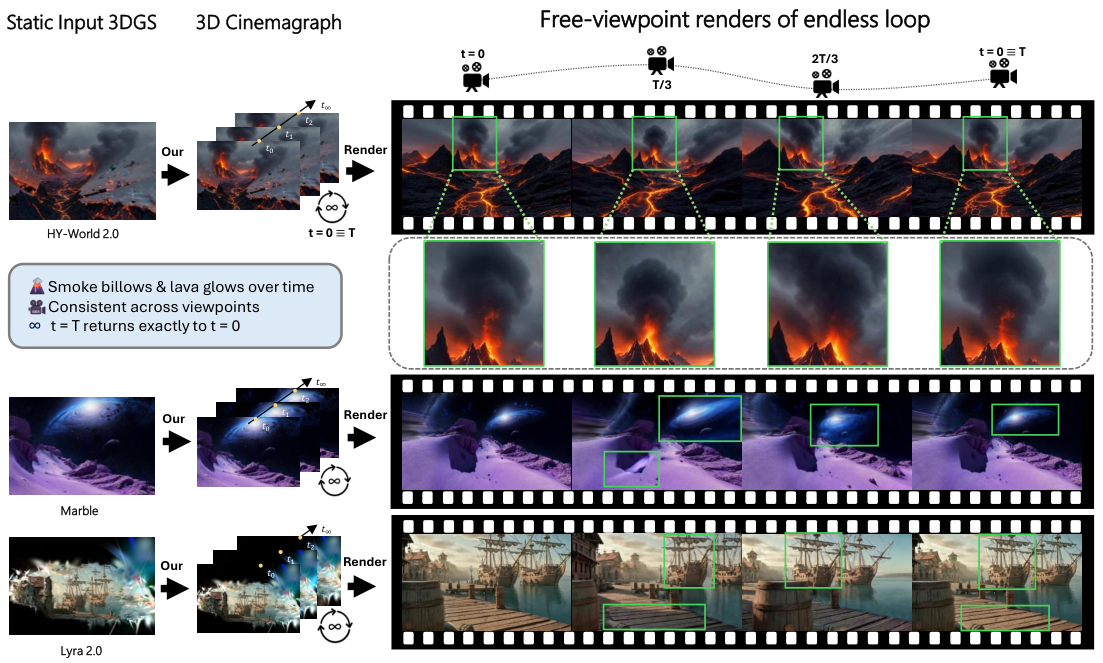
The pipeline is a relay of existing models, in three stages:
- One looping reference video. A vision-language model (GPT-5.5 in the paper) looks at a render of your scene, decides what should plausibly move, and writes the prompt for a video model (Seedance 2.0).
- Twenty more views. VGGT-Ω lifts that video into a dynamic point cloud, and the TrajectoryCrafter inpainting model fills in the views the reference camera never saw.
- A periodic 4D splat. The generated views disagree with each other, so the team fits what they call an Inconsistency-Robust Periodic 4DGS on top of your original Gaussians.
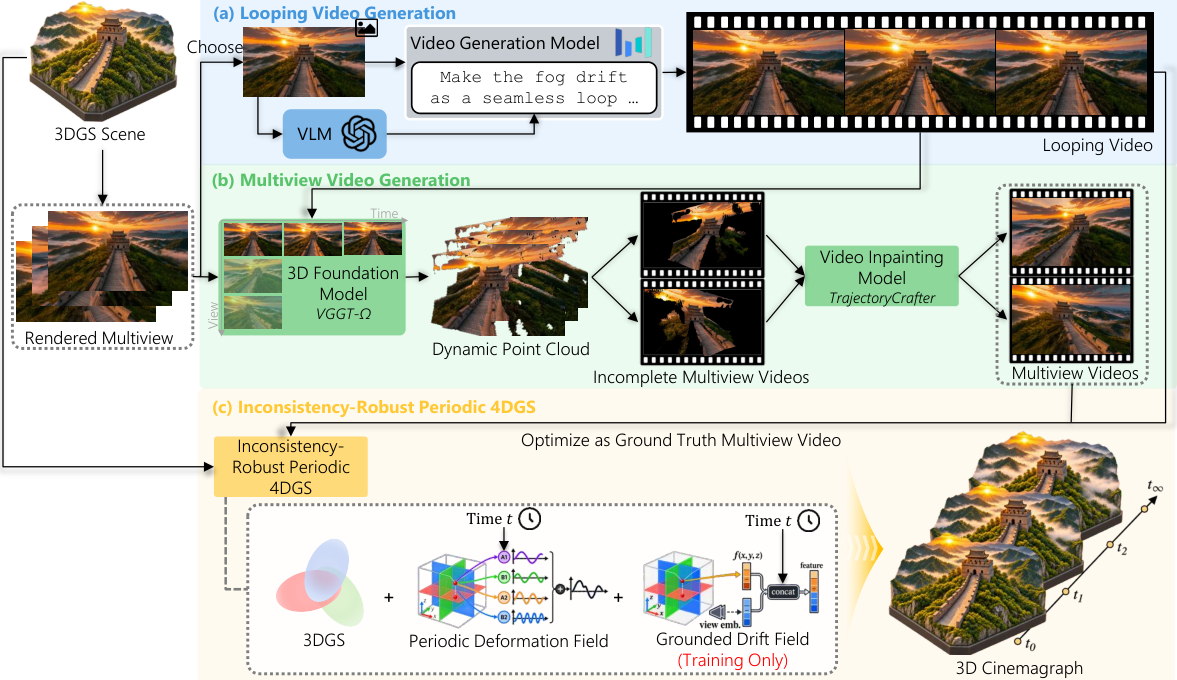
Two ideas in that last stage are the clever part. First, motion is written as a Fourier series, so the scene at the end of the period is the scene at the start by construction — the loop is guaranteed by the math, not hoped for by a loss. Second, a Grounded Drift Field soaks up the contradictions between generated views during training, stays anchored to the reference view so it cannot swallow the real motion, and is thrown away at render time.
Why You Should Care
- It plugs into splats you already have. The input is a standard 3DGS PLY in the original INRIA layout plus one camera. The paper tests 39 scenes: 9 from Mip-NeRF 360 captures and 10 each from HY-World 2.0, Marble and Lyra 2.0.
- The loop is long. OuroWorld’s native loop period is 10 seconds, against 0.5 to 2.4 seconds for the four baselines listed in the paper’s appendix.
- People preferred it. In a 30-participant study, OuroWorld was chosen in 70.8% to 99.0% of head-to-head comparisons, with the biggest gap on vividness. That is a preference study on the authors’ own test set, not an independent benchmark.
- It runs on one consumer card. All experiments were run on a single RTX 4090.
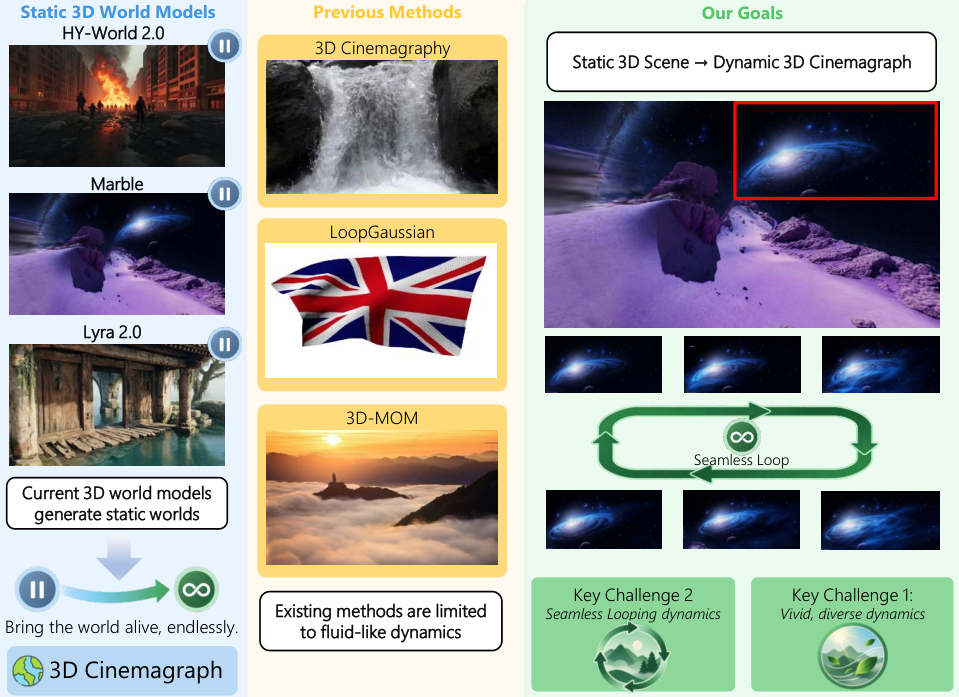
The authors are upfront about the limits. The motion is only as good as the video model’s guess, so an implausible generation ends up in your scene. And because every view is completed from a single reference video, holes and inconsistencies grow as the camera travels further from that view.
Try It
The code is public, which is not a given for a week-old paper. Start with the project page to watch the loops, then the GitHub repo.
- Hardware: Linux, an NVIDIA GPU with 24 GB, about 35 GB of system RAM, CUDA 12.1, and roughly 55 GB of model weights. VGGT-Omega is a gated download on Hugging Face.
- Time per scene (README figures, one RTX 4090): about 6 minutes for the reference video, 68–74 minutes for the multi-view videos, about 1.4 hours of 4D optimisation. Budget around three hours.
- Paid step: only the reference video calls paid APIs (an OpenAI key for GPT-5.5, a BytePlus ModelArk key for Seedance 2.0). The 39 released scenes ship with their prompts and reference videos, so replaying them needs no key.
- Data: the Hugging Face dataset has cameras, prompts, reference videos and results. The input splats themselves are not included — the world models’ licenses do not allow redistribution, so you fetch them from the original galleries.
- License: the authors’ own code is MIT, but parts derived from Free4D and 3DGS and several model weights are non-commercial. The README says it plainly: the full pipeline is for non-commercial research use.
- Output: the documented results are
static.mp4andorbit.mp4renders (20 s, 30 FPS) plus model checkpoints. We found no documented export to a standard splat player.
IK3D Lab Take
We have not run OuroWorld ourselves yet — everything above comes from the paper, the README and the project videos. So take this as a reading, not a review.
What we like is the honesty of the engineering. Generated multi-view video is messy, and instead of pretending otherwise the team built a dedicated bin for the mess and empties it before rendering. The Fourier trick is the kind of idea you wish you had thought of: stop asking a network to loop, make looping the only thing it can do.
What holds us back is the last mile. Three hours and two paid APIs for one loop is fine for a hero shot, not for a library of environments. The non-commercial dependencies rule out client work today. And with video files as the documented output, this is a way to make a beautiful looping shot, not yet an animated splat you drop into Unreal or a web viewer. If you build ambient scenes, installations or backgrounds from world-model splats, this is worth an afternoon on a 4090. Everyone else: watch the gallery, and watch for a real-time export.
How this article was made: researched and drafted with AI assistance, then fact-checked against the original sources and reviewed by Issa before publication.