Jensen Huang just dropped the biggest graphics bombshell since real-time ray tracing in 2018. At GTC 2026, NVIDIA unveiled DLSS 5 — a system that fuses classical 3D rendering with generative AI to produce photorealistic visuals in real time. This isn’t an incremental upscaler update. This is a paradigm shift.
What DLSS 5 Actually Does
Previous DLSS versions were smart upscalers — render at low resolution, AI fills in the pixels. DLSS 5 is fundamentally different. It takes a game’s color output and motion vectors as a structured basis, then applies a neural rendering model that infuses every frame with photorealistic lighting, materials, and surface detail — all generated in real time by the RTX GPU’s AI cores.
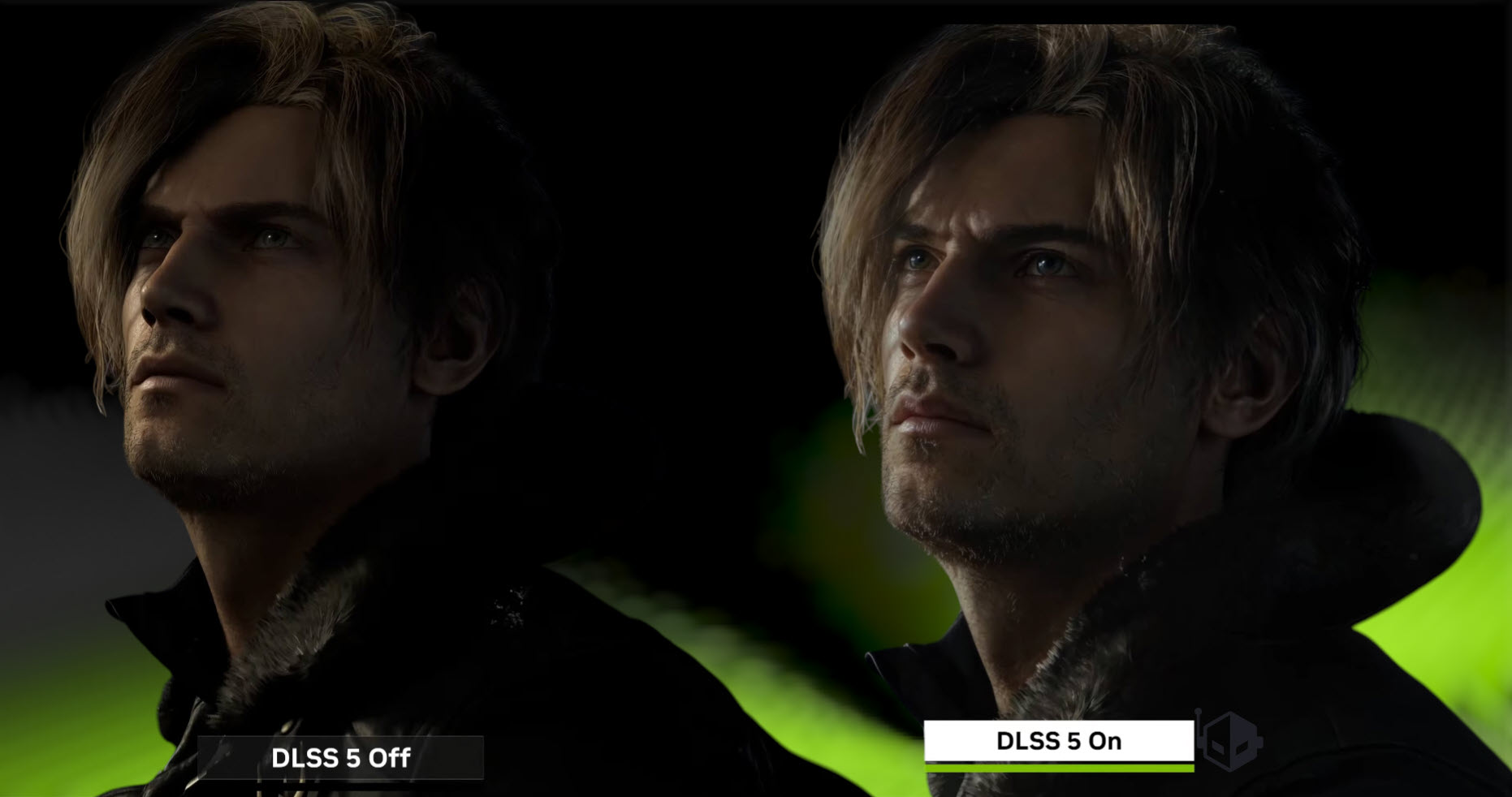
The AI model understands scene semantics: it recognizes characters, hair, fabric, translucent skin, environmental lighting conditions. It generates subsurface scattering on skin, fabric sheen, and complex light-material interactions on hair — effects that would be prohibitively expensive with traditional rendering — while keeping everything anchored to the original 3D scene structure.
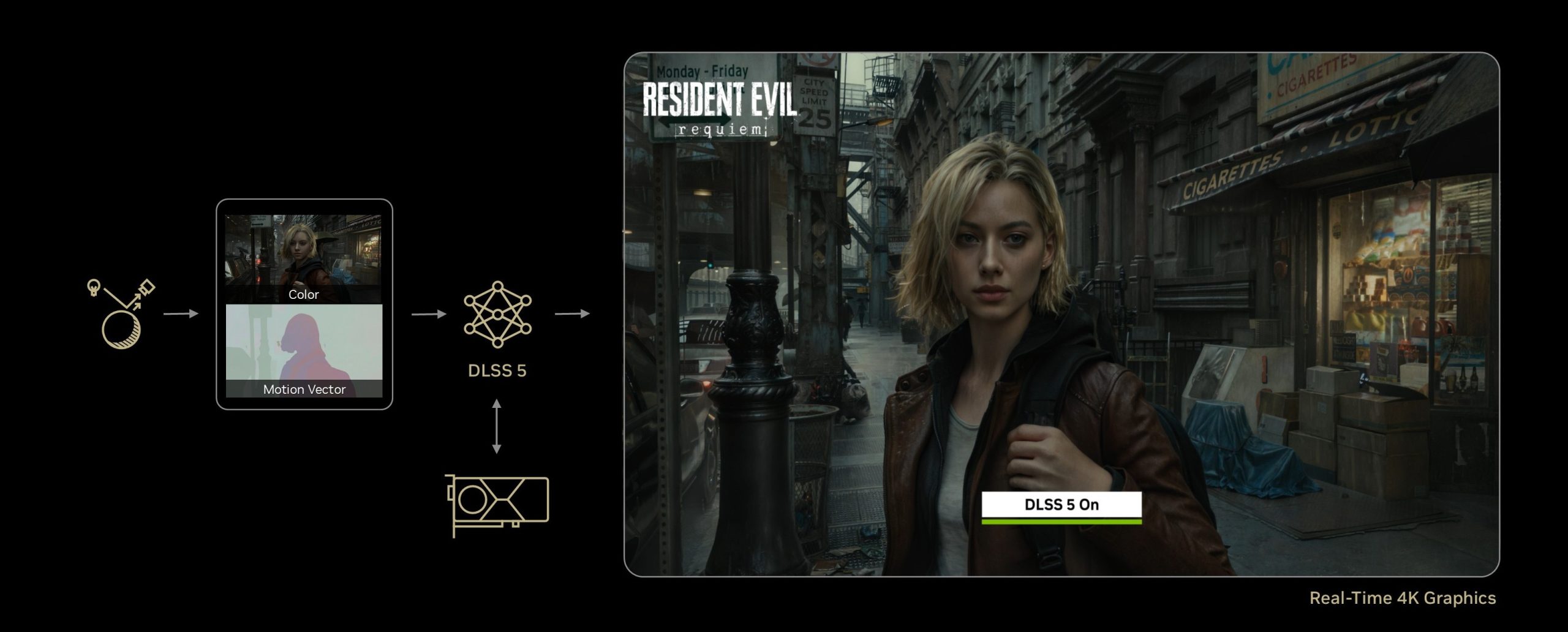
The result runs at up to 4K resolution in real time for smooth, interactive gameplay. This is not a post-processing filter — it’s generative AI embedded directly into the rendering pipeline.
Why This Is a Big Deal
For years, achieving photorealism in real-time graphics meant throwing more compute at ray tracing, path tracing, and physically-based rendering. DLSS 5 takes a radically different approach: let the neural network learn what photorealistic lighting looks like and generate it on the fly, anchored to the 3D scene’s structure.
This has massive implications beyond gaming. Think architectural visualization with instant photorealistic walkthroughs. Think film previsualization at final-render quality. Think 3D artists getting cinema-grade lighting on their viewport in real time. The boundary between “game engine” and “offline renderer” just got a lot blurrier.
Developer Control
DLSS 5 isn’t a black box that overrides art direction. Developers get detailed controls for intensity, color grading, and masking — they can fine-tune blending, contrast, saturation, and gamma to match their game’s visual identity. Integration happens through NVIDIA’s existing Streamline framework, which means studios already using DLSS 4 have a clear upgrade path.
Who’s On Board
Major publishers are already committed: Bethesda, CAPCOM, Tencent, Ubisoft, Warner Bros. Games, and more. Confirmed titles include heavy hitters like Starfield, Hogwarts Legacy, Assassin’s Creed Shadows, Resident Evil Requiem, Phantom Blade Zero, Delta Force, and The Elder Scrolls IV: Oblivion Remastered.
DLSS 5 launches this fall 2026, optimized for RTX 50 series GPUs at launch.
Why You Should Care
DLSS 5 signals that generative AI is no longer just about creating images from text prompts — it’s becoming a core component of real-time 3D rendering itself. For anyone working in 3D — game developers, arch-viz professionals, VFX artists, digital creators — this collapses the gap between real-time and offline rendering quality. The creative tools we use daily are about to look very different.
This also validates a direction that matters for the broader AI-powered creative ecosystem: neural networks that understand 3D scenes rather than just generating 2D images. That’s the foundation for everything from better AI 3D generation to smarter world simulation.
Try It / Learn More
- NVIDIA DLSS 5 Official Announcement
- GTC 2026 Live Updates — NVIDIA Blog
- Jensen Huang GTC 2026 Keynote (Full Video)
- TechCrunch Deep Dive on DLSS 5
IK3D Lab Take
This is genuinely exciting. DLSS 5 isn’t just another version bump — it’s a philosophical shift in how real-time graphics work. The idea that a neural network can understand your scene and generate physically plausible lighting on the fly is wild. The catch? It’s RTX 50 series at launch, and we’ll need to see how it handles edge cases and artistic styles beyond photorealism. But if it delivers on even half of the GTC demo quality, it’s going to reshape how every 3D artist thinks about their rendering pipeline.