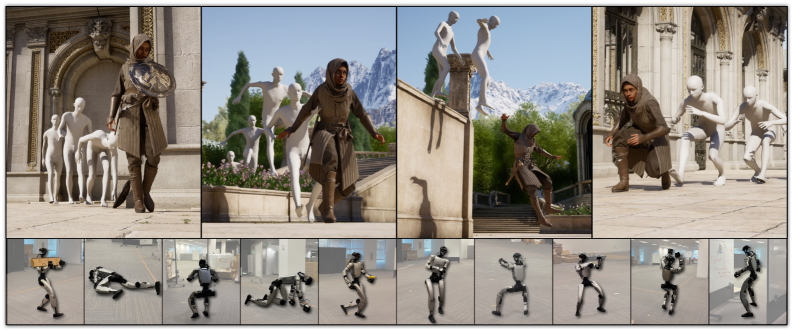
NVIDIA just dropped a motion model that generates 15,000 frames of character animation per second. Same model, one neural net, and it drives both a game character and a real humanoid robot. Welcome to MotionBricks.
The Story
For 20 years, game studios have leaned on motion matching: a giant library of mocap clips that the engine searches and blends at runtime. It looks great. But it can only replay what’s in the database. Ask for a transition it never recorded, and it fakes it badly.
MotionBricks throws that out. It’s a generative motion model, unveiled at SIGGRAPH 2026 by a team from NVIDIA, ETH Zürich, Simon Fraser and UT Austin. Instead of retrieving clips, it synthesizes new motion on the fly, respecting whatever constraints you give it.
The scale is the headline. It was trained on 350,000+ motion clips — about 700 hours, 9,300 distinct skills, 163 performers. And it runs at 15,000 FPS with a 2ms latency on an RTX 5090. That’s not a typo. It’s fast enough that motion is basically free.
How It Actually Works
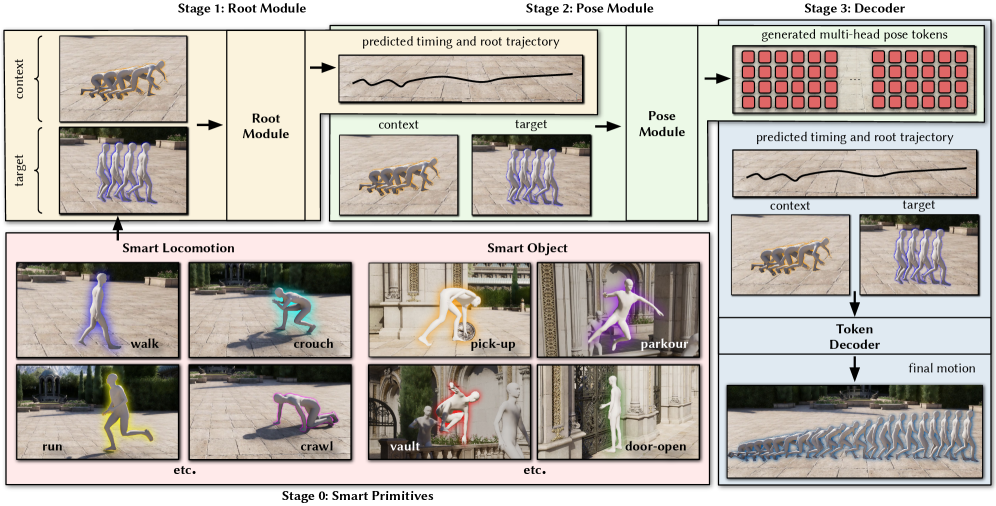
Two layers stacked together. Down below sits a modular latent backbone. A tokenizer squashes motion into discrete tokens, then a 150M-parameter transformer predicts the pose tokens in a single forward pass — no slow, iterative diffusion sampling. That’s where the speed comes from.
Up top sit the smart primitives. These are the human-friendly controls. Smart locomotion turns a velocity, a heading and a style into keyframes. Smart object stores how to approach and grab a thing. So you say “jump over this bench” or “pick up this sword,” drop a couple of keyframes, and the AI fills in every natural in-between frame itself.
Think of it as auto-complete for animation. You give the intent; MotionBricks writes the motion.
Why You Should Care
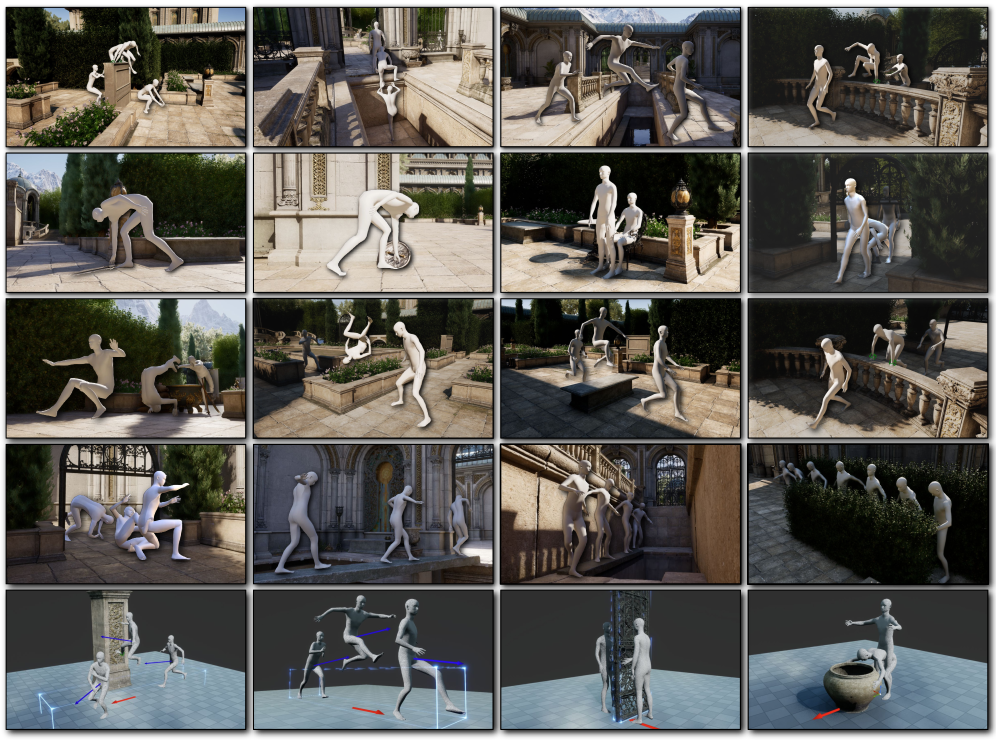
If you build games, this is a plausible replacement for hand-tuned animation state machines. Fewer clips to record, fewer transitions to babysit, and novel movements you never captured — all at runtime cost near zero. It already retargets to characters in Unreal Engine 5.
If you’re into robotics or embodied AI, here’s the wild part: the same model that animates the screen character also drives a real Unitree G1 humanoid. On a Jetson Orin it runs a pass in 5ms. MotionBricks is a core piece of NVIDIA’s GR00T Whole-Body Control project. The line between animating a character and controlling a robot just got very thin.
For 3D artists, the takeaway is the same one we keep hitting in the Lab: the tedious middle of the pipeline is dissolving. First it was geometry, then rigging, then texturing. Now it’s the in-between frames.
Try It / Follow Them
MotionBricks ships as an initial public release: interactive demo, pretrained checkpoints and the synthetic training pipeline. Go poke at it.
- Project page & interactive demo
- The paper (arXiv 2604.24833) — ACM TOG / SIGGRAPH 2026
- GitHub — GR00T Whole-Body Control / MotionBricks
IK3D Lab Take
Motion matching had a 20-year run. MotionBricks looks like the thing that ends it. What sells us isn’t the 15,000 FPS number, impressive as it is — it’s that one model bridges the screen and the physical robot. That’s the same convergence we saw when Gaussian splats jumped from research to every DCC. Animation is next. Grab the demo before your competitors do.

Quality content right here. Appreciate it. useful tool
This answered a question I’ve had for a while. Thanks! helpful site
Appreciate the detailed breakdown here. this one
This is exactly what I was looking for, thanks! see here
This is super helpful, thanks for the effort! worth a look