Here is a heretical idea for generative 3D: stop asking a neural network to invent your world, and let a coding agent write it instead. Hand the video model a rough draft — the geometry, the motion, the camera path, already pinned down in code — and ask it to do one job: make it look real. A new benchmark called WorldDraft takes that split seriously, and the results are a reality check for anyone betting on text-to-video as a world engine.
The Story
WorldDraft (arXiv:2611.16217, posted 12 November 2026) starts from a simple observation. Multimodal coding agents are getting good at building structured 4D scenes — objects, trajectories, timing, camera moves — directly as executable code. That code is a precise, editable “draft” of a world. So why force a video diffusion model to hallucinate the whole thing from a text prompt? Let the agent own the structure, and let the video model own the pixels.
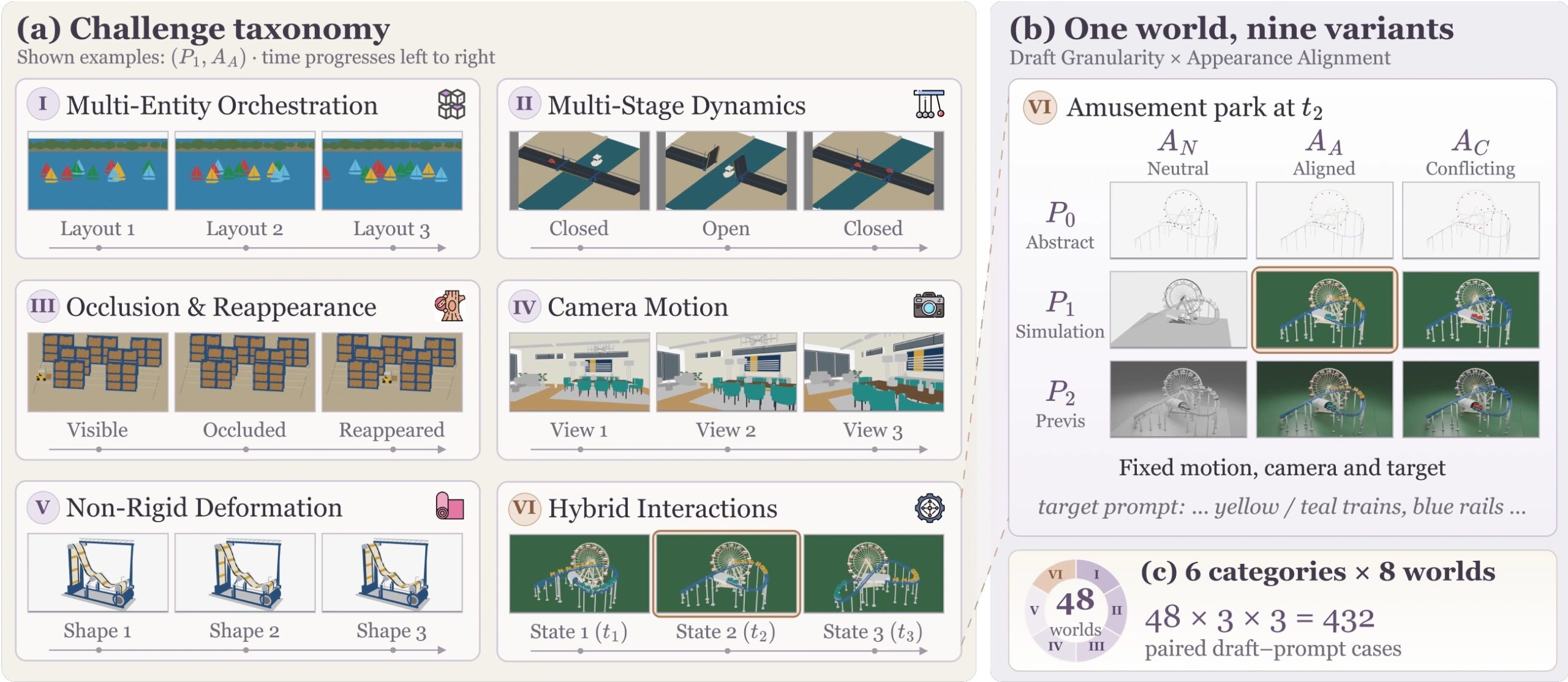
To test whether video models can actually play that rendering role, the authors built a benchmark. It covers 48 executable 4D world families spread over six dynamic challenge categories, and pairs each world with drafts along two axes. One axis is how detailed the draft is: from an abstract sketch, to a physics-style simulation, to a full previs. The other is how the reference appearance relates to the target: neutral, aligned, or deliberately conflicting. That 3×3 design yields 432 paired test cases.
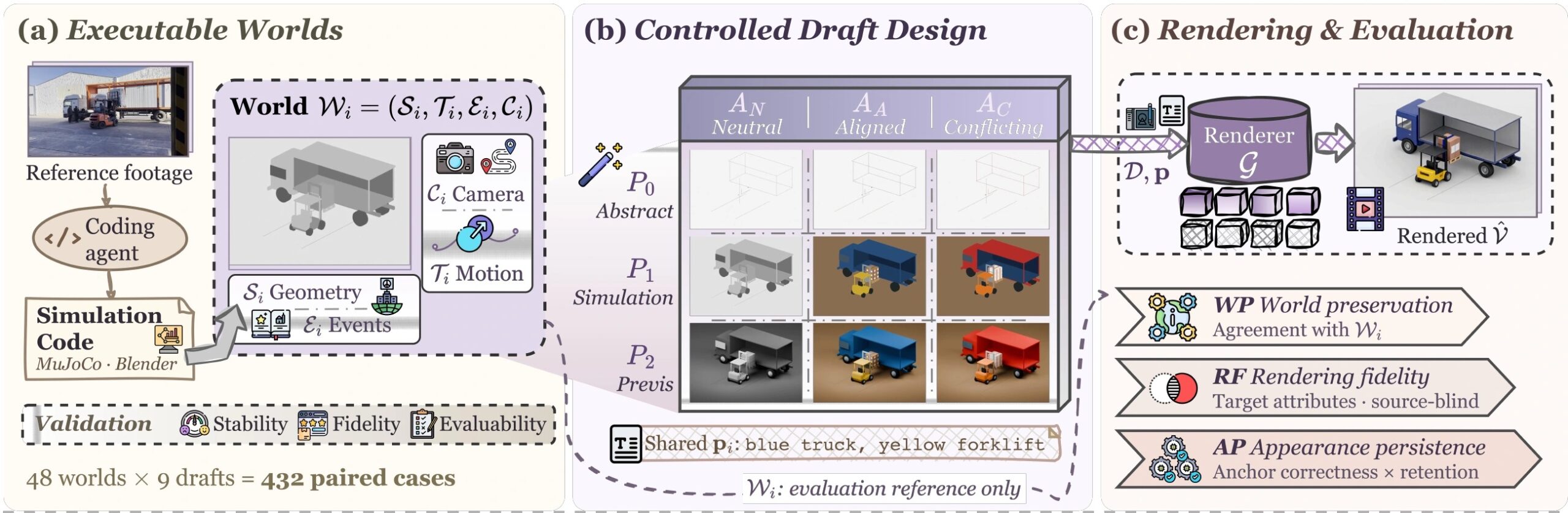
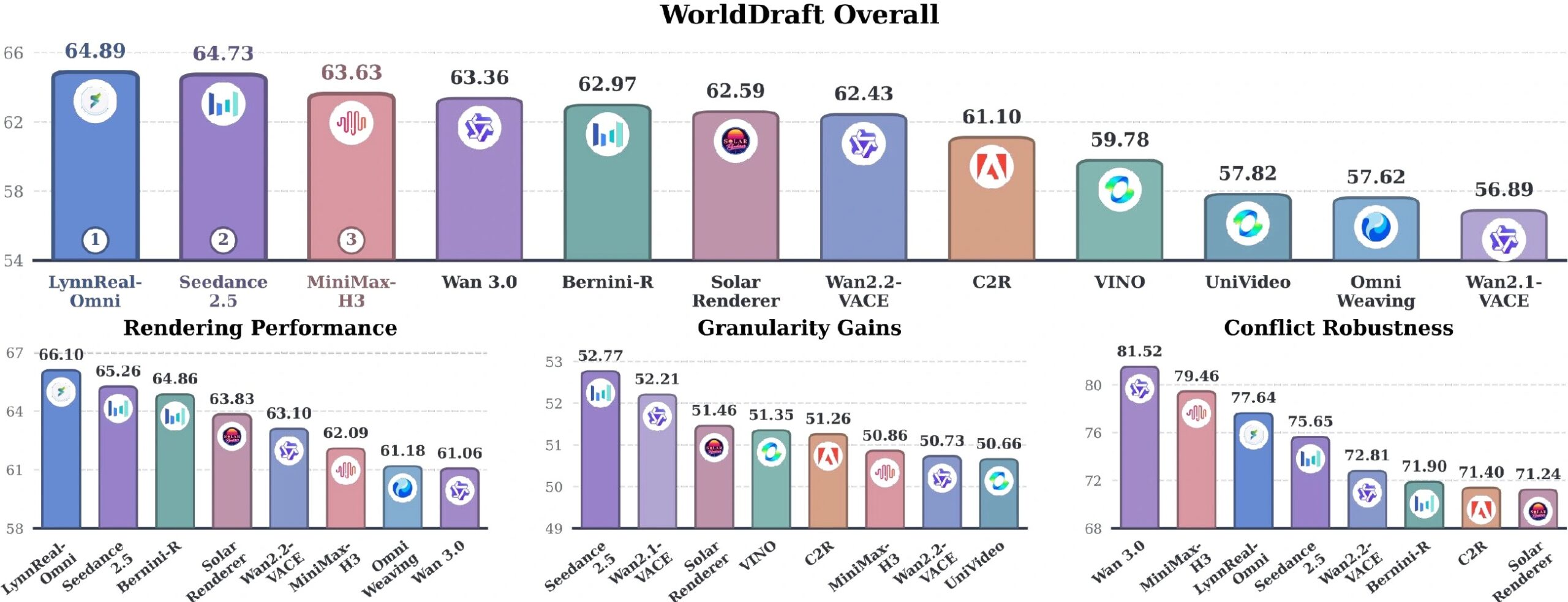
The benchmark judges two things that turn out to fight each other. First, world preservation: does the rendered video keep the prescribed motion and camera paths? Second, appearance fidelity: does it apply the text-specified look consistently across every frame? The team ran 12 video models through all of it and scored them on rendering performance, gains from richer drafts, and robustness when the cues conflict.
Why You Should Care
The headline finding is a tension, not a victory lap. Structure preservation and visual realization pull against each other. Give a model a richer scaffold and its structure improves — but its appearance fidelity can get worse. And when the draft’s look conflicts with the target prompt, models leak the wrong appearance badly: the paper reports source leakage of up to 64%. In plain terms, the reference image bleeds into a shot where it was never supposed to be.
If you have ever tried to art-direct an AI video — lock the blocking, then restyle it — you have felt this exact failure. You nail the camera move, and the material look drifts. You fix the look, and the motion goes soft. WorldDraft is the first benchmark that isolates and measures that trade-off instead of hand-waving it. For a 3D or game pipeline, that’s the difference between “neat demo” and “tool I can actually schedule shots around.”
There is also a fix on offer. The authors propose WorldDraft-Primer, a plug-and-play visual prompting method that improves both world preservation and appearance fidelity across frozen video renderers — no retraining required. That matters because it means the draft-to-video idea isn’t just a critique; it comes with a lever you can pull on models you already use.
Try It / Follow Them
This is a benchmark and a method, not a one-click app, so “trying it” means reading the paper and pulling the data. Everything is public:
- Paper: arXiv:2611.16217
- Project page: haroldchen19.github.io/WorldDraft-site
- Code: github.com/KevinHuge/WorldDraft
- Dataset: Hugging Face: KevinHuge/WorldDraft
The work is credited to Zhiyu Hou, Wen-Jie Shu, Harold Haodong Chen, Weilin Ruan, Chenfei Liao, Liuzhou Zhang, Disen Lan, Xiaogang Xu, Qi Chen and Ser-Nam Lim. The paper page does not list author affiliations, so we are not naming any.
IK3D Lab Take
We did not run the benchmark ourselves — this is a read of the paper and the project page, not a hands-on test, and we are flagging that plainly. What we can judge is the framing, and the framing is the best part. “Let code build the world, let the video model render it” is exactly the division of labor the generative-3D space has been circling for a year. It turns the video model from an unreliable dreamer into a controllable renderer, which is what a production pipeline actually needs.
Who should care right now: anyone building agent-driven previs, virtual production, or procedural game cinematics, where the geometry and camera are already yours and you just want a photoreal pass. What it replaces: nothing yet — WorldDraft measures a gap more than it closes one. Where it breaks: the moment your reference look and your target prompt disagree, the 64% leakage number says today’s renderers will betray you. WorldDraft-Primer is the interesting hedge, but we would want to see it tested outside the authors’ own benchmark before trusting it in a shot. For now, treat this as the clearest map yet of why “just render my draft” is harder than it sounds — and a sign the field is finally asking the right question.
How this article was made: researched and drafted with AI assistance, then fact-checked against the original sources and reviewed by Issa before publication.
This WorldDraft write-up is useful if you want the video model to render a scene that is already defined, instead of inventing everything in one pass. After I have a couple of photos ready, I still look at how to turn them into a short scene, so I check I Love the Smiths AI before exporting. Do you usually start from a planned world, or from a couple of stills?