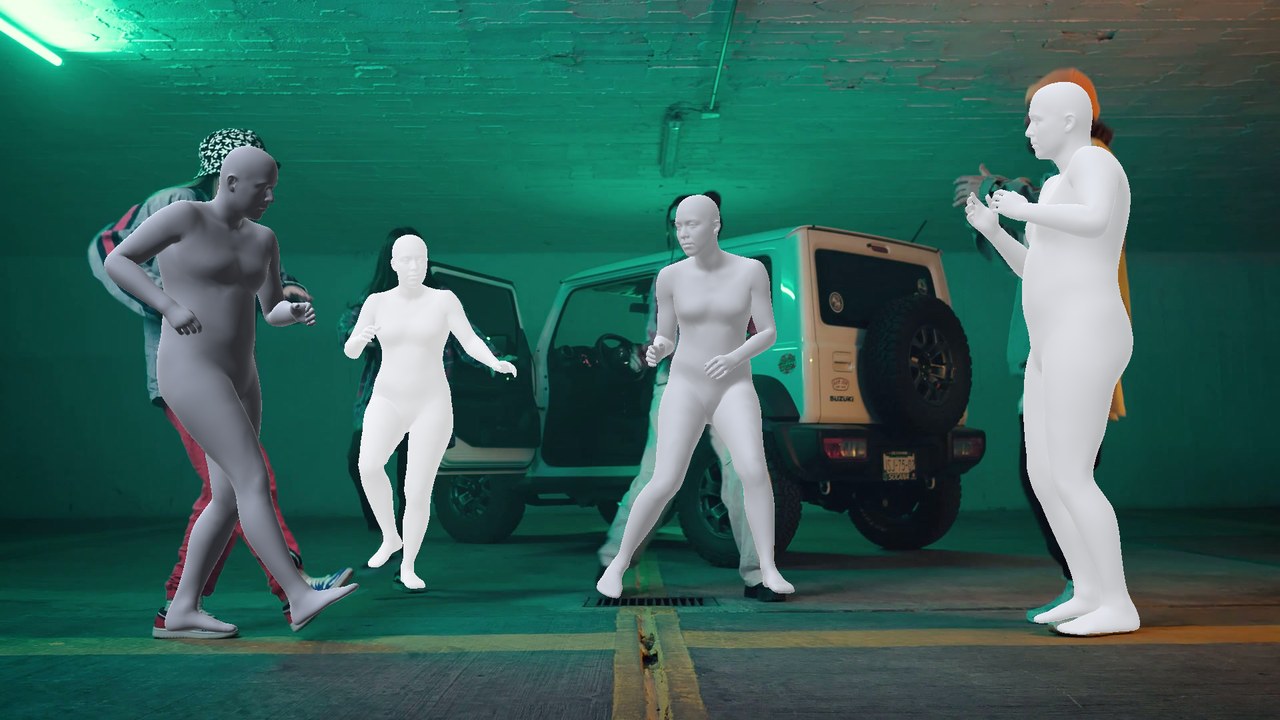
A full 3D body — pose, shape, mesh, 70 joints — pulled out of a single webcam frame in about one millisecond on a desktop GPU, and about five on a phone. No suit, no markers, no stage. InstantHMR is a 20-to-32-million-parameter model, and someone just wired it into ComfyUI with a live camera node that drives your rigged character and streams the motion straight to Blender, Unity or a VTuber app.
The Story
The model comes from a small French team — Mohamed Adjel, Kahina Chalabi and Vincent Bonnet — with compute from GENCI on the Jean Zay supercomputer. Their idea is almost stubbornly simple: human mesh recovery does not need a giant network. InstantHMR ships in five sizes, from nano (20.0M parameters) to medium (32.2M, the default). It finds each person with an RF-DETR detector, then regresses a full body in Meta’s Momentum Human Rig (MHR) format — the same rig as ComfyUI’s native SAM 3D Body.
The output is dense: an 18,439-vertex mesh, 204 pose parameters and 45 shape parameters per person. On a Galaxy S23 NPU the medium model runs the network in 5.49 ms per person; on an RTX 4070 with TensorRT, 0.98 ms. Accuracy is not a toy either — medium scores 40.0 mm PA-MPJPE on 3DPW and 48.8 mm on EMDB-1 (lower is better). Version 1.1 added a kinematic fit that refines each pose against the network’s own 2D keypoints.
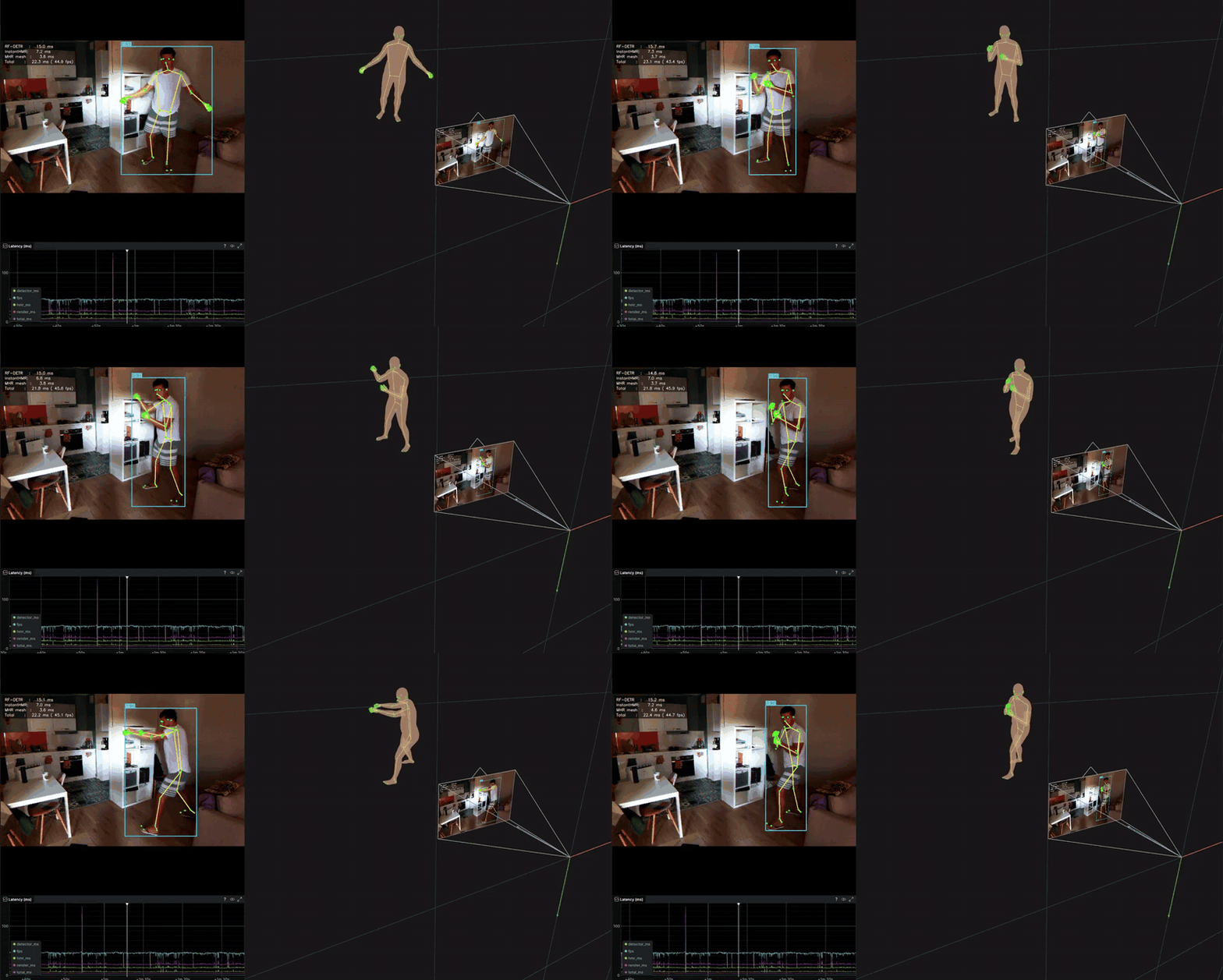
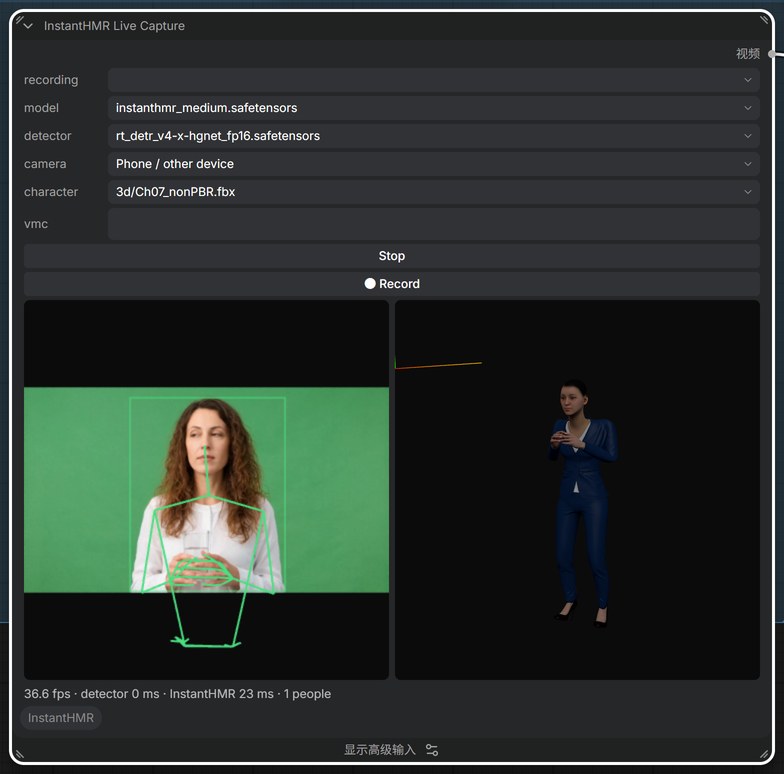
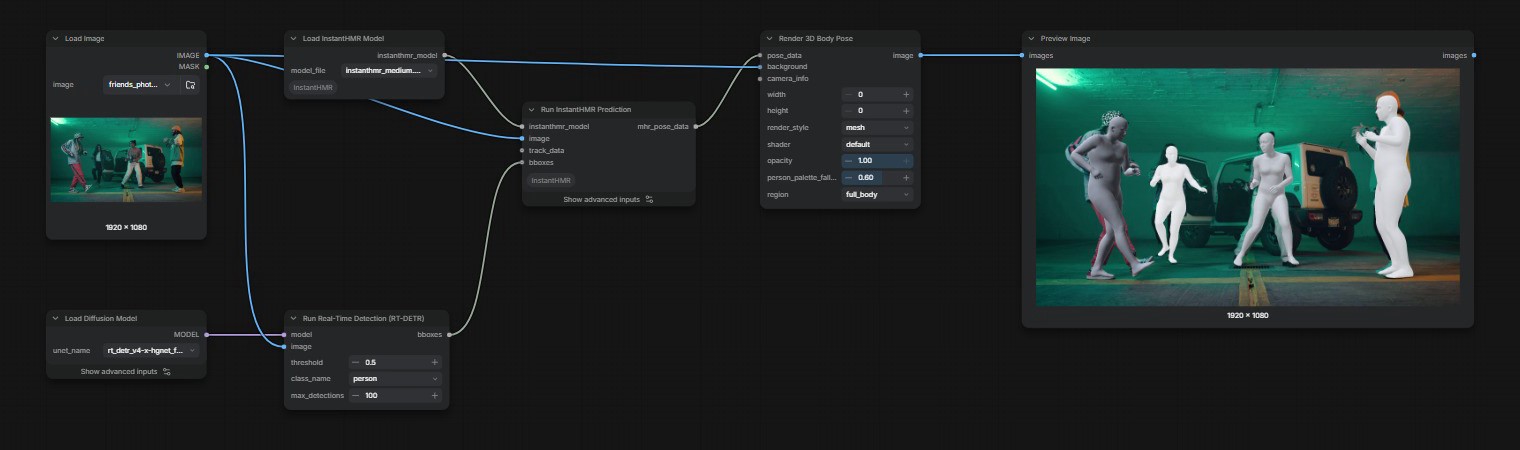
That is the research. The part that matters for makers landed on 8 November, when developer jtydhr88 released a ComfyUI node pack around it. It adds three nodes — load, predict, and a Live Capture node that opens your webcam (or a phone’s camera over a QR code on the same network) and shows the 2D skeleton and 3D body side by side while it records.
Why You Should Care
Markerless motion capture has been creeping toward “free” for years. This pushes it over the line, inside a tool 3D artists already have open. The Live Capture node takes a character file — .fbx, .glb, .gltf or .vrm — and matches bones by name (or the VRM humanoid table). It can stream the first person as a humanoid pose over the VMC protocol to VSeeFace, Warudo, VNyan, Blender (VMC Link) or Unity (VMC4U). A smoothing slider steadies the body between frames; set it to 0 for raw per-frame output, higher to trade lag for calm.
For BVH export and the mesh styles, you plug in a SAM 3D Body loader, since those paths reuse the native rig. It is not a one-click miracle — you still need ComfyUI, the weights, and a detector — but the gap between “person in front of a laptop” and “animated rig in Blender” just got very short.
Try It / Follow Them
- ComfyUI node pack: github.com/jtydhr88/ComfyUI-InstantHMR — weights on Hugging Face, placed in
models/detection. - Upstream model + paper: github.com/Naturalpad-studio/InstantHMR (HAL preprint hal-05854387).
- Phone capture: open the browser camera over HTTPS or a QR code; recordings save to
input/instanthmr_live/.
IK3D Lab Take
We have not run this one in the viewport yet, so treat the numbers as the authors’ and the node behavior as read off its README, not as a Lab benchmark. But on paper this is the kind of release we love: tiny, fast, honest, and built to plug into pipelines people already use. If you make VTuber content, previz, or indie game animation, the webcam-to-VMC path alone is worth an evening.
The one real catch is licensing, and it is not small. Code is Apache-2.0, but the weights are under Meta’s SAM License because they inherit SAM 3D Body data and checkpoint parts. Only the medium_commercial model is cleared for commercial use — and it trades accuracy for that freedom (50.7 mm vs 40.0 mm on 3DPW). So: a brilliant free tool for learning, personal projects and R&D; read the license carefully before anything ships for money.
How this article was made: researched and drafted with AI assistance, then fact-checked against the original sources and reviewed by Issa before publication.