Every feed-forward splat model shares a dirty secret: it quietly assumes your scene is about the size it trained on. Point it at a tabletop, then at a city block, and the Gaussians fall apart. A new paper from the ZJU3DV group argues the whole field has been normalizing the wrong number — and fixing it is almost embarrassingly simple.
The Story
SplatAnything — full title Gaussian Spacing Normalization for Feed-forward 3DGS across Arbitrary Scenes — landed on arXiv (2611.08264) on November 5, 2026, with a revision on November 8. The authors are Hao Yu, Zhenwei Wang, Yongzhen Hu, Yuning Gong, Junta Wu, Xiaowei Zhou, Hujun Bao, Tengfei Wang, Chunchao Guo and Sida Peng. It is the third entry in the lab’s InfiniSplat series.
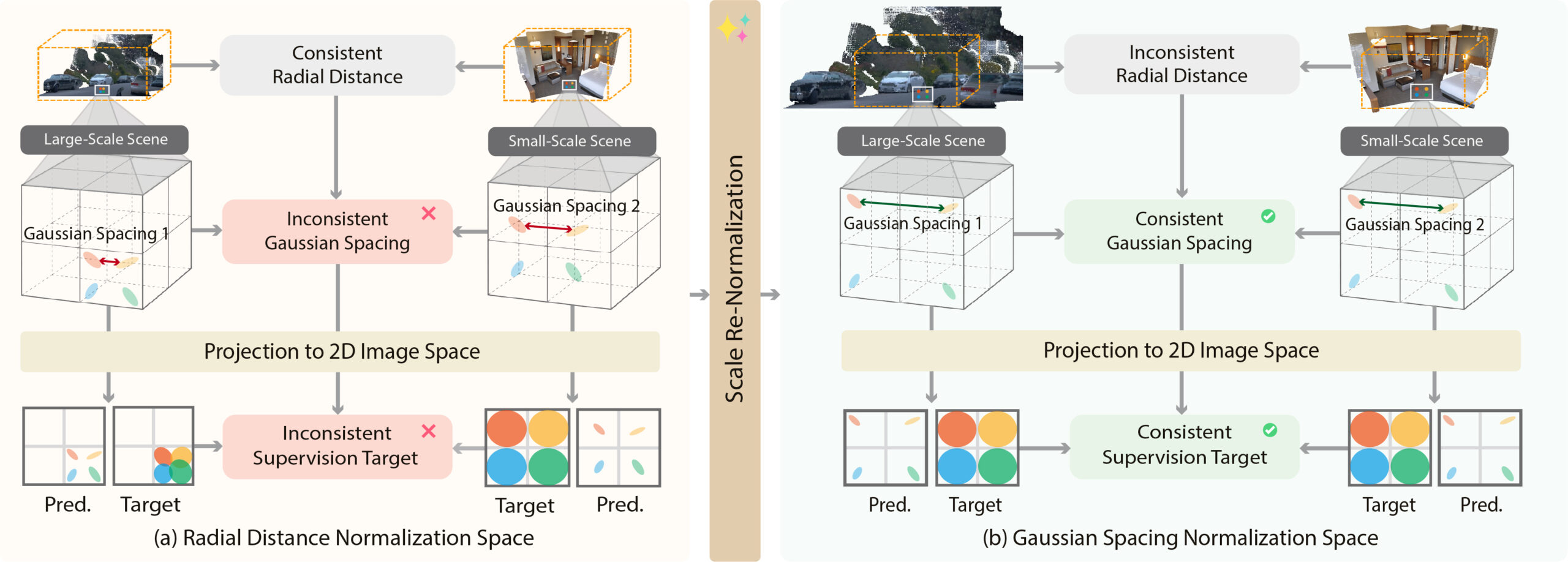
Here is the problem it chews on. A feed-forward 3D Gaussian Splatting model takes a handful of photos and spits out a full splat in one forward pass — no per-scene optimization, no waiting. To make that work, the network has to predict the size of each Gaussian. And to keep training stable, everyone normalizes those sizes by a global statistic: roughly, the radial distance from the camera to the scene.
The authors say that statistic lies. Radial distance tells you how far the scene is, not how densely the Gaussians are packed. A sparse 10-photo capture and a dense 100-photo capture of the same room need very different Gaussian scales, yet the old normalization hands them the same target. The result: shifted scale targets, ambiguous supervision, and splats that under-cover thin surfaces or pile up into blurry overlap when the scene scale drifts from training.

Their fix is Gaussian Spacing Normalization (GSNorm). Instead of the camera-distance statistic, they normalize by a robust, scene-level measure of how far apart neighboring Gaussian centers sit — the median spacing between them. That number travels with the actual geometry, so it stays meaningful whether you fed the model a desk or a drone flight over a village.
The pipeline around it is lean. A frozen geometry foundation model estimates the multi-view geometry first. That geometry is converted into the spacing-normalized space, and only then does a Gaussian backbone plus a lightweight head (“GShead”) predict the per-pixel Gaussian attributes. The heavy geometry brain is reused, not retrained; the splat-specific part is small.
Why You Should Care
The InfiniSplat series is built as a ladder, and SplatAnything is the top rung. v1 builds a splat from a single RGB image, optionally guided by LiDAR depth. v2 takes multiple images, with or without known camera poses, and ships COLMAP and 360° panorama guides. v3 (SplatAnything) removes the last constraints: arbitrary numbers of images, at arbitrary scene scales.
For anyone who captures real places — architects, VFX scouts, game-environment artists — that “arbitrary scale” claim is the whole point. The recurring pain of feed-forward splat tools is that a method tuned on object scans chokes on a building, and vice versa. If one model genuinely holds up from tabletop to aerial without retraining, that is one fewer tool to juggle. The authors report state-of-the-art results, and say the gap is largest exactly where it hurts: big changes in scene scale and extrapolated viewpoints.
One honest caveat up front: the project page shows qualitative viewers, not numbers. The quantitative tables live in the arXiv PDF, and the public page does not list the metrics or the named baselines — so treat “state-of-the-art” as the authors’ claim pending a read of the paper, not something we re-measured.
Try It / Follow Them
This one is actually runnable today. The code is on GitHub at zju3dv/InfiniSplat (591 stars at the time of writing), with v3 pulled in as a Git submodule — git submodule update --init InfiniSplat_v3, then follow the SplatAnything install guide. Pretrained weights for v3 are on Hugging Face at ritianyu/SplatAnything (v2 weights at Edisoneh/InfiniSplat-v2), and the repo links a Hugging Face demo for each version.
Read the license before you plug it into anything. InfiniSplat uses the Project Registration License (PRL) v1.0: free for academic research, education, evaluation and personal use with no registration — but organizations must register the project first, including for non-commercial and internal work. v3 follows the SplatAnything repository’s own license. If you are a studio, that registration step is not optional.
IK3D Lab Take
We did not run SplatAnything for this piece — no local benchmark, no weights pulled, no scene of our own put through it. What we did was read the paper, the project page and the repo, and the idea is the kind the Lab loves: not a bigger model, a better-posed one. “Normalize by neighbor spacing, not camera distance” is the sort of one-line insight that, if it holds, quietly fixes a class of failures nobody had named cleanly.
Where we expect it to bite: very sparse captures (the 3-to-5-photo case), thin or reflective surfaces, and the honesty gap between glossy project-page viewers and your own messy phone footage. And the PRL license will make some teams walk — “register before internal use” is friction a permissive MIT repo doesn’t have. But as a free, code-available, weights-available feed-forward splatter that claims to not care about scene scale, it earns a spot on the test bench. If you capture spaces for a living, clone it, feed it one scene that always broke your last tool, and judge the viewer with your own eyes. That is the only benchmark that matters here.
How this article was made: researched and drafted with AI assistance, then fact-checked against the original sources and reviewed by Issa before publication.

I stumbled on this paper while scrolling and it actually fixed a problem I didn’t even know I had. The authors are right – every feed-forward splat model I’ve tried assumes your scene is roughly the same size as the training data. Point it at something tiny or massive, and those Gaussians just fall apart. This ‘Gaussian Spacing Normalization’ fix sounds embarrassingly simple but seems to actually work across different scales. Game-changing for real-world 3DGS applications. Wonderhop