A big-budget movie just used Gaussian splats to play a character, not a background. In Superman, the holographic message from Superman’s Kryptonian parents is a real human performance captured as splats. Framestore just told us, in a 54-minute talk, exactly how they pulled it off — and where the whole thing nearly fell apart.
The Story
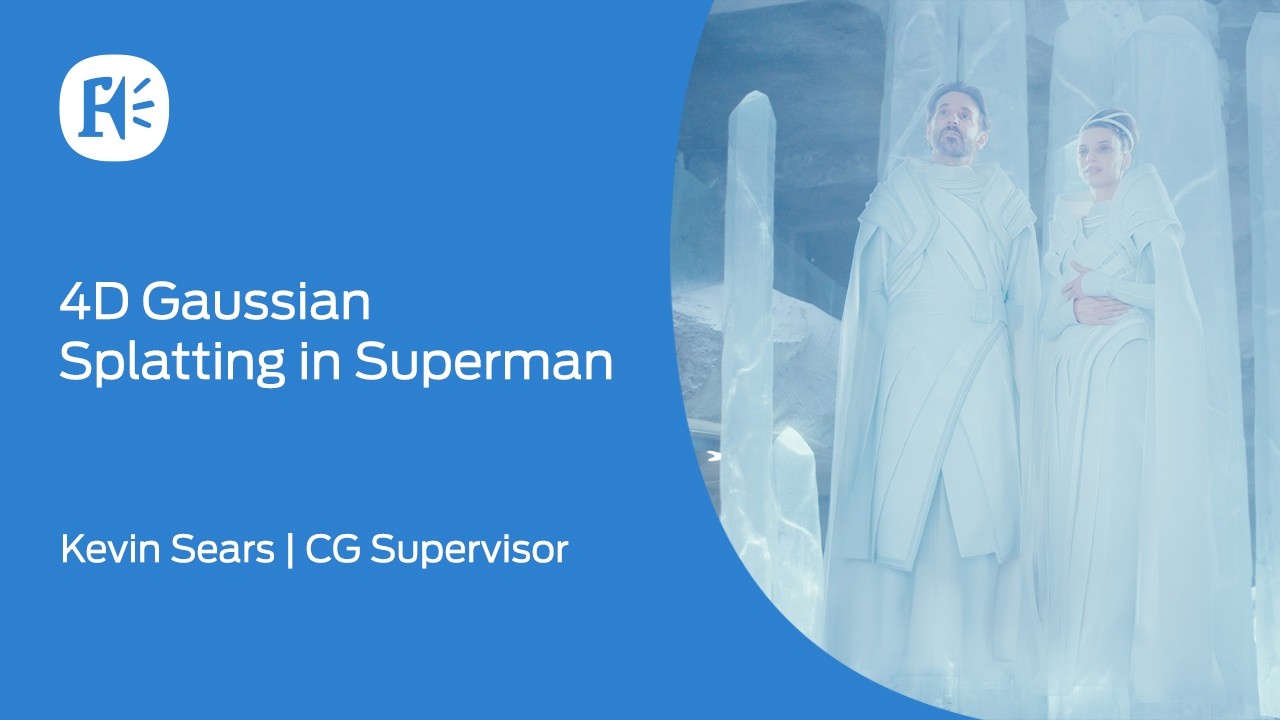
The Lab has covered splats as scans of places for two years. This is different. For the first time in a feature film, a moving actor performance was turned into a 4D Gaussian splat and shown on screen as a character. Kevin Sears, a CG Supervisor at Framestore Montreal, ran the pipeline. He gave the breakdown as a webinar on September 22, then posted the full talk to YouTube on October 21.
Why splats and not a classic digital double? The holograms change size from shot to shot, and the camera could not be locked early. So a normal filmed plate could not be composited in. Framestore VFX Supervisor Stephane Naze said it was easier to get a believable, unstable hologram this way than by building a CG human from scratch.

How They Built It
The capture happened in August 2024 in Ipswich, with James Gunn supervising remotely. Infinite Realities ran the rig: 192 cameras shooting 12-megapixel frames at 24 fps, in a volume about the size of a small bedroom. Sears said it was the first time they had squeezed two performers that close together. The client picked one take of about 88 seconds and cut every shot from it — roughly 2,000 frames per camera, just over 400,000 images, about 5 TB of data per take.
Training ran in Postshot across 20 nodes of RTX 4090 GPUs. Each frame resolved to around 1.6 million splats. The first results flickered badly around faces, hair, and the white costumes; a longer retrain of several more hours per frame calmed it down. The look lands in about 30 shots across the film.
Here is the honest part. At the time, nothing in the pipeline wanted to do this. Postshot could not load animated cameras. Houdini did not read splats natively. Nuke had no splat plugin. There was no relighting. So the team improvised: a constraint system baked one render camera per splat cluster, Sears rendered every frame himself through a command-line batch on Inria’s SIBR viewer, and the FX team used CG Nomads’ GSOPs to push splats through a newer Houdini. Output was 4K PNG frames, cleaned up with heavy grading and temporal denoising in comp — because each frame was trained alone, with no coherence between them.
Why You Should Care
This is the first time the tech the Lab tracks every week shipped in a tentpole film as a performing character. It is proof that radiance fields are production-ready for more than static environments. And it is a map of every pothole: no relighting, no temporal coherence, no native tools at the time. If you are experimenting with 4D splats, this talk tells you which walls you will hit before you hit them.
It also dates fast in a good way. Sears himself says Houdini and Nuke now load splats natively, and he would not necessarily rebuild this exact workflow today. In one year, a heroic hack became something close to a button.
Try It / Follow Them
- Watch the full breakdown: 4D Gaussian Splatting in Superman | Framestore
- Train your own splats in Postshot (Jawset), the same tool Framestore used.
- Move splats through Houdini with GSOPs by CG Nomads (open source) — the Lab covered this one before.
- Read the capture side at Infinite Realities.
IK3D Lab Take
We did not run this pipeline — we watched the talk and cross-checked it against Framestore’s own pages and the VIEW Conference interview. So take this as a read, not a test. What stands out: Framestore won by choosing a hard-to-fake effect (an unstable, glitchy hologram) where splat flicker is a feature, not a bug. That is the real lesson for makers. Do not use splats where you need a clean, relightable CG human — use them where imperfection sells the shot. Where it breaks: no relighting and no temporal coherence meant brute-force rendering and heavy comp cleanup. If your project needs splats lit into a scene, you are still on your own. For ghosts, holograms, memories, and anything that should shimmer, this is now a proven path.
How this article was made: researched and drafted with AI assistance, then fact-checked against the original sources and reviewed by Issa before publication.