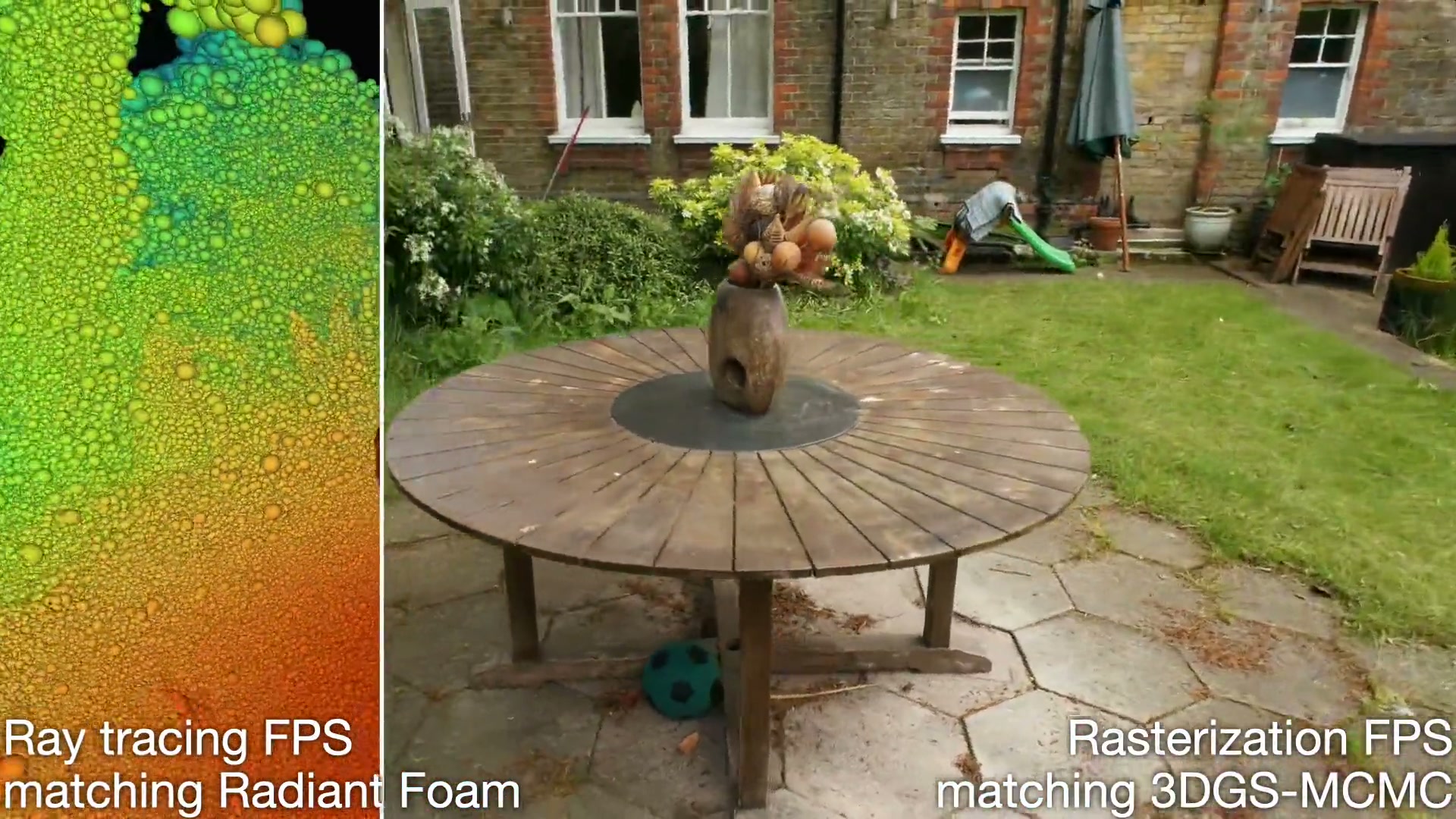
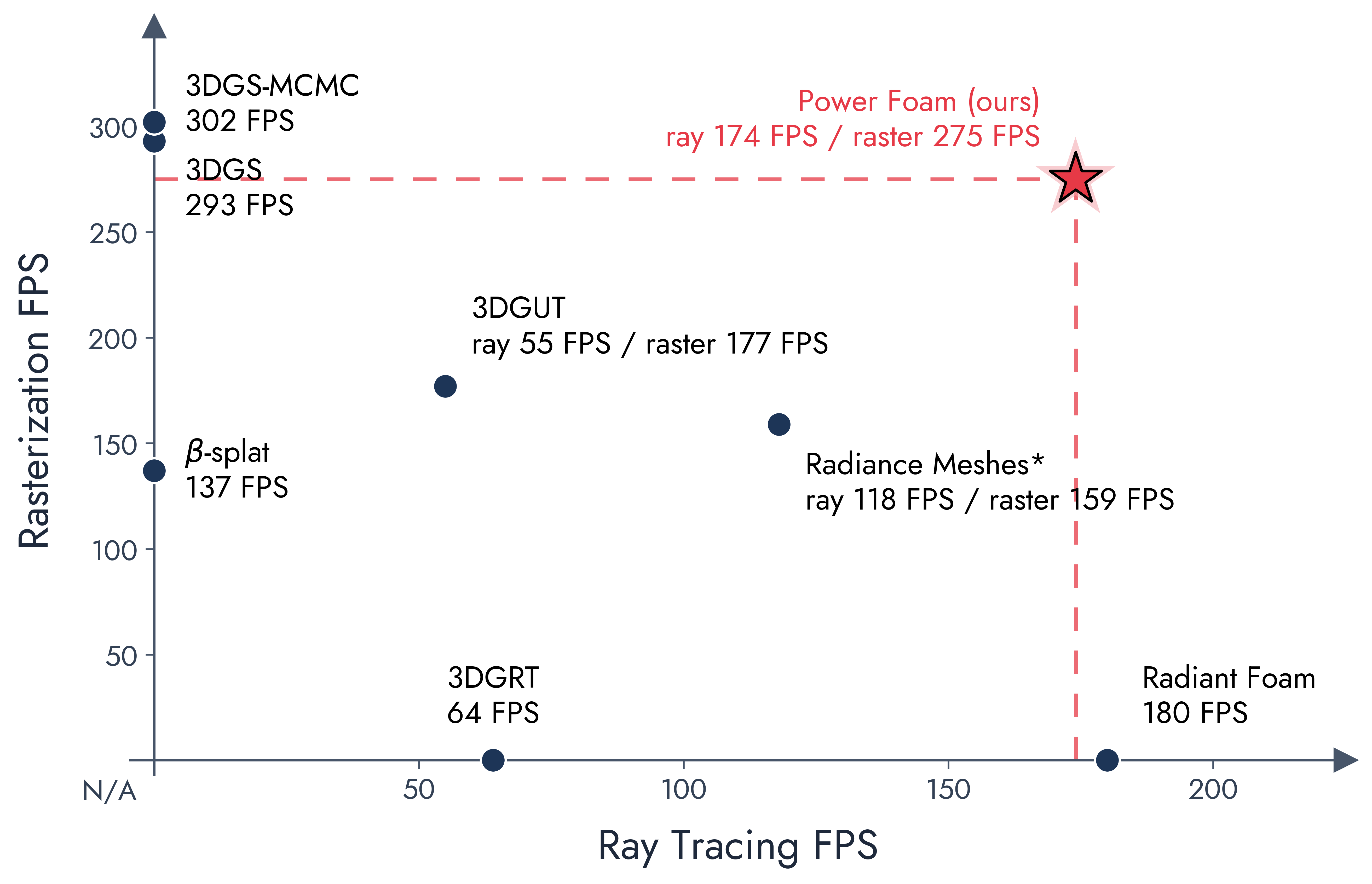
Since 3DGS dropped, the radiance field world has lived in two camps that refused to talk to each other: rasterizers (fast, splatty, bounded) and ray tracers (slow-but-correct, beautiful reflections, unbounded). On April 27, the Theia Lab crew at SFU/UBC and Google DeepMind dropped Power Foam — a single representation that does both, on the same trained model, with a flip of a switch. 275 FPS in raster mode. 174 FPS while ray-tracing reflections off a chrome sphere. Same scene. Same weights.
The Story
The team behind Power Foam — Shrisudhan Govindarajan, Daniel Rebain, Dor Verbin, Kwang Moo Yi, Anish Prabhu and Andrea Tagliasacchi — shipped Radiant Foam last year and stunned everyone by ray-tracing radiance fields at hundreds of FPS without RT cores. Cool. The catch: their Voronoi-cell foam was potentially unbounded, so tile-based rasterizers (the trick that makes 3DGS so fast) couldn’t touch it. You had to pick a lane.
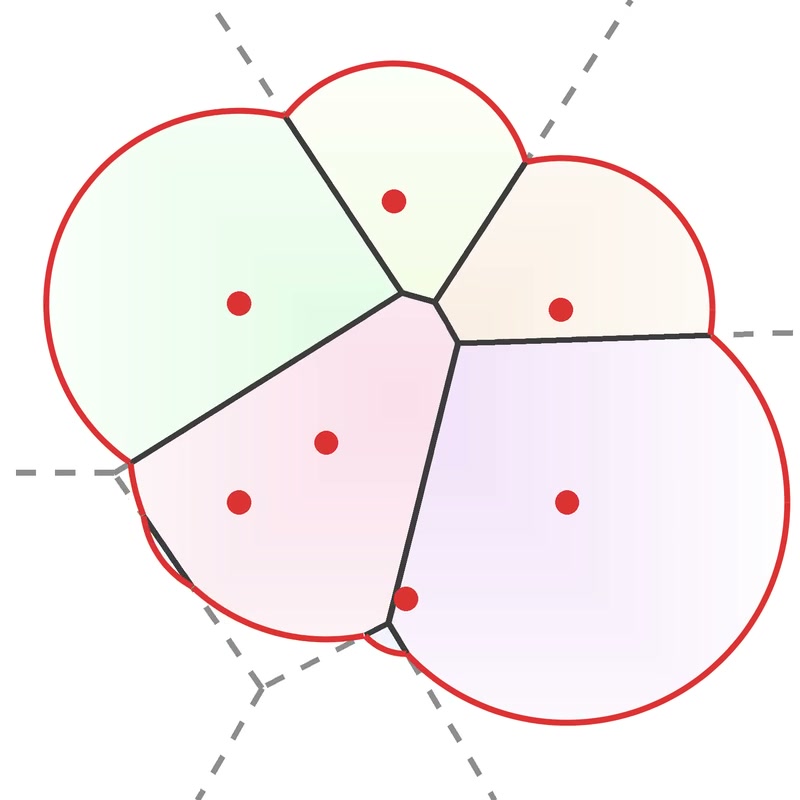
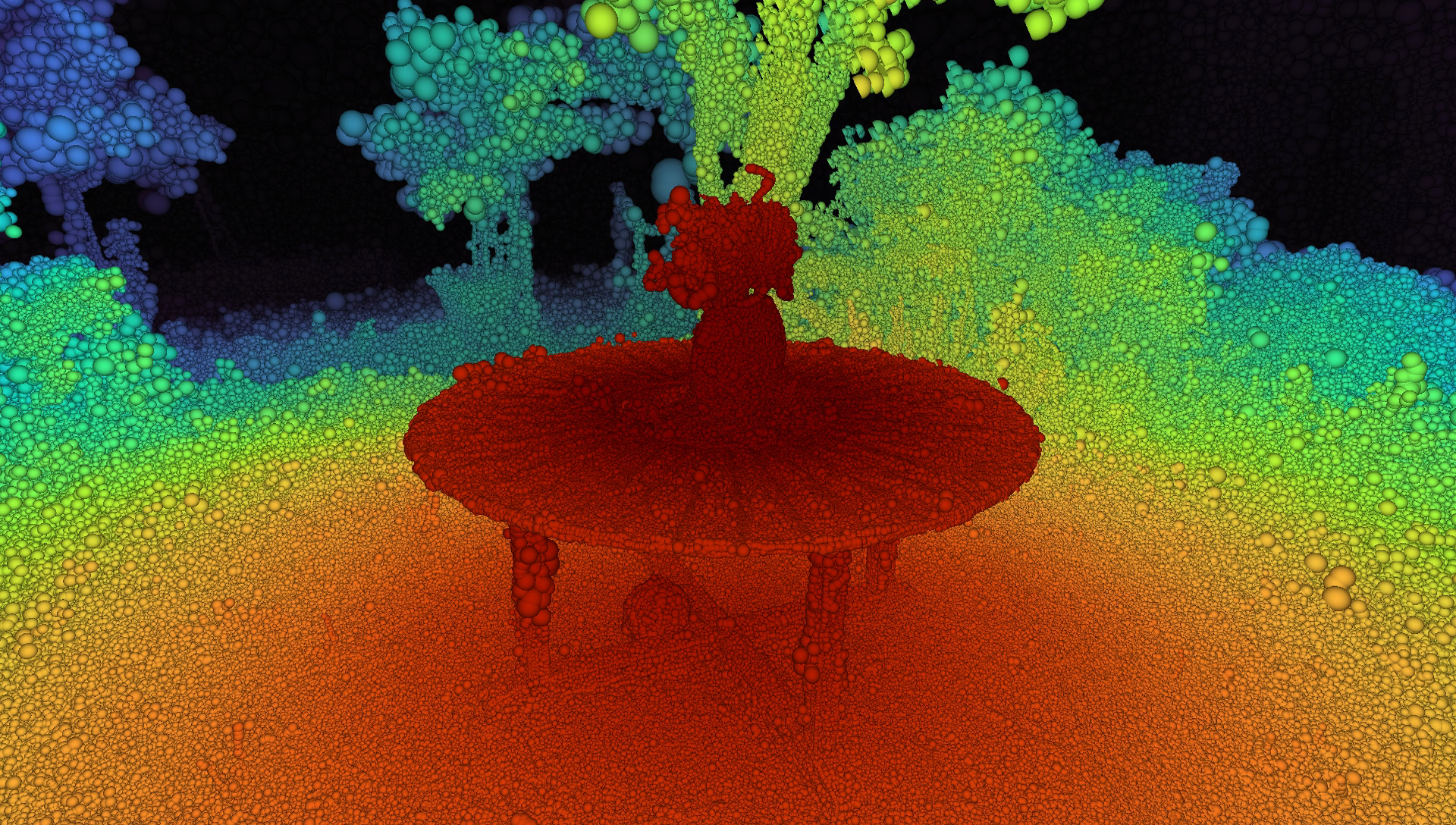
Power Foam’s move is mathematically elegant and visually obvious in hindsight: replace Voronoi cells with power diagrams. Each cell now carries an associated radius that explicitly controls its spatial extent. Bounded cells = rasterizable. The cells are still convex polytopes you can shoot a ray through in constant time. So the same scene representation now feeds both pipelines, mode-switched on demand.
Two more knobs they turned that matter for production:
- Geometry decoupled from appearance. An oriented surface formulation embeds differentiable texture directly on the interfaces between cell interior and exterior. You can now poke at the look without retraining the geometry — and vice versa.
- Bye-bye spherical harmonics. View-dependent color is replaced by a spherical Voronoi decomposition across the sphere of directions. SH is a fixed-bandwidth basis — it smears specular highlights. Spherical Voronoi adapts: sharp where you need sharp, smooth where you don’t. Reflections finally stop looking like cotton candy.
Why You Should Care
If you’re building anything that touches real-time radiance fields — a virtual production stage, a Vision Pro spatial app, a game with a NeRF asset pipeline, a robotics sim — you’ve been forced to make the rasterize-OR-raytrace bet at training time. That bet ages badly. Power Foam closes the door on that whole conversation.
Concretely, what becomes free that wasn’t:
- Fisheye, panoramic, anamorphic cameras. Trivial in ray-tracing mode, painful in 3DGS rasterization. Power Foam: same scene, switch the camera model, done.
- Real reflections and refractions. Glass, chrome, water — actual secondary rays bouncing through the scene, not screen-space hacks. The project page has a chrome sphere demo that’s worth opening at full speed.
- Same asset, different deployment targets. Web preview? Rasterize. Hero shot or VFX comp? Ray trace. No retraining, no reformatting.
Power Foam beats both 3DGRUT (NVIDIA’s unified ray-tracer) and the team’s own Radiant Foam on visual quality, while matching 3DGS-class rasterization speed. That’s not a side-grade — that’s the new ceiling for unified radiance field representations.
Try It / Follow Them
- Project page (interactive demos): powerfoam.github.io — chrome reflections, glass refractions, side-by-side comparisons against 3DGRUT and Radiant Foam.
- Code (Apache 2.0): github.com/theialab/powerfoam — train your own scenes, both pipelines included.
- Paper: arXiv:2604.24994 — “Power Foam: Unifying Real-Time Differentiable Ray Tracing and Rasterization”.
- Coverage: Michael Rubloff’s writeup on Radiance Fields.
- Follow: theialab at SFU/UBC — they keep dropping these.
IK3D Lab Take
3DGS won the speed war. Radiant Foam won the ray-tracing-without-RT-cores war. Power Foam just walked in and said the war was a category error — these are two halves of the same renderer, and the only reason they were ever separate is because nobody had bounded the foam yet. The Apache 2.0 license is the cherry: this is the kind of paper that doesn’t sit behind a paywall waiting to be ignored. Expect to see Power Foam (or its descendants) in your favorite splat viewer within months. The big open question is dynamic scenes — 4D Power Foam isn’t here yet, but with a representation this clean, somebody’s already training it as you read this.
If you’re shipping radiance fields into production today, clone the repo this weekend. The bet you placed on raster-or-trace is now optional.