Pokémon GO secretly trained the most complete spatial intelligence model of the physical world ever built — and Niantic just flipped the switch to open it up. On April 7, 2026, the company that made millions of us walk around staring at our phones launched Scaniverse for Business, VPS 2.0, and NSDK 4.0 — the full stack of infrastructure to make physical spaces machine-readable. This isn’t an AR gimmick. This is the foundation of physical AI.
The Story
Niantic didn’t just pivot — they burned the boat. The company that was synonymous with location-based gaming quietly rebranded to Niantic Spatial and spent the last year building what they’re now calling a Large Geospatial Model: a living, machine-readable map of the physical world that AI and robots can actually navigate.
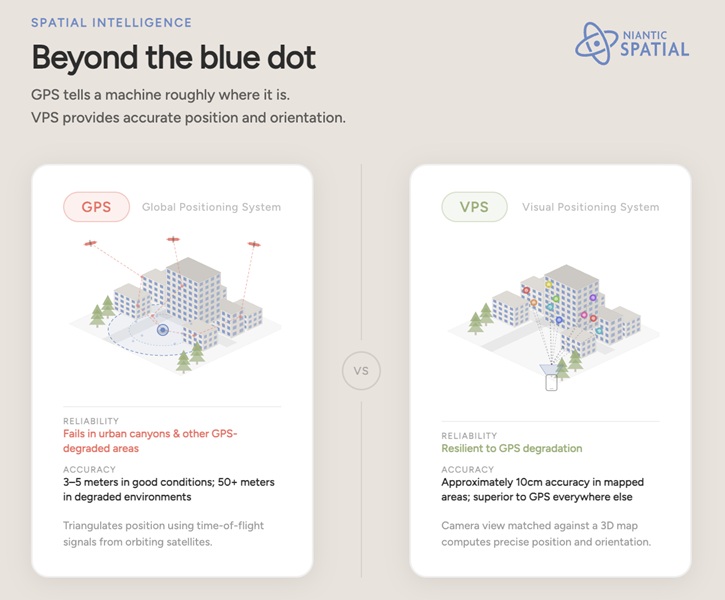
The number they keep citing stings: “80% of the economy operates outside digital screens.” Warehouses, construction sites, hospitals, retail floors, urban streets — all invisible to AI because there’s no structured spatial data representing them. GPS gives you a blue dot within 3-5 meters. That’s useless if you’re a delivery robot trying to navigate a hospital corridor, or an AR app trying to anchor a digital object to a real-world surface with precision.
Here’s what Niantic Spatial just shipped:
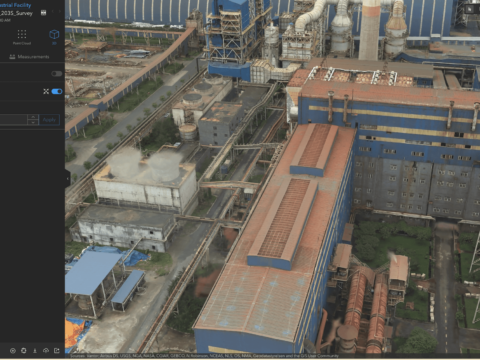
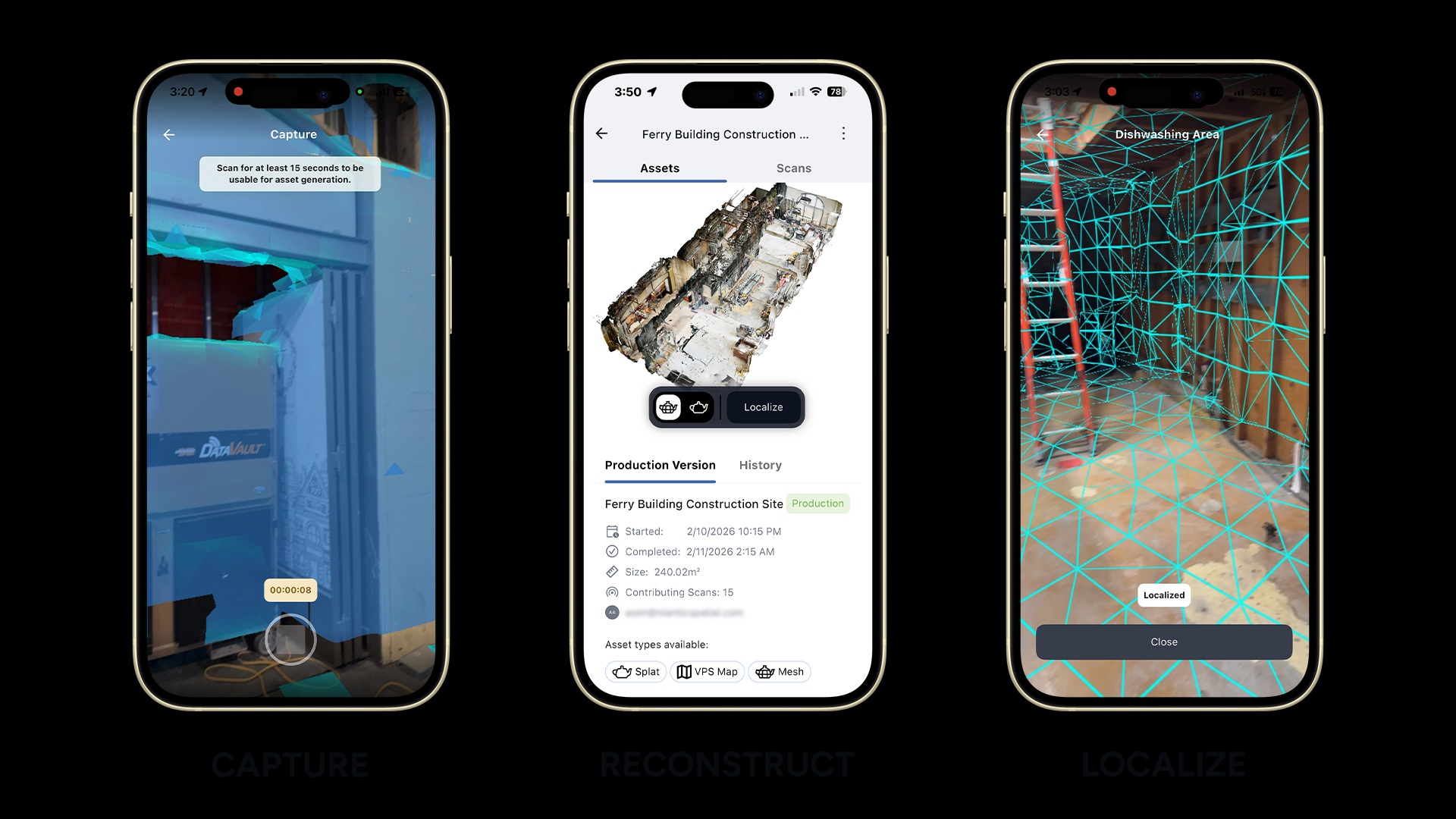
- Scaniverse for Business — An integrated mobile + web platform. Point your phone (or a 360° camera) at anything — a single room, a construction site, an entire shopping mall. It generates visual positioning maps, meshes, and Gaussian splats from a single scan. Multiple users can contribute scans to a shared project across different sessions; the cloud fuses everything into a unified model. Exports in FBX, PLY, and SPZ — formats that plug straight into robotics simulators and 3D pipelines.
- VPS 2.0 — Visual Positioning System 2.0 delivers near-centimeter 6DoF localization in Scaniverse-mapped areas. Globally, without pre-scanning, it provides 3DoF positioning that corrects and augments GPS. In a mapped location? You’re talking 60-100x more accurate than GPS. This is the layer that makes persistent AR, autonomous robots, and spatial computing actually reliable.
- NSDK 4.0 — The Niantic Spatial Development Kit now supports Unity, Swift, Android, and early ROS 2 access. Launched in general availability this April. If you build AR experiences, game worlds, or robotic systems — this is your unified entry point.
Why You Should Care
Let’s be direct about why this matters to each person in this community:
If you’re a 3D artist or scanning nerd
Scaniverse was already one of the best free Gaussian splatting capture apps on iOS and Android. The new business-tier features — collaborative scanning, cloud fusion, enterprise exports — mean you can now tackle large-scale capture projects. A museum. A stadium. A whole city block. Multiple team members scanning simultaneously, merged into one coherent splat. No expensive LiDAR rigs. Just phones.
If you’re an architect or spatial designer
Digital twins of your construction site — updated daily by the site crew’s phones — that are accurate to the centimeter. That’s what VPS 2.0 + Scaniverse delivers for construction and logistics. Pair it with FBX exports and you have a live-updating 3D model that plugs straight into your pipeline. The “site visit” might genuinely become optional.
If you build games or AR experiences
Niantic’s Unity SDK has been the gold standard for location-based AR for years. NSDK 4.0 combined with centimeter-accurate VPS means you can build AR experiences where digital objects stay exactly where you placed them — across sessions, across users, across devices. Think persistent AR art installations. Think multiplayer spatial games with real-world precision. The infrastructure that made Pokémon GO work at global scale is now yours to build on.
The real proof
Coco Robotics is already deploying VPS technology for autonomous delivery robot fleet navigation. When robots trust Niantic’s maps over GPS, you know the accuracy is real and production-hardened. This isn’t a demo — it’s infrastructure that’s already working in the wild.
Try It / Follow Them
- Download Scaniverse free on iOS and Android — personal accounts stay free, business features available via scaniverse.com
- NSDK 4.0 documentation and getting started: nianticspatial.com
- GitHub: Niantic Spatial development resources and SDK examples
- Follow @NianticSpatial on X/Twitter for deployment updates and developer drops
IK3D Lab Take
This is one of those moments where you have to squint and see the bigger picture. Niantic spent a decade getting hundreds of millions of people to walk every street on Earth with a GPS-enabled camera. That was the training data phase. Now they’re deploying the model.
What excites me most isn’t the robotics angle — it’s what centimeter-accurate spatial anchoring does for creative work. Permanent AR art that survives app updates. Multi-user collaborative spatial design sessions in a real room. Game worlds that aren’t just layered on top of reality but embedded in it, millimeter-precise. The gap between physical and digital just got measurably smaller.
We’ve been waiting for someone to build the spatial OS for the real world. Niantic Spatial just shipped version 2.0 of it. Time to build.