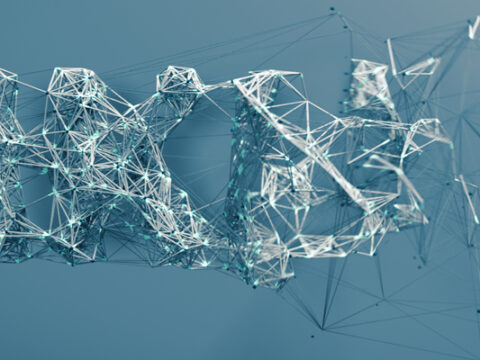
Scanning birch bark fragments from Auschwitz for artist Pascal Convert — three pieces barely 5 cm tall and as thin as 1 mm. Here is the process, step by step.
In 2019, artist Pascal Convert asked Iconem, where I was working at the time, to digitize three birch bark fragments from Crematorium V of Auschwitz-Birkenau. These tiny relics — roughly 5 cm tall, 2 cm wide at most, and often thinner than 1 mm — were destined for his exhibition “Trois Arbres” at Galerie Éric Dupont in Paris. The goal: ultra-high-definition 3D scans turned into glass-like renders for print.
1 — Capture: 400 Photos, Zero Room for Error
At this scale, depth of field collapses to just 2–3 cm. Every detail outside that razor-thin plane is blurred. The solution: ~400 photographs per bark, taken across 3 to 4 complete orbits at different elevations.
Two tricks made this work:
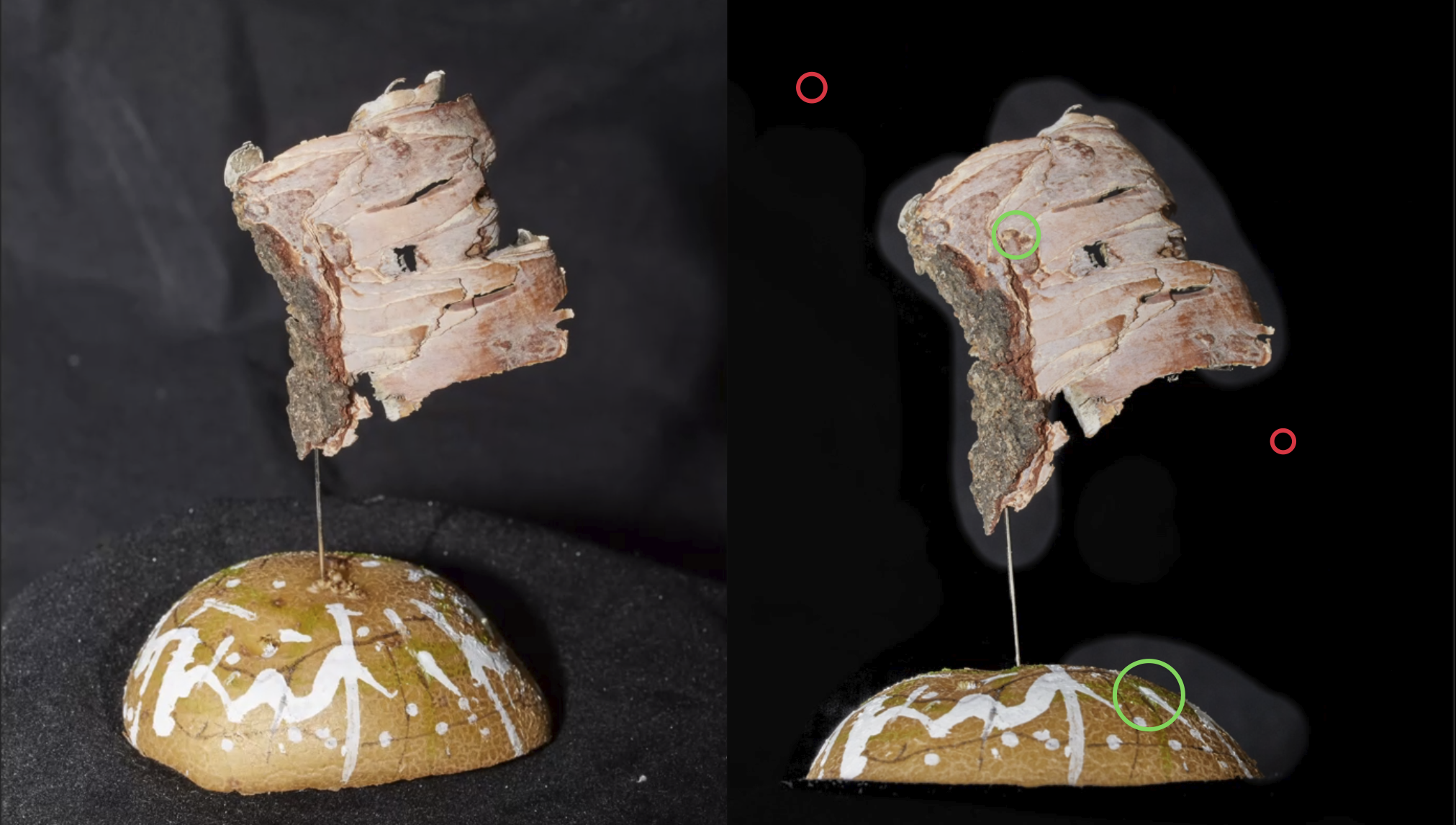
- Dark background — I masked out any element that could distract RealityCapture’s feature detection. The left/right comparison below shows the raw shot versus the cleaned version ready for alignment.
- Painted pedestal — A hand-painted base with random patterns gives the software abundant features to lock onto. It also bridges the front and back orbits into one coherent model — without it, the two sides would never merge.
2 — Alignment: Perfect Orbits Matter
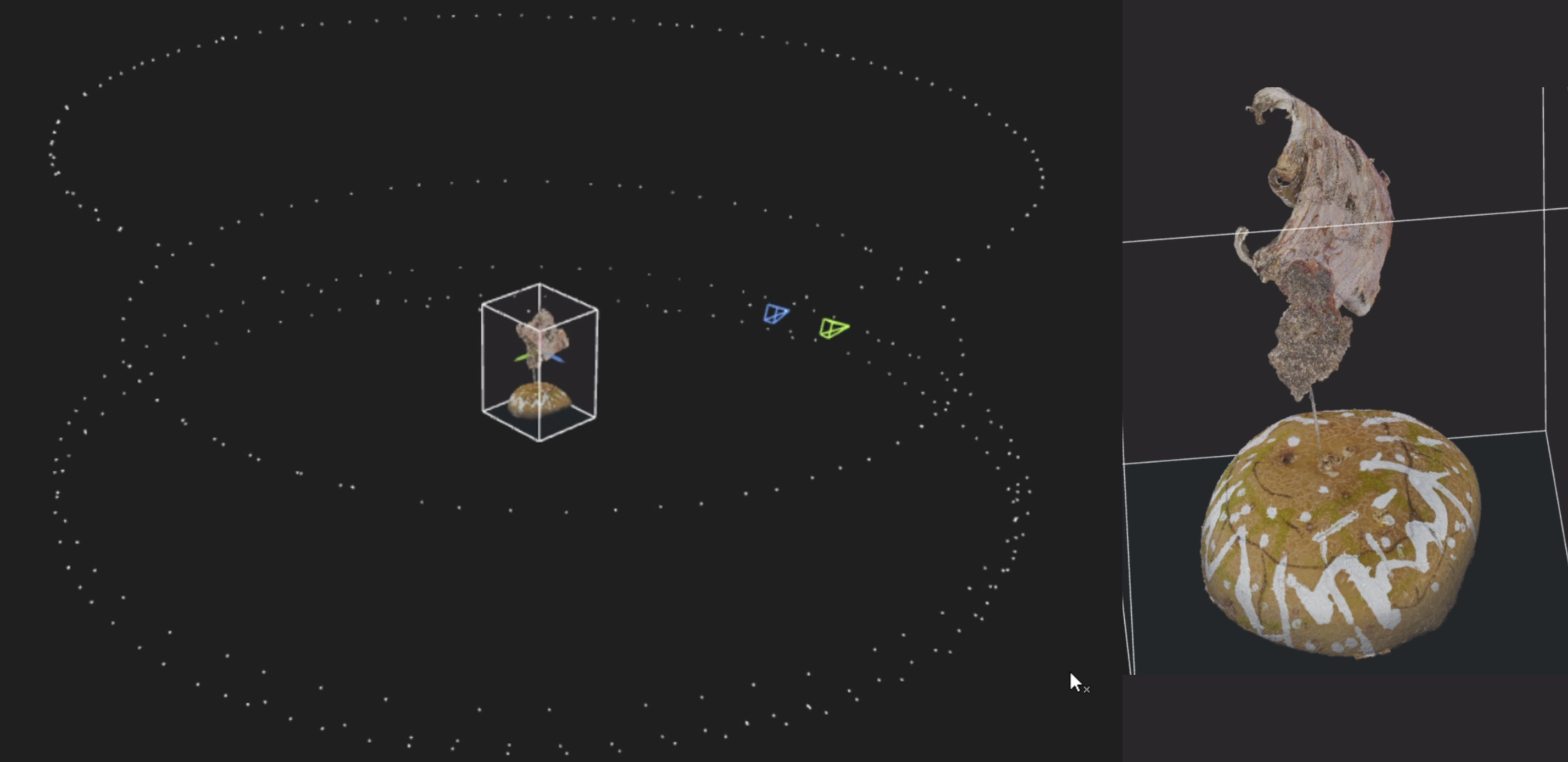
In RealityCapture, consistent spatial coverage is everything. Each white dot below is a camera position. The orbits form clean, evenly-spaced rings around the subject — this regularity is what allows the software to reconstruct the geometry with confidence, especially on a sub-millimeter object.
The painted pedestal proved critical here: it guaranteed continuity between the front-facing and back-facing orbits. Without those shared features on the base, the two halves of the scan would remain disconnected.
3 — Cleanup: Sculpting the Raw Mesh
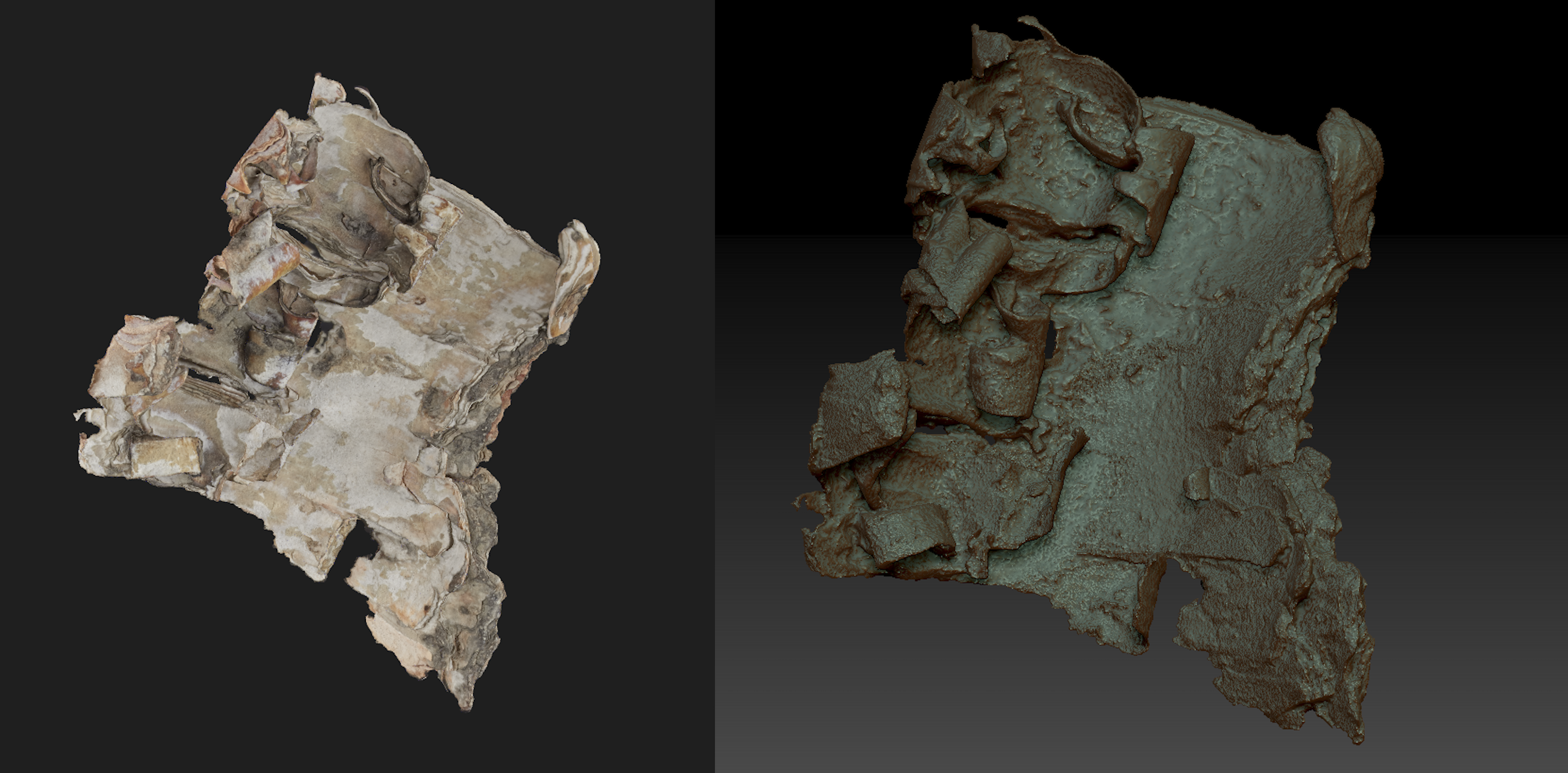
The raw output from photogrammetry is never print-ready. In ZBrush, I cleaned the mesh — removing floating artifacts, smoothing scan noise, and closing holes while preserving every fold and crack of the bark. The side-by-side below shows the textured model (left) and the bare mesh revealing all surface imperfections (right).
4 — Presentation: Turntable & Final Lookdev
A turntable is the simplest way to show the full geometry at a glance:
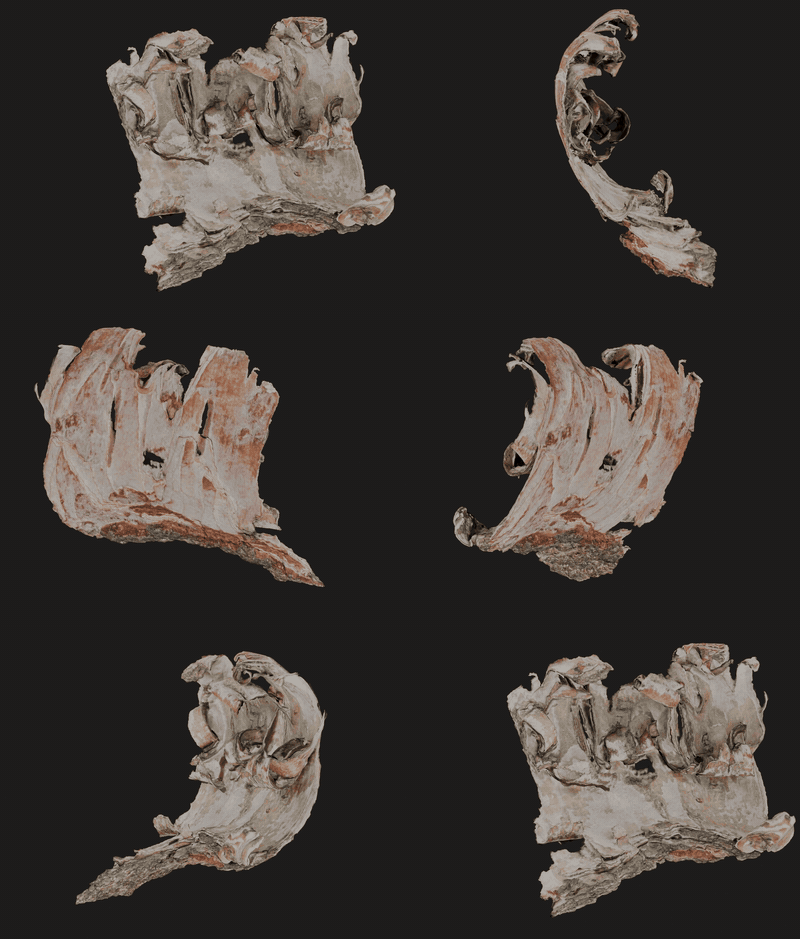
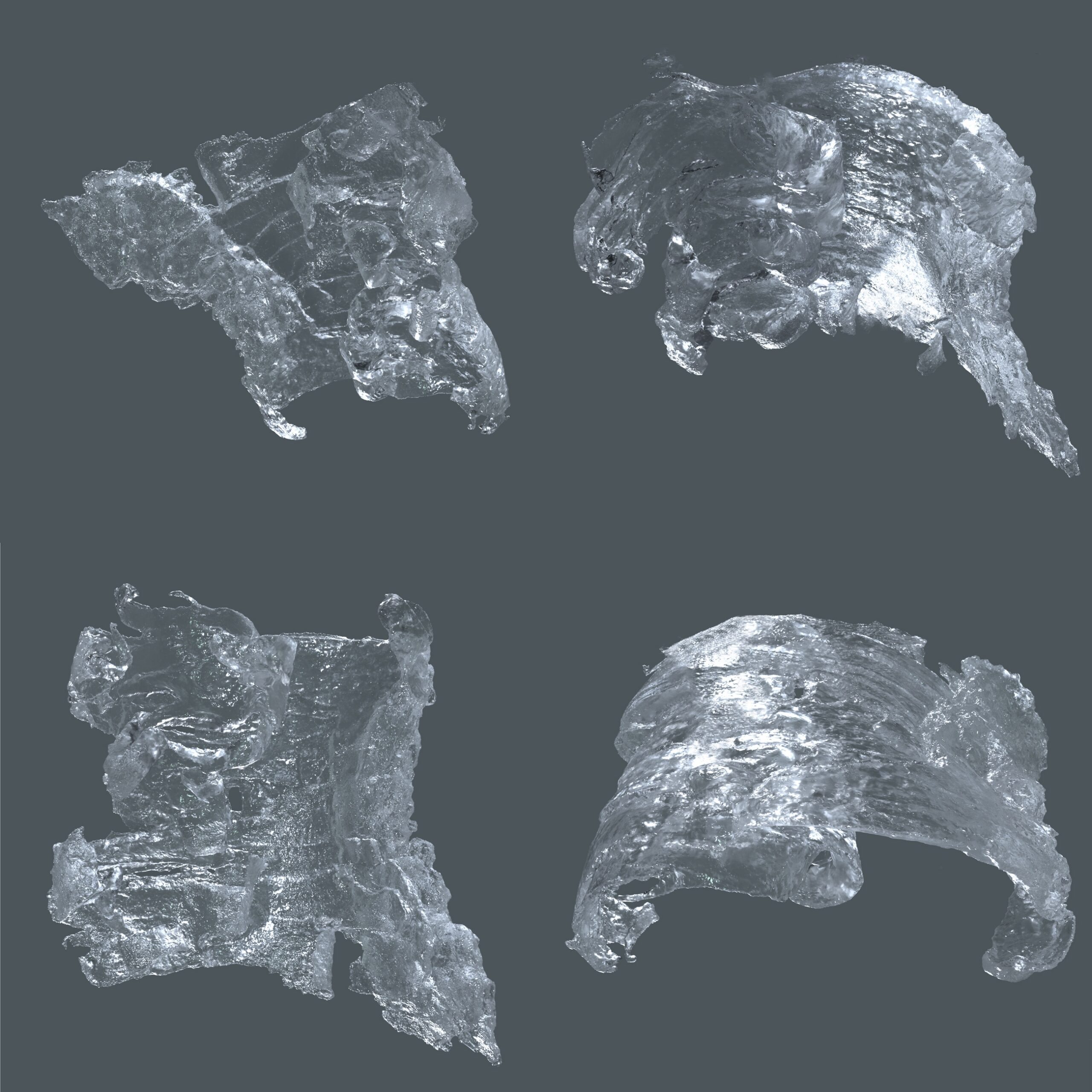
For the final delivery, Pascal wanted renders that evoke glass — a translucent, almost frozen quality, as if the bark had been encased in ice. This fits perfectly with his broader artistic practice of casting molten glass over organic objects. I developed a custom lookdev shader to achieve this plexi/glass effect across four views per fragment.
Acknowledgments
Thanks to Pascal Convert for trusting me with such meaningful objects, and to the team at Iconem for the opportunity. The results were used in the exhibition “Trois Arbres” (Galerie Éric Dupont, Paris, Oct–Nov 2019) and in a portfolio with an essay by philosopher Georges Didi-Huberman.
Tools used: Canon DSLR, RealityCapture, ZBrush, Blender/Octane.