Here’s an uncomfortable truth about the Gaussian splatting boom: before any of the flashy tools we cover — Postshot, KIRI, Luma, Nerfstudio, gsplat — can touch your photos, a 14-year-old academic workhorse has to figure out where the cameras were. That workhorse is COLMAP. And it just had its slowest, most painful stage replaced with a GPU engine that runs up to two orders of magnitude faster.
The Story
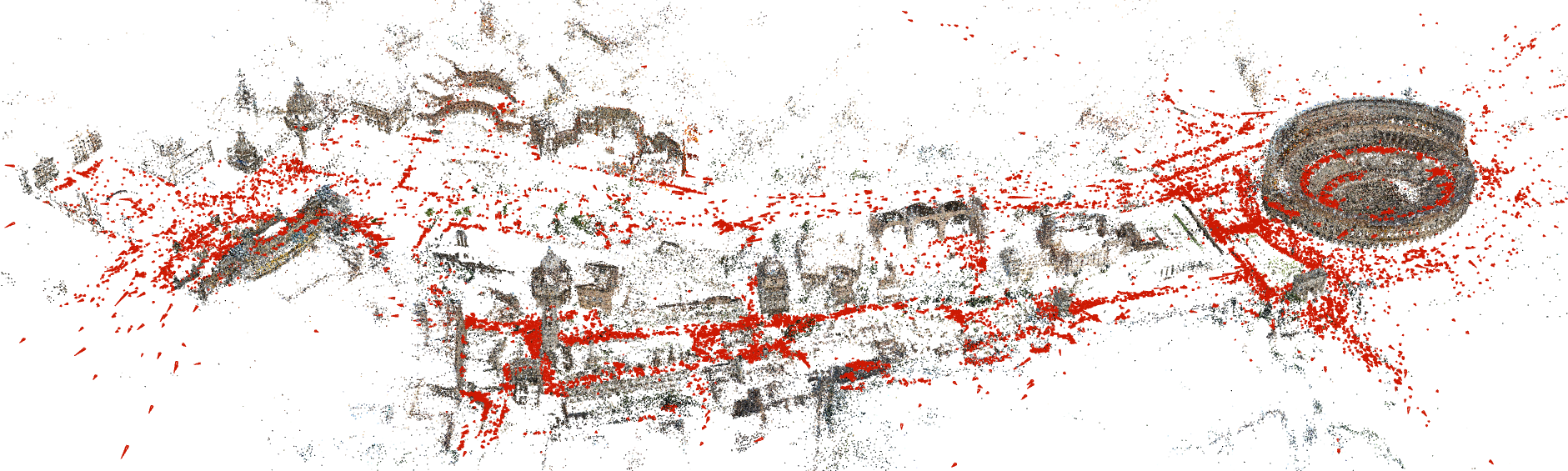
If you’ve ever trained a splat or a NeRF, you’ve used COLMAP whether you knew it or not. It’s the open-source Structure-from-Motion (SfM) pipeline that takes a pile of unordered images and solves for two things every radiance-field method depends on: the precise 3D position and orientation of each camera, and a sparse point cloud of the scene. Get those poses wrong and your splat is a smeared, floaty mess. Every “magic” capture app you’ve tried is, under the hood, either running COLMAP or reimplementing what it does.
The catch has always been speed. The heavy math at the center of SfM is bundle adjustment — the global optimization that jointly refines every camera and every 3D point so they all agree. For years COLMAP leaned on Ceres, a brilliant but CPU-bound solver, and on big scenes bundle adjustment is where you’d go make coffee. Several coffees.

COLMAP 4.1.0 changes that with a new backend called Caspar — a GPU-accelerated nonlinear optimization library built on SymForce (the symbolic-math and code-generation engine that came out of Skydio’s drone-autonomy work). Caspar is a drop-in alternative to Ceres, and the maintainers describe it as “often one to two orders of magnitude faster” than even the Ceres CUDA backend on medium-to-large problems. Because incremental mapping calls bundle adjustment again and again as each new image registers, that speedup compounds across the entire reconstruction. The thing that used to gate your whole pipeline is now the fast part.
The other headline in the 4.x line is just as overdue: native 360 reconstruction. COLMAP now does equirectangular SfM directly, so you can feed it 360 panoramic captures without slicing them into pinhole sub-views and praying. Add first-class camera-rig support, GPU device selection, and pycolmap bindings to pick your backend, and it’s clear this is a serious modernization pass — not a patch. It builds on COLMAP 4.0, which already folded in the GLOMAP global mapper, ALIKED + LightGlue learned features via ONNX, and a ~2.5× faster image I/O layer.
Why You Should Care
This is infrastructure, and infrastructure is where the Lab keeps finding the real story — the same way the boring little SPZ file format quietly powers hundreds of thousands of Photoshop splats. Nobody posts a hype reel about bundle adjustment. But a 100× speedup at the very first step of the pipeline ripples through everything downstream.
- Bigger captures become practical. Scenes that were “leave it overnight” jobs can now finish in a session, which means more cameras, denser coverage, and cleaner poses feeding your splat.
- 360 rigs are first-class. Insta360-style panoramic capture goes straight in — huge for interiors, real estate, and heritage scanning where one 360 shot replaces a dozen framings.
- Learned features by default. ALIKED + LightGlue matching means COLMAP holds up on the textureless walls and repetitive patterns that used to wreck classic SIFT matching.
- It’s free and it’s the foundation. Whatever AI 3D tool you adopt next, odds are it sits on top of this. A faster COLMAP makes the entire AI-3D stack faster — for everyone, at zero cost.

Try It / Follow Them
- Grab it: COLMAP 4.1.0 is on the official GitHub releases page, with Windows/Linux/macOS builds and the full changelog.
- Switch backends: select Caspar in the GUI’s bundle-adjustment options, or via
pycolmapif you script your pipeline — point it at your CUDA GPU and watch the mapper fly. - Read the deep dive: Radiance Fields has the best running coverage of why this matters for the splat community.
- Backend curiosity: SymForce (the engine behind Caspar) is worth a look if you care about how the optimization sausage is made.
IK3D Lab Take
We spend a lot of time here on the dazzling end of AI 3D — one-image-to-world models, 10-million-poly generators, splats streaming to your headset. COLMAP 4.1 is a reminder that the unglamorous plumbing matters just as much. The reason this release excites us isn’t the benchmark; it’s the leverage. When the first step of every reconstruction gets 100× faster, every artist, every studio, and every AI tool built on top inherits that win without changing a thing. The radiance-field gold rush was always standing on COLMAP’s shoulders. Those shoulders just got a lot stronger — and it’s still free and open source. Honestly, the best kind of upgrade.